The Secrets Hidden in Archimedes' Palimpsest
"Centuries-old words of genius lay hidden beneath a prayer book's surface, their power waiting to be uncovered. What happens when the past's whispers reveal a brilliance that could change everything?"
What Happened?
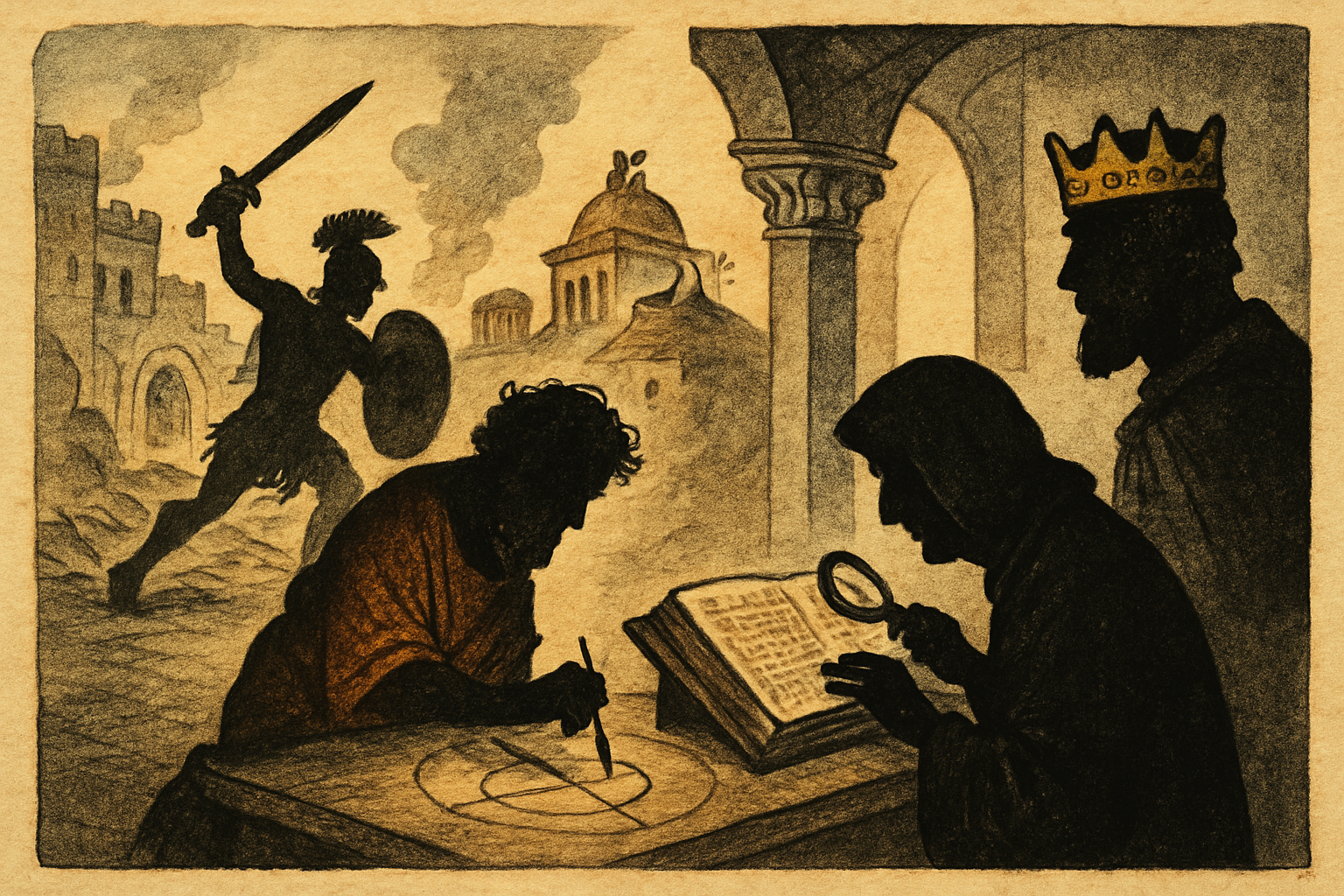
In the silence of a conservation lab, a nondescript prayer book became the unlikely carrier of revolutionary ancient knowledge. Beneath its religious pages lay Archimedes' genius, unknowingly preserved across the ages. Originally faded by time and religious repurposing in the 13th century, these works included advanced mathematical thinking that hinted at the concept of calculus centuries before Newton or Leibniz. Their revelation created a seismic shift in our understanding of scientific history, suggesting that the roots of many modern theories may be deeper and more ancient than previously believed.
Takeaway
The lesson this story keeps teaching
“The rediscovery of Archimedes’ hidden texts illustrates the potential of overlooked history to redefine modern science and provoke intellectual revolutions.”
Why People Are Talking About This
The rediscovery of Archimedes’ writings fuels a profound reflection on the permanence and fragility of human knowledge. History, with its propensity for misplacing or recasting genius, offers tales like Archimedes’ to illustrate that innovation is not a linear progression. This story underscores the transformative potential of forgotten knowledge when revisited with fresh eyes, inviting us to question the historical continuum of learning.
Archimedes’ work challenges modern perspectives on intellectual lineage and the parallels between their discoveries and what we claim as 'modern' today. It reinstates an essential conversation around the preservation and rediscovery of knowledge, bridging past innovations with current scientific narratives. We are reminded that our heritage offers potent lessons and hidden reservoirs of inspiration, all waiting to impact future explorations in unforeseen ways.
Thread Map
9 entities · 8 connections · Hover to explore, click to inspect
This is the connection map for this thread. Every node is a person, company, event, or idea. The red lines show how they connect. Hover a node to highlight its connections. Click a node to see why it matters to this story.
How We Got Here
Archimedes' Tragic Demise Amidst Syracuse’s Fall
During the Roman infiltration of Syracuse, Archimedes was killed by a soldier, a death mired in anecdotes and irony during a time when intellect collided with aggression and empire-building forces.
Creation of the Archimedes Manuscript
In Constantinople, an anonymous scribe transcribed Archimedes' thoughts onto parchment—a manuscript that would later morph into something much more common and sacred.
Transformation into a Prayer Book
The manuscript was repurposed as a prayer book, concealing Archimedes' revolutionary ideas beneath layers of religious texts, erasing much of its scientific materiality with ecclesiastical solemnity.
Rediscovery and Analysis of the Palimpsest
New technologies enable scholars to peel back centuries of hidden script, revealing Archimedes' original writings and providing insights that bridge time and innovation.
Archimedes Develops Pi
While in Alexandria, Archimedes puzzles over the mysteries of circular shapes, leading to the creation of Pi—a constant fundamental to math and engineering breakthroughs that shaped future scientific method.
Invention of the Archimedes Screw
Utilizing intellect and necessity, Archimedes develops a device to raise water levels, an invention soon applied universally and impacting agriculture and engineering through history.
Defending Syracuse: Engines of War
Under siege from Rome, Archimedes contrives ingenious defenses—catapults and mechanisms causing genuine Roman awe—and underscores his impactful blend of science and warfare.
Restoration and Publication of Findings
The vibrant annotations and groundbreaking concepts rediscovered in the Archimedes Palimpsest are restored and analyzed, influencing the historical understanding of mathematics and sciences worldwide.
Auction and Conservation Efforts
This 'common' prayer book fetches over $2 million at auction, stirring scientific communities to grapple with intellectual property and conservation imperatives.
Wait... Who Is This?
In the ancient world, knowledge was often a closely guarded treasure, shared sparingly and cherished deeply. Born in 287 BC in Syracuse, a Greek colony brimming with cultural and intellectual fervor, Archimedes was a product of his time—a time when science and philosophy were woven into the fabric of daily life. His home, ruled by King Hiero II, was a bustling hub of innovation and thought. At the height of his prowess, Archimedes applied his phenomenal mind to both the abstract and the practical, demonstrating an unparalleled ability to bridge theory with application.
Influenced by prior thinkers and fueled by a burning curiosity, Archimedes' work spanned geometry, calculus precursors, and physics long before these fields were formally recognized. His drive to explore also found expression in pragmatism as he engineered solutions for pressing military needs. During the Roman siege, these innovations not only fortified Syracuse but positioned Archimedes as an intellectual paragon standing against the might of the Roman Empire.
The legacy of Archimedes was poised to echo through the ages. Yet, following his untimely death at the hands of a Roman soldier, his documentation faced a perilous fate. As centuries turned and twined, his works were threatened by oblivion—sometimes deliberately erased; other times overshadowed by historical and religious shifts.
Amidst the tumult of the medieval era, fate dealt an arbitrary hand when a monk in Constantinople re-purposed his parchment into prayer text. It distanced Archimedes from his true scientific heritage, initiating an odyssey in which his original words lay dormant until modern imaginations resurrected them from slumber.
Receipts
Continue the Rabbit Hole
Each story explores the same idea from a different angle. Follow the connections and discover where the thread leads.




Fictional placeholder content