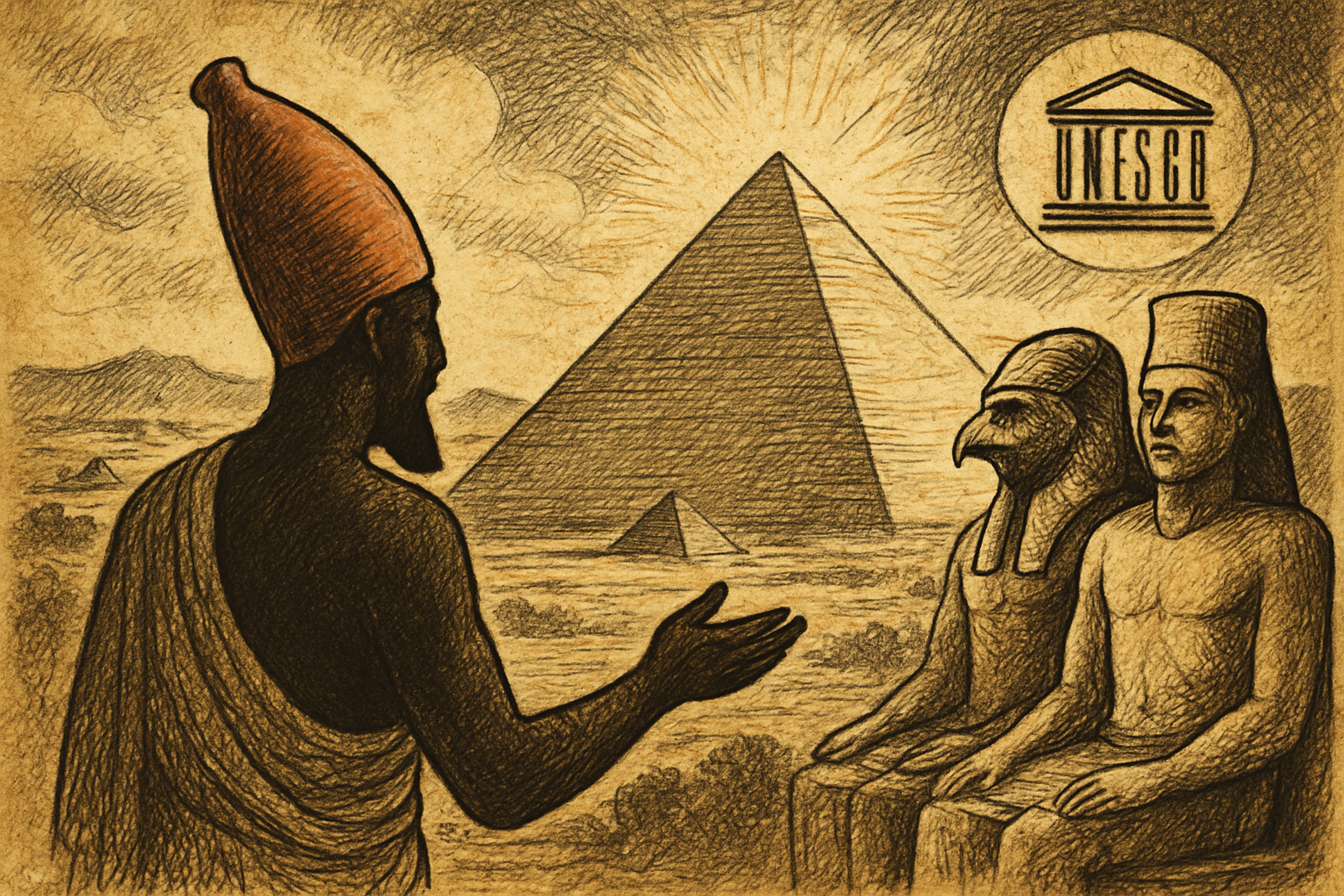
The Pyramid Puzzle
"Somehow, in 2580 BCE, Pharaoh Khufu commanded the construction of an edifice so enduring that it still stands today. Why wouldn't it crumble under its own weight or time's relentless assault?"
What Happened?
It's a scorching afternoon, the kind when the sun bakes the Egyptian sands into a blinding, golden sheet. But beneath this relentless heat stand the Pyramids of Giza, defying both time and logic. How did a civilization over 4,500 years ago, without the aid of modern technology, construct these colossal monuments? It's a question that continues to baffle and intrigue.
The Great Pyramid of Giza, built for Pharaoh Khufu around 2580-2560 BCE, isn’t just a feat of engineering; it's a silent testament to an era driven by mysterious ambitions and meticulous precision. Originally standing at over 481 feet—a fact noted in history books—it now measures approximately 450 feet, having shed some of its outer stone covering over millennia.
These pyramids, alongside their enigmatic companion, the Sphinx, were more than royal tombs. They were symbols of spiritual and political power, constructed with precision that defies their epoch. Each block, some weighing as much as 80 tons, was placed with such accuracy that the structure's sides are aligned with the cardinal points of the compass.
Yet, beneath their grandeur lies a quilt of stories woven through history—a lesser-known narrative of labor and ambition. Scholars argue about the means of construction, debating whether ramps, levers, or a workforce of thousands were behind this wonder. Recent discoveries even hint at the possibility of an 'Underground City,' a theory that surfaced amid controversy in March 2025.
Today, as a UNESCO World Heritage Site, the Giza pyramids endure not just as relics of a distant past but as baffling chapters of human ingenuity and ambition. Their story isn't merely about ancient Egypt's opulence but about our continuous desire to push boundaries, challenge the natural world, and leave a legacy that transcends time. Where else does such a stone testament to human endeavor still beg so many questions? As time treads on, these pyramids silently urge us to seek out their secrets further—and perhaps also the secrets that lie within ourselves.
Takeaway
The lesson this story keeps teaching
“Legacies require more than ambition: they demand vision, execution, and endurance.”
Why People Are Talking About This
Today, the Great Pyramid compels us because it encapsulates timeless human themes: ambition, immortality, and legacy. Its standing reminds us that with a vision exceeding mere existence, humans can carve permanence out of impermanence, echoing lessons in every grand project since.
Thread Map
8 entities · 7 connections · Hover to explore, click to inspect
This is the connection map for this thread. Every node is a person, company, event, or idea. The red lines show how they connect. Hover a node to highlight its connections. Click a node to see why it matters to this story.
How We Got Here
Khufu's Grand Scheme Unfolds
Pharaoh Khufu orders the construction of the Great Pyramid at Giza, aiming to immortalize his divine reign in stone.
Labor for Eternity
Thousands of skilled laborers, not slaves, commence work on the Great Pyramid, reflecting ancient Egyptians' resourcefulness and manpower.
Completion of the Great Pyramid
Khufu's monument is completed, symbolizing mastery over both engineering and spiritual beliefs.
Khafre's Rising Legacy
King Khafre, son of Khufu, initiates the construction of his own pyramid and the Great Sphinx.
Menkaure's Modest Monument
Pharaoh Menkaure, following his father's footsteps, begins building a pyramid on a smaller scale.
UNESCO World Heritage Recognition
Giza Pyramids receive UNESCO World Heritage status, securing their legacy in both culture and memory.
Controversy: The Underground City
Italian researchers ignite debate by claiming evidence of a vast underground city beneath the Giza Plateau.
Wait... Who Is This?
At the stage of pyramidal rule, Egypt stood at the threshold of the ancient world's most impressive feats. This was the Old Kingdom era, spanning from 2686 to 2181 BCE, when pharaohs were not just rulers but divine demi-gods on Earth allocating resources and sculpting legacies in stone. By this time, Egypt had discovered a rhythm with the annual flooding Nile, mastering agriculture and ensuing prosperity, and allowing for large scale projects, including tomb construction. Pharaoh Khufu, successor to Sneferu, was determined to transcend ordinary mortality — a feat achieved not through empire but etching his name in monumental stone. At Giza, this ambition would find a canvas. Here, in the age of axles and sands, architectural marvels rose, serving testimonies to human imagination and determination. Harnessing mathematics, manpower, and materials, these pyramids would shoulder centuries, millennia, and mythology.
Receipts
Pyramids of Giza | History, Location, Age, Interior, & Facts
Egyptian Pyramids - Facts, Use & Construction | HISTORY
Great Pyramid of Giza - Wikipedia
When Was the Great Pyramid at Giza Built? Timeline Details
How were the Pyramids of Giza built? | National Geographic
The Egyptian Pyramid | Smithsonian Institution
Continue the Rabbit Hole
Each story explores the same idea from a different angle. Follow the connections and discover where the thread leads.

Fictional placeholder content