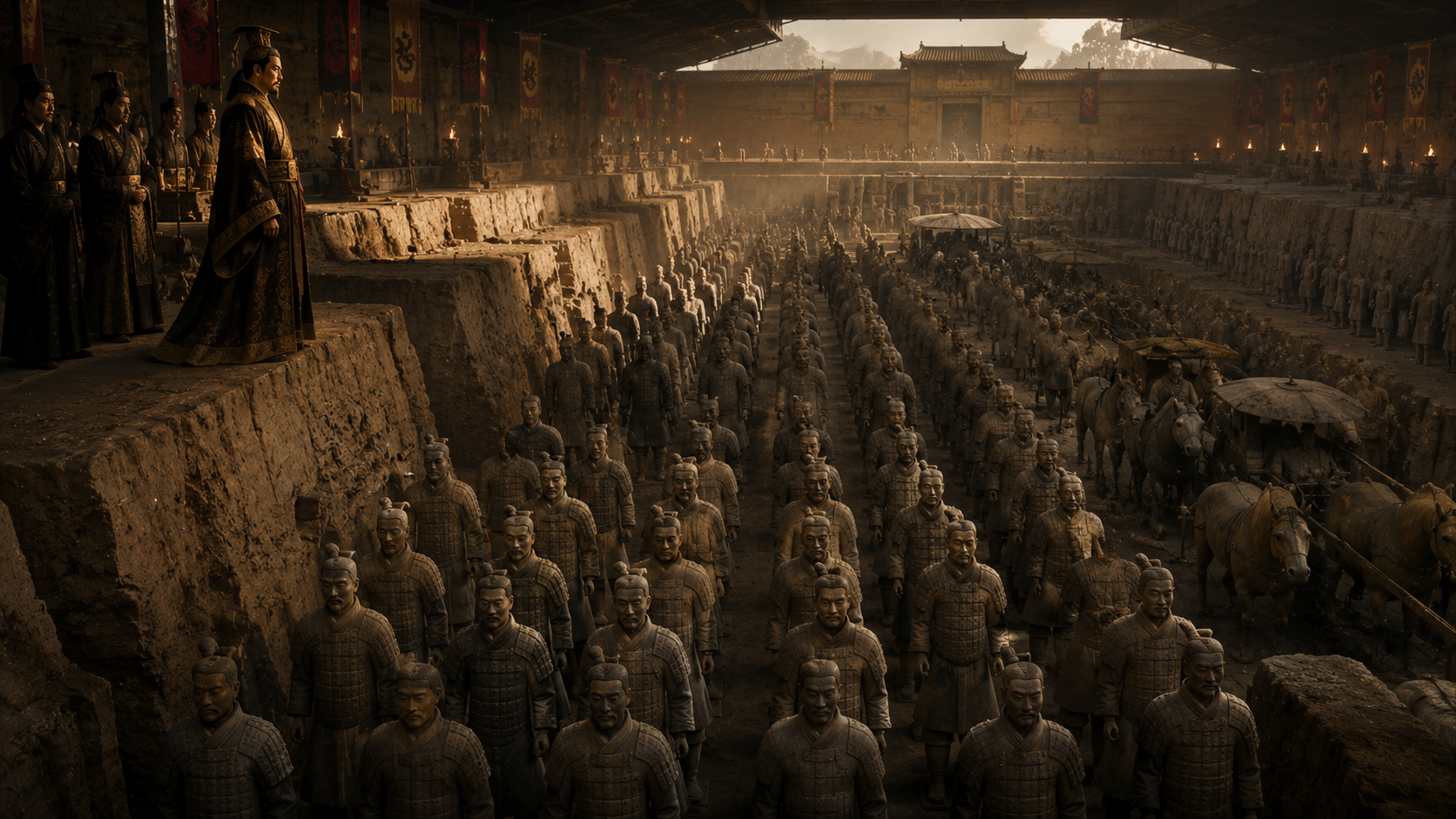
The Eternal Legion: Qin’s Underground Army
"Farmers stumbled upon China's ancient secret in 1974: a massive underground army. This discovery unlocked tales of power, obsession, and the eternal pursuit of immortality."
What Happened?
In 1974, farmers near Xi'an, China, uncovered a silent army of terracotta soldiers, a testament to the ambitions and fears of Emperor Qin Shi Huang. Known for unifying China, he was driven by an obsession with immortality, sending expeditions to discover elixirs and constructing a vast mausoleum filled with life-sized statues to protect him in the afterlife. His quest for eternal life led him to consume elixirs laced with dangerous levels of mercury, ultimately hastening his death. Today, the Terracotta Army remains a symbol of the tyrannical lengths to which Qin's pursuit of immortality extended and the extravagant imprint of ambition.
Takeaway
The lesson this story keeps teaching
“Qin Shi Huang's life reveals the perilous path of obsession with immortality, showing how the fear of death can create legacies that defy death's finality.”
Why People Are Talking About This
The Terracotta Army's significance transcends archaeology, offering a lens into the psychological depths of legacy and obsession intertwined with power. Qin Shi Huang's fixation on immortality serves as a cautionary tale about the intoxicating nature of absolute power and its propensity to extend beyond the pragmatic into the fantastical.
In a contemporary context, this story echoes within society's continuous pursuit to transcend natural limits via technology and medicine. Just as Qin's endeavors forged lasting impacts across epochs, modern pursuits might well be on the cusp of redefining humanity’s relationship with mortality. Understanding Qin's tale provides a vital vantage point into both the roots and ramifications of chasing the eternal.
Thread Map
3 entities · 2 connections · Hover to explore, click to inspect
This is the connection map for this thread. Every node is a person, company, event, or idea. The red lines show how they connect. Hover a node to highlight its connections. Click a node to see why it matters to this story.
How We Got Here
Future Emperor is Born to Peace and Turmoil
Ying Zheng, who would become Qin Shi Huang, was born into discord and ambition, destined to become the first emperor of a unified China.
Qin Shi Huang Unifies China
Rising above fractious states presented sweeping changes. His rule established the Qin Dynasty, a monumental achievement amplified by his later obsessions.
Construction on Mausoleum Ambitiously Begins
Over decades, more than 700,000 laborers erected a city of the dead: Qin Shi Huang's grand mausoleum complete with a terracotta army, extending his ambition into the afterlife.
Qin Shi Huang’s Quest for Immortality
Driven by his immortal ambitions, he consumed dangerous elixirs, searching for mythical islands, crossing realms unknown in pursuit of eternity.
Emperor Dies with Secrets in Tow
Qin Shi Huang's death unleashed turmoil. Ministers clandestinely transported his decomposing body until official transition, deepening the mystery of his reign.
World Stunned by Terracotta Army Discovery
Farmers stumbled upon thousands of terracotta statues, sparking worldwide intrigue and revealing the grand scale of Qin Shi Huang's ambitions.
Terracotta Army Gains UNESCO Recognition
The site was designated a UNESCO World Heritage Site, affirming its cultural significance and drawing global interest, ensuring the preservation of this historic site.
Wait... Who Is This?
In the midst of the Warring States period in ancient China, the land was fractured into competing kingdoms. It was into this turbulent world that Ying Zheng, later known as Qin Shi Huang, was born. His rise to power marked the beginning of a new era. By 221 BCE, he had achieved the seemingly impossible—unifying China under his centralized rule. This feat, accomplished through a blend of military might and political acumen, laid the groundwork for the Qin Dynasty.
However, Qin Shi Huang's ambitions extended far beyond unification. His vision was colored by an unyielding desire for immortality. Influenced by the time's prevalent philosophies and enigmatic tales of distant lands, he ventured on quests that pushed the boundaries of his empire, driven by the promise of defeating mortality itself.
These quests for eternal life consumed Qin Shi Huang. He dispatched emissaries to mythical islands in search of elixirs rumored to grant immortality, a pursuit that veered into the realm of alchemy. Despite his efforts, mortality loomed ever closer, and the emperor's fear of it influenced every major decision of his reign.
The construction of his mausoleum, featuring the famed Terracotta Army, was a testament to his belief in a grand afterlife. The army, intended to safeguard him in death as he had been protected in life, signified both his fearsome power and his paranoia. As his reign continued, his consuming obsession with eternity became manifest in these and other ambitious projects, forever sealing his legacy.
Receipts
Terracotta Army - Wikipedia
Terracotta Warriors | The first Qin emperor of China (article) | Khan Academy
China's Terracotta Warriors: The First Emperor's Legacy - Exhibitions - Asian Art Museum
About Emperor Qin's Terra Cotta Army | National Geographic
2,000-Year-Old Texts Reveal the First Emperor of China’s Quest for Eternal Life
How China's first emperor searched for elixir of life
Continue the Rabbit Hole
Each story explores the same idea from a different angle. Follow the connections and discover where the thread leads.





Fictional placeholder content