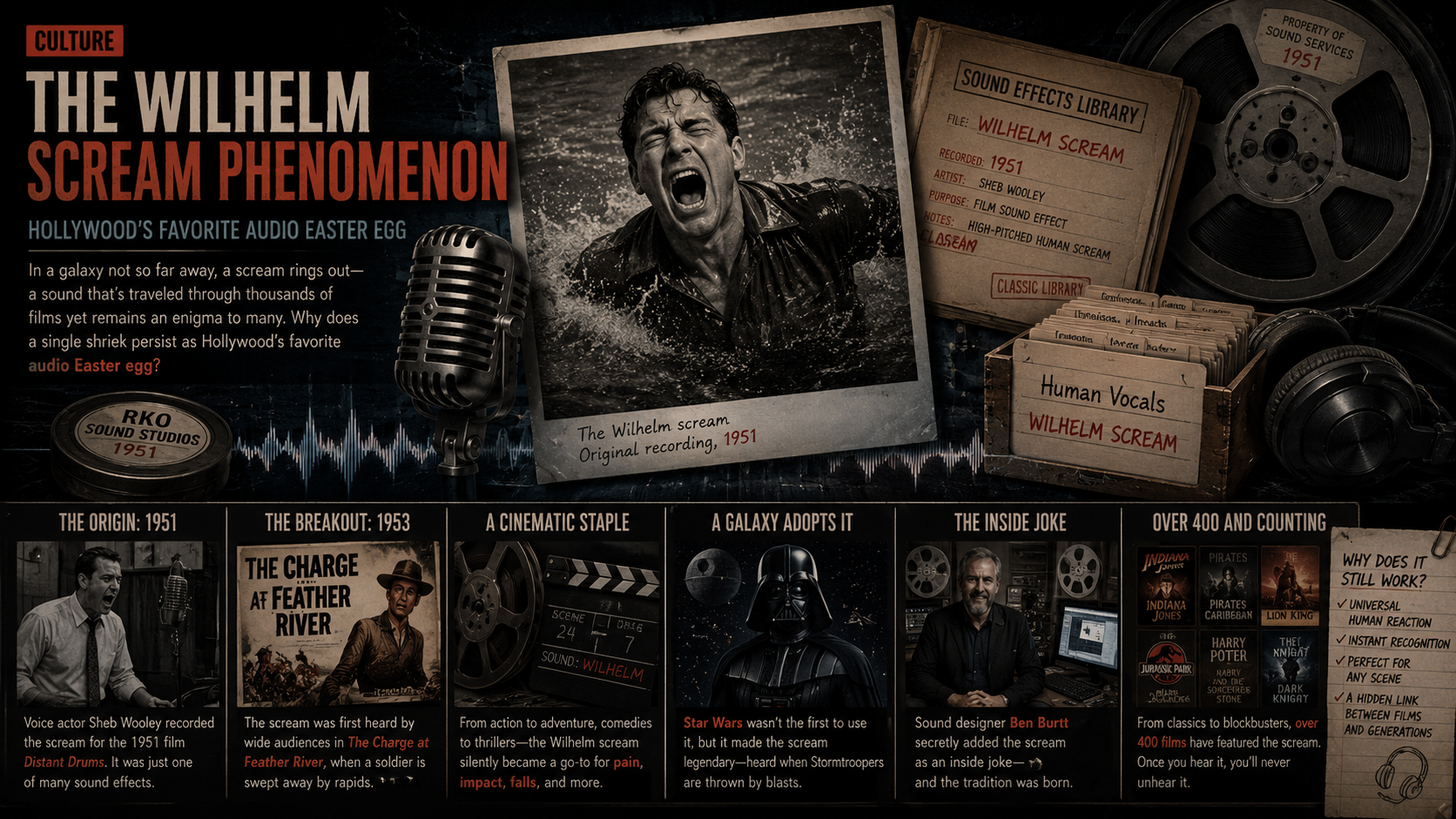
The Wilhelm Scream Phenomenon
"In a galaxy not so far away, a scream rings out—a sound that’s traveled through thousands of films yet remains an enigma to many. Why does a single shriek persist as Hollywood’s favorite audio Easter egg?"
What Happened?
In the realm of sound design, there's one unexpected star: the Wilhelm scream. First crying out from 'Distant Drums' in 1951, likely voiced by Sheb Wooley, this peculiar sound effect would eventually transform into a beloved inside joke across Hollywood. Its journey from obscurity began in 1953, earning the name from 'The Charge at Feather River.' Yet, its renaissance didn't peak until the late 1970s, when Ben Burtt revived it for 'Star Wars.' The scream became a staple in over 400 films, connecting a humorous nod from filmmakers to sharp-eared audiences. Its legacy continues as a curious testament to how unexpected moments thread themselves through time and space in filmmaking history.
Takeaway
The lesson this story keeps teaching
“The Wilhelm scream exemplifies how a seemingly insignificant sound effect becomes an enduring symbol of humor and homage in filmmaking.”
Why People Are Talking About This
The Wilhelm scream has transformed from background art to a fundamental element of cinematic universe creation. It challenges contemporary filmmakers to rethink the value of hidden elements within film production that foster shared experience and tradition. As pop culture evolves, it navigates between legacy and innovation, reminding us of the connective power hidden in art. The scream is a lesson in how minute artistic decisions can cultivate vast cultural landscapes, establishing commonalities among filmmakers and audience alike—proving indispensable yet ephemeral. It embodies our search for resonance, unique from mundane realities.
Thread Map
5 entities · 4 connections · Hover to explore, click to inspect
This is the connection map for this thread. Every node is a person, company, event, or idea. The red lines show how they connect. Hover a node to highlight its connections. Click a node to see why it matters to this story.
How We Got Here
A Scream Born in Distant Drums
Sheb Wooley, during a routine recording session, unknowingly created one of cinema's most iconic sound effects while working on 'Distant Drums.' This scream would echo through decades, curated inadvertently as an eerie trademark.
The Scream Resurfaces in The Charge at Feather River
The Wilhelm scream appeared in 'The Charge at Feather River,' voiced by Private Wilhelm, solidifying its association with cinema's penchant for recognizing hidden gems.
Ben Burtt Resurrects the Scream
Sound designer Ben Burtt reintroduced the Wilhelm scream in 'Star Wars: Episode IV – A New Hope,' embedding it as a signature element in the film’s soundscape, catalyzing its newfound fame.
Empire Strikes Back with a Familiar Shriek
The Wilhelm scream found its way into 'Star Wars: Episode V – The Empire Strikes Back,' echoing throughout the saga and reinforcing its fledgling in-joke status within film circles.
Adventuring with Indiana Jones
The scream reverberated into 'Indiana Jones and the Raiders of the Lost Ark,' branding it further within cinematic tradition as an Easter egg revered by both filmmakers and fans alike.
Scream Adopts a Formative Role
With its presence becoming increasingly regular, the Wilhelm scream was adopted by many directors as a hallmark of audio humor and historical tribute across various films.
Last Jedi Forgets the Shriek
In a surprising turn, 'Star Wars: The Last Jedi' omitted the Wilhelm scream, leading to speculation about whether its absence signaled a farewell or a new phase in cinematic sound design.
Wait... Who Is This?
In the years following World War II, Hollywood was a buzzing hub of innovation and evolution, serving as a cultural epicenter of imagination. The emergence of sophisticated sound technology allowed creative freedom beyond the linear dialogue script, setting the stage for a new era of film production. It was within this dynamic landscape that Sheb Wooley found himself, forging a less visible yet impactful legacy in sound. During this transformative period, audio content expanded beyond utilitarian needs, cultivating an ecosystem where even auxiliary sounds could wield lasting influence. The burnished talent crafting auditory delights forged amalgamations from raw audio to resonant art pieces, the Wilhelm scream emerging as an icon. Free-spirited designers fueled growth, turning what appeared onomatopoeic improvisations into definitive cinematic voices.
Receipts
Continue the Rabbit Hole
Each story explores the same idea from a different angle. Follow the connections and discover where the thread leads.

Fictional placeholder content