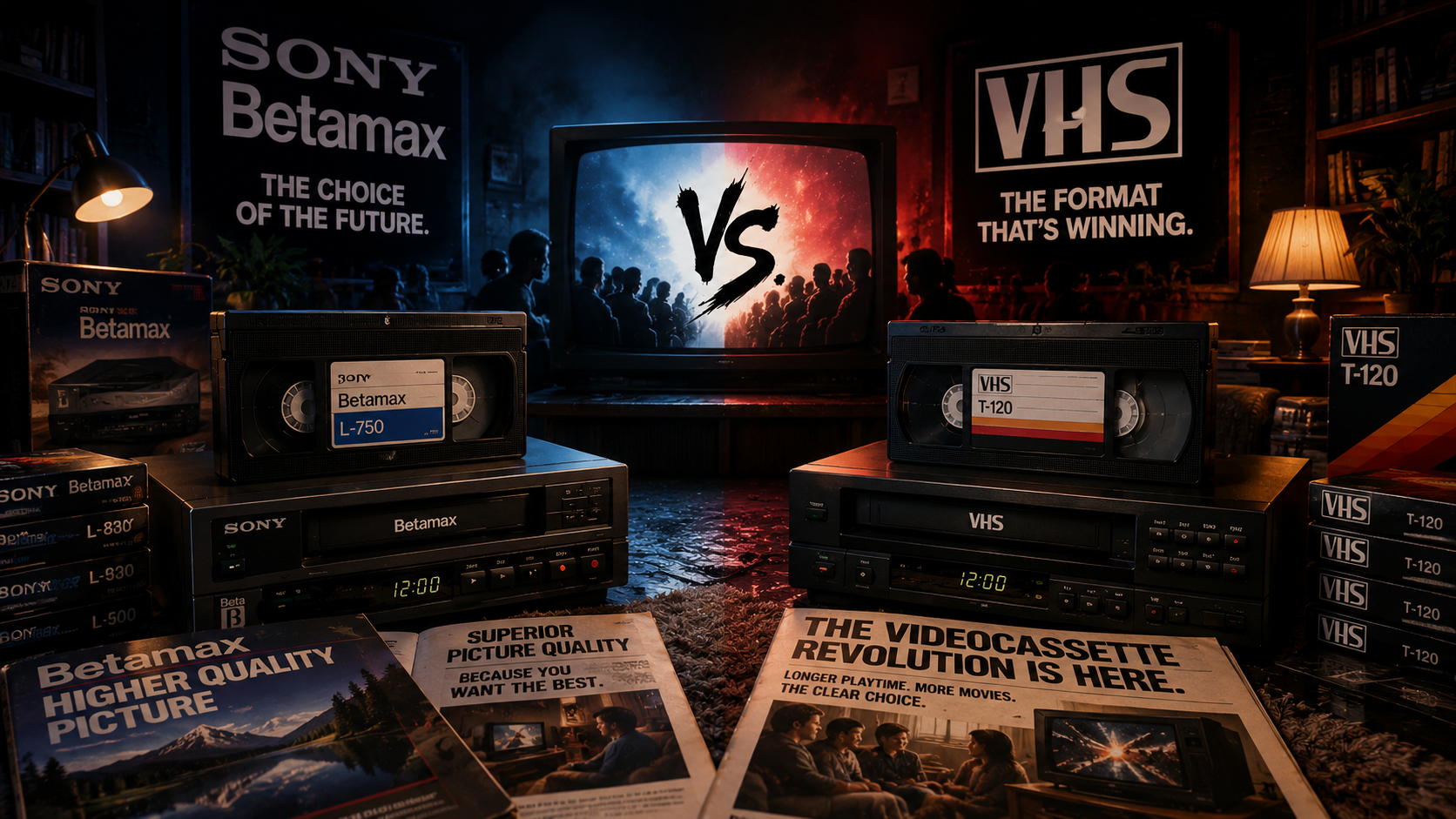
The High-Stakes Battle for Your Living Room
"In 1987, VHS owned 90% of the U.S. VCR market. But how did Sony's Betamax become a museum exhibit of failure?"
What Happened?
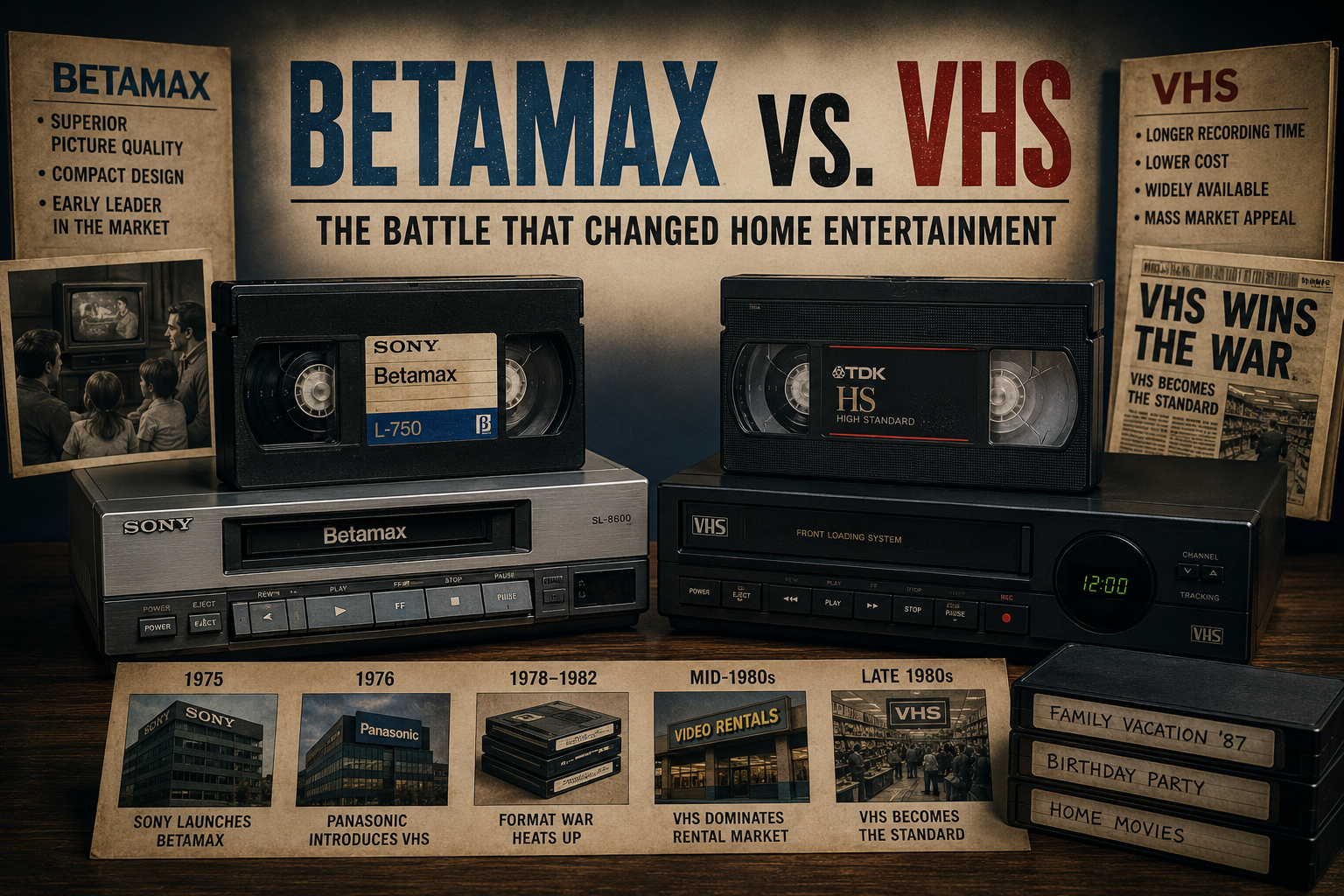
In the battle between Betamax and VHS, Sony learned a harsh lesson: it's not always the best technology that wins. Betamax had the edge in video quality, but JVC's VHS format capitalized on a critical advantage — longer recording times. This, combined with JVC's open licensing strategy, allowed them to outmaneuver Sony. By the mid-1980s, VHS dominated the market, capturing over 90% of US homes. When Sony finally conceded and began producing VHS players, it marked both a capitulation and a testament to the role of strategy over technical superiority in the tech world.
Takeaway
The lesson this story keeps teaching
“Superior technology means nothing without the right strategy.”
Why People Are Talking About This
The Betamax vs. VHS conflict extends beyond a singular technological showdown. It represents a profound business lesson on the significance of aligning strategic vision with consumer expectations. Even in today's rapidly advancing tech world, where giants like Google and Apple battle for market supremacy, the fundamentals remain rooted in the Betamax-VHS lesson. Understanding consumer behavior, scalability, and alliances are as crucial as the technology itself.
For new entrants and established players alike, this historic duel inspires strategies to embrace flexibility and foresight, ensuring the product delivered isn't just seen for its features, but its relevance and adaptability in ever-shifting markets.
Thread Map
9 entities · 8 connections · Hover to explore, click to inspect
This is the connection map for this thread. Every node is a person, company, event, or idea. The red lines show how they connect. Hover a node to highlight its connections. Click a node to see why it matters to this story.
How We Got Here
Sony Unleashes Betamax Revolution
Sony introduced Betamax in 1975, revolutionizing home entertainment with unparalleled video quality. Yet, this marked the start of a fierce battle with JVC about to unfold.
VHS Enters the Arena
JVC launched the VHS format in 1976, forming alliances with other manufacturers. The promise of longer recording times began shifting market dynamics.
VHS Gains Market Dominance
By 1980, VHS secured 60% of the market share. Betamax's closed ecosystem seemed outclassed by VHS's expansive growth.
VHS Rules the American VCR Market
VHS claimed 90% of the U.S. VCR market by 1987, solidifying its supremacy over Betamax's once-promising surge.
Sony Capitulates to VHS
In 1988, Sony started manufacturing VHS players. It marked an implicit concession — a turning point in the format war as Sony shifted tactics.
Farewell to Betamax
The final Betamax unit was produced by Sony in 2002. This closed a chapter on a technology once heralded as the future of home viewing.
The End of VCR Production
In 2016, the last VCR/DVD combo unit was produced, symbolizing the conclusion of the VCR's long-standing legacy.
Wait... Who Is This?
During the 1970s, as televisions gained status in homes, the desire for film and content at one’s convenience emerged as a burgeoning demand. No more were families restricted to scheduled broadcasts. Amidst this, Betamax from Sony appeared as more than another gadget — it was a promise.
Designed to merge quality with convenience, its launch in 1975 marked a significant milestone. Sony, a name synonymous with cutting-edge technology, positioned Betamax as both a leader in quality and a game-changer in consumer electronics. But unknown to them, JVC was plotting its course. The year 1976 saw the birth of VHS, a response shaped not in competition but consumer aspiration.
The battle that unfurled wasn't just about machines; it was a commentary on consumerism. Betamax versus VHS became less an issue of tech specs and more one of alliances, pricing, and the intrinsic understanding of what the public truly wanted — an unseen force shaping the decades to come.
Receipts
Continue the Rabbit Hole
Each story explores the same idea from a different angle. Follow the connections and discover where the thread leads.



Fictional placeholder content