The Marathon From Hell
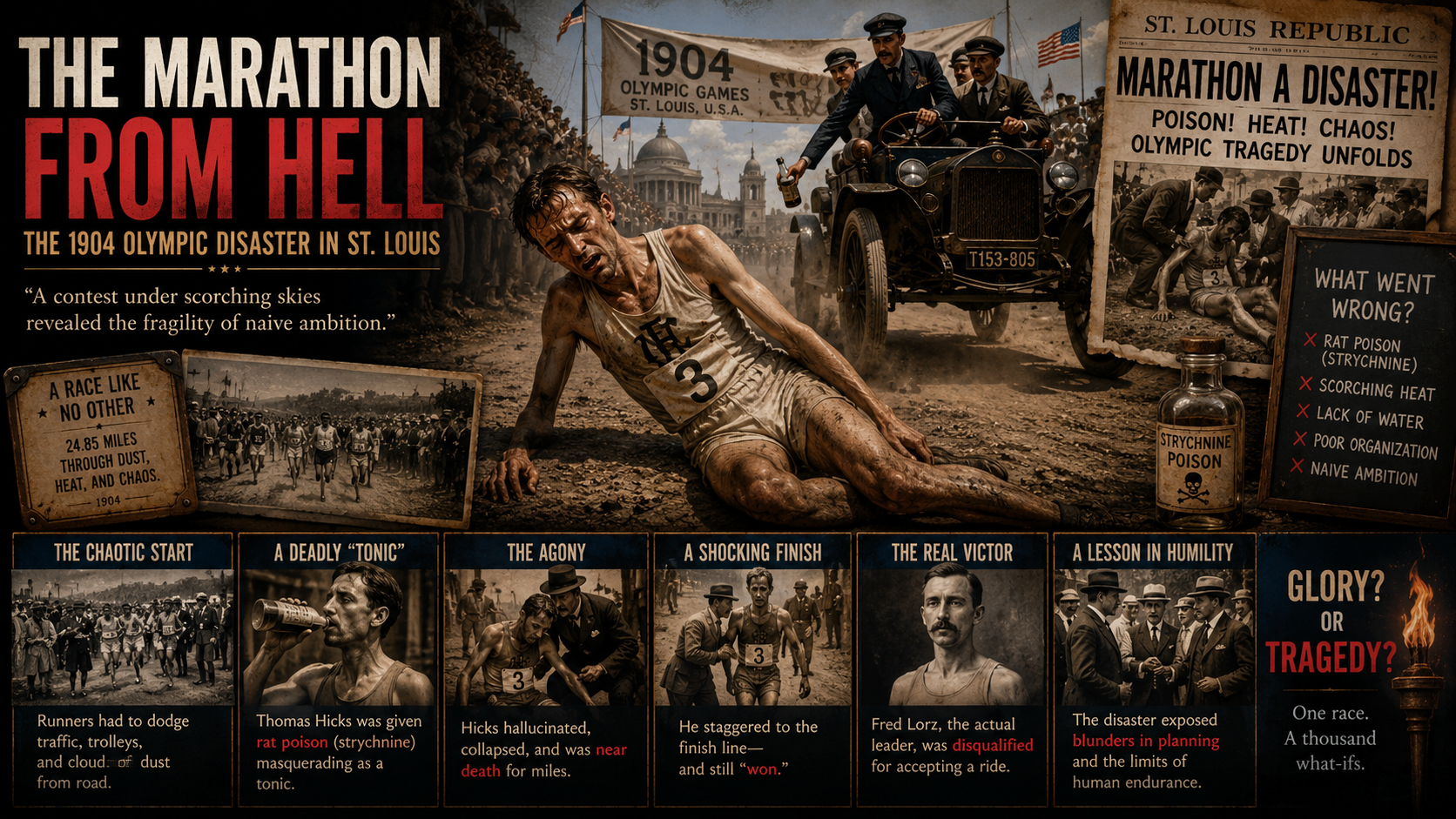
"In 1904, the Olympic marathon turned into a chaotic trivia of incompetence: one runner dosed with rat poison, another disqualified for catching a ride. A contest under scorching skies revealed the fragility of naive ambition."
What Happened?
The 1904 Olympic marathon in St. Louis was supposed to be a testament to human endurance, but it instead exposed a perfect storm of chaos and mismanagement. Under brutal heat, runners faced a course riddled with hazards, minimal water stations, and clouds of dust. Frederick Lorz briefly claimed victory after hitching a ride for much of the race, leading to his immediate disqualification once spectators found out. Thomas Hicks, declared the winner, was aided by a lethal cocktail of strychnine and brandy, teetering on the brink of collapse as he crossed the finish line. This marathon revealed the stark consequences of ambition unchecked by foresight, building a chilling legacy in Olympic history.
Takeaway
The lesson this story keeps teaching
“When ambition overshadows preparation, chaos follows — a reminder that spectacular failure can overshadow great human achievement.”
Why People Are Talking About This
The 1904 marathon demonstrates dramatically the peril when ambition overshadows foresight, offering a cautionary focus still relevant amid today's athletic and managerial realities. The chaos signaled the need for rigorous oversight and balanced preparation, reshaping how endurance sports are planned and executed.
This reflection holds influence on Olympic protocols, illuminating the dichotomy between progressive ambition and foundational safety. In moments present, it resonates loudly, an echo of the Olympic spirit through an era marked by both human conquest and vulnerability.
Thread Map
9 entities · 8 connections · Hover to explore, click to inspect
This is the connection map for this thread. Every node is a person, company, event, or idea. The red lines show how they connect. Hover a node to highlight its connections. Click a node to see why it matters to this story.
How We Got Here
The Marathon Turns Into Chaos
The 1904 Olympic marathon started under brutal conditions with intense heat and dusty routes. From the outset, the runners were set for a tumultuous race.
Frederick Lorz Disqualified for Cheating
Frederick Lorz was initially declared the winner but was disqualified when it was discovered he used an automobile to cover a significant portion of the race.
Thomas Hicks Administered Strychnine
To combat exhaustion, Thomas Hicks received strychnine, a decision that nearly cost him his life but arguably secured his victory.
The Spectacle of Charles Lucas
Race official Charles Lucas meticulously documented the chaotic event, ensuring the marathon's absurdity was preserved for posterity.
Felix Carbajal Harbors Drama
Amidst the chaos, Felix Carbajal, a Cuban messenger, joined the race, only to be delayed after losing money gambling before it started.
The Finish Line: Thomas Hicks’ Victory
Despite the trials and errors, Thomas Hicks crossed the finish line first, surviving the torturous race and pharmacological hazards.
Revisiting Lorz and Regulating the Race
Frederick Lorz participated in later events after the controversy subsided, pushing the Olympic committee to draft clearer rules.
Historical Panels Installed
The St. Louis Olympic Legacy Committee installed informational panels along the marathon route to commemorate the infamous race.
Wait... Who Is This?
The 1904 Olympics was symbolically tethered to the World’s Fair, aspiring to project the spirit of American ingenuity. Relocated from Chicago to St. Louis, it served as a confluence of sporting talent and burgeoning cityscape, but was marred by disorganization on a massive scale.
The marathon, a highlight of the Summer Olympics, aimed to epitomize triumph. Yet, it exposed competitors to extreme heat, suffocating dust, and inadequate infrastructure, transforming the event into a test not just of athletic prowess but of sheer survival. Diverse participants punctuated this narrative. Thomas Hicks, the industrious bulldozer, strove past fading will while Felix Carbajal, spurred by tenacity, saw faith outsize his resources. In bizarre synchrony, Frederick Lorz, emblematic of ambition and fraud, traversed a blurred path of manipulation and momenta.
With water stations sparse, and temperatures soaring to 32 degrees Celsius (90°F), the race's unruly course jeopardized runners from start. It highlighted an Olympic epoch where organization melted beneath white-hot pressure, leaving an indelible mark on history remembered for its chaotic potential rather than its regulated reality.
Receipts
Continue the Rabbit Hole
Each story explores the same idea from a different angle. Follow the connections and discover where the thread leads.







Fictional placeholder content