Roanoke's Vanishing Act
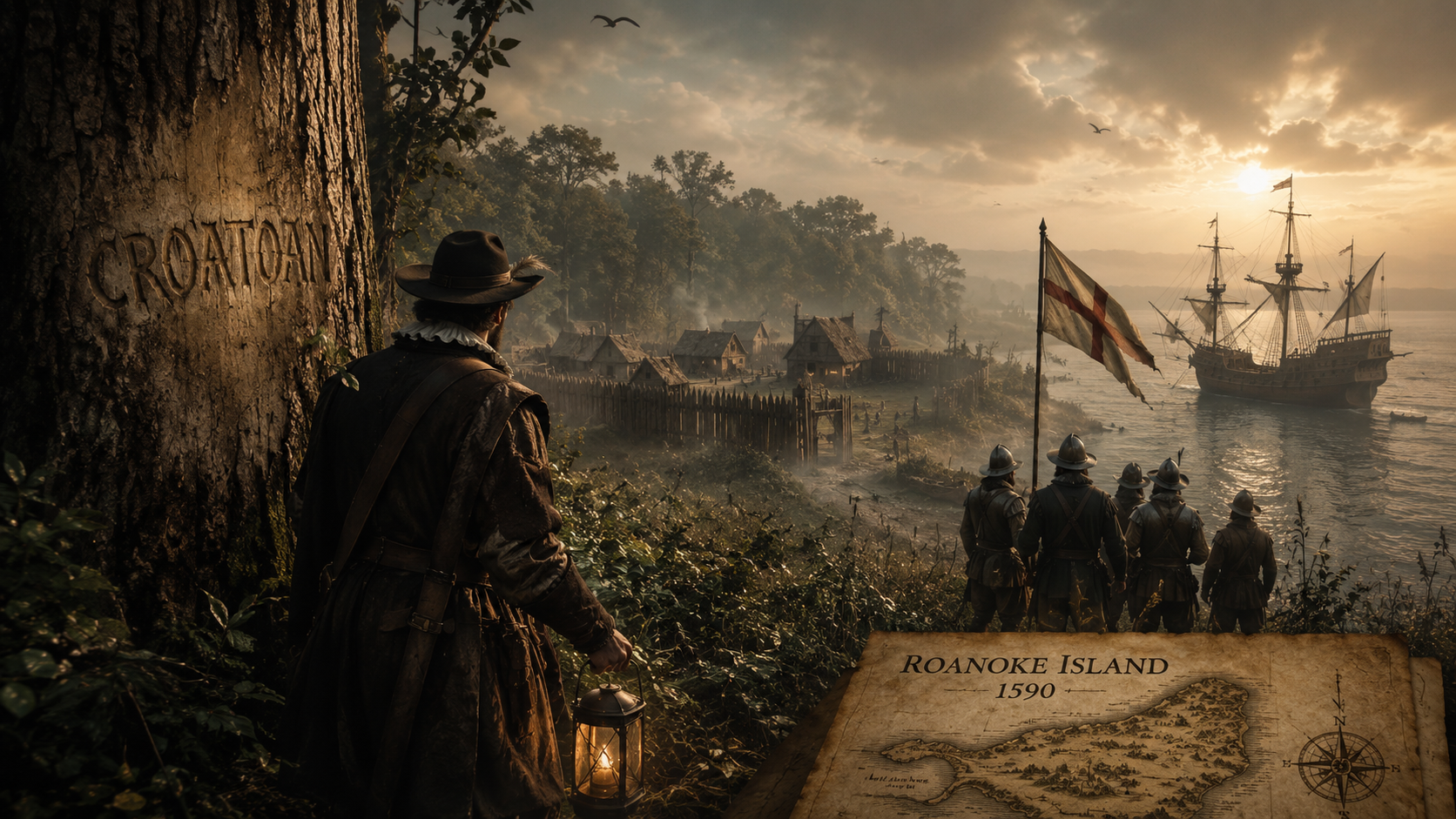
"In 1590, John White returned to find the Roanoke Colony eerily deserted, with 'Croatoan' carved into a tree. This single word sparked centuries of speculation and mystery."
What Happened?
In 1590, John White returned to Roanoke Island to find it deserted, a single word 'Croatoan' carved into a post marking the chilling absence of the once vibrant colony. These settlers, led by White, represented England's pioneering attempt at establishing itself in the New World—an ambition torn asunder. Theories abound: integration with local tribes, disaster, or a fraught relocation. The legend of Roanoke fuels debates over the collision of narrative, truth, and collective memory, emphasizing the fragile line between myth and reality.
Takeaway
The lesson this story keeps teaching
“In the echoes of Roanoke, history teaches us how narratives can eclipse truth, leaving our imaginations to fill the gaps.”
Why People Are Talking About This
The vanishing of Roanoke makes us reconsider how we narrate history and prioritize myth over fact. This absence isn't just historical—it informs the collective conscience about fragility when truth and fiction collide. As we confront intangible legacies, we see reflections in modern society's inclinations toward stories that fit narratives neatly over complexities. Roanoke is significant not because it disappeared, but because it re-emerges, lending us perspectives on consequence, adaptation, and the caution that stories often shape the world as forcefully as does the truth.
Thread Map
7 entities · 6 connections · Hover to explore, click to inspect
This is the connection map for this thread. Every node is a person, company, event, or idea. The red lines show how they connect. Hover a node to highlight its connections. Click a node to see why it matters to this story.
How We Got Here
First Colony Attempt Unravels
Led by Ralph Lane, the first Roanoke colony faced starvation and conflict. His hostile approaches with Native Americans led to dwindling resources and eventual evacuation back to England.
The Lost Colony Sets Roots
Under John White, 115 settlers established the second Roanoke colony. Hopeful yet under-resourced, they pin hopes on the crown’s promise of support.
John White’s Haunting Return
White found the colony empty upon his return, structures in place but the settlers vanished. The carved word 'Croatoan' was his only clue.
White's Croatoan Theory
White theorized that missing settlers migrated to Croatoan Island, integrating with the local tribe there, based on the inscription left behind.
Jamestown: Success After Roanoke Failure
The Jamestown settlement, established after Roanoke, marked the first successful English colony in the New World, learning from Roanoke’s eerie disappearance.
Artifacts Fuel Lost Colony Theories
Newly unearthed artifacts in North Carolina provide evidence that Roanoke settlers might have relocated and integrated with local tribes, lending credence to adaptation theories.
Wait... Who Is This?
In the closing years of the 16th century, England stood at a crossroads, its ambitions curtailed by Spain’s overwhelming dominance on the world stage. The New World, with its vast landscapes and untapped resources, presented an opportunity—a chance not merely for expanding territory but stretching England's influence across oceans. It was a canvas painted with challenges, unknowns, and possibilities. This desire coalesced around Sir Walter Raleigh, a courtier igniting the vision for colonization, venturing beyond the known to lay claim upon what could be. Roanoke, nestled within the Carolina Sounds, held promise as the point of transformation. It would be the outpost of English resilience, secured against adversarial nations yet mostly mere hope adrift against harsh, untamed environments.
The inaugural attempts to settle Roanoke were marked by strife. Ralph Lane's initial foray, supported by Raleigh's patronage, sought trade and rapport with the local tribes like the native Secotans. However, tensions soon frayed, tearing at the fabric of fledgling diplomacy as sustenance dwindled, and cultural misunderstandings piled on. When Lane pulled stakes and returned empty-handed, knowledge and resilience were all that persisted.
John White, arriving with dreams larger and lessons learned, pressed forward with a new wave of settlers—more determined, materially unprepared, yet hopeful. His charge lay in transcending past errors, establishing a thriving community beyond oceans and against hardships jarring the heart and spirit. Suddenly, all stood silent. From the embers of colonial ambition flickered whispers and questions—In its vanishing, Roanoke whispered across time the frailties of knowledge and the stories man's imagination weaves—history and legend interlocked, victorious in their ambiguity.
Receipts
The Lost Colony — An Outer Banks Mystery
New Theory Suggests 'Lost Colony' of Roanoke Is a Misconception
Roanoke Colony | Background, Mystery & Theories - Lesson | Study.com
Roanoke Colony found deserted | August 18, 1590 | HISTORY
The Lost Colony of Roanoke | Britannica
Continue the Rabbit Hole
Each story explores the same idea from a different angle. Follow the connections and discover where the thread leads.





Fictional placeholder content