The Enigma of the Sea Peoples
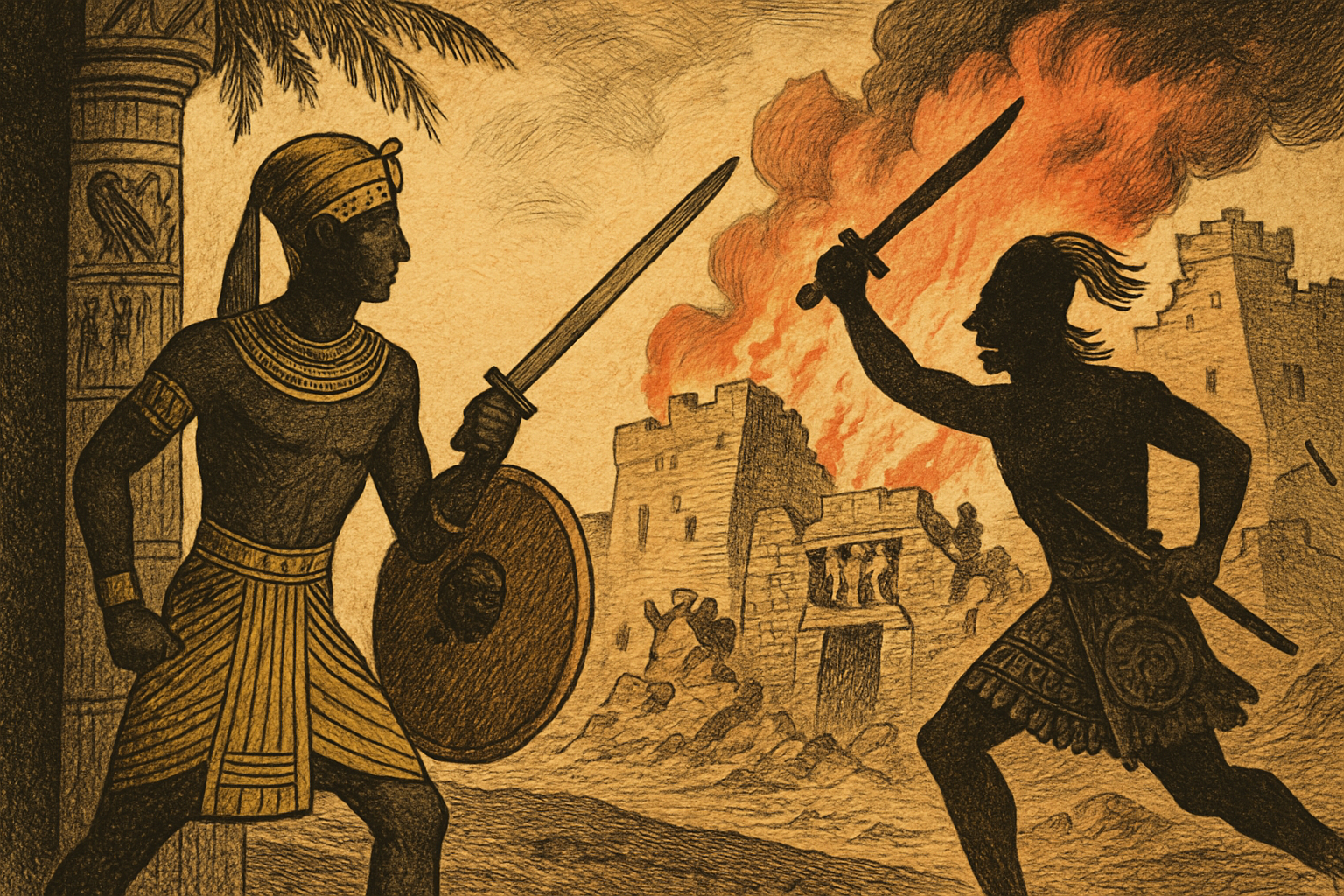
"In 1177 BCE, Ramses III faced an invasion that threatened to annihilate Egypt. These mysterious attackers, known only as the Sea Peoples, left a trail of destruction across the Mediterranean."
What Happened?
Amidst churning seas and looming shadows, the Mediterranean world faced an enigma whose legacy still calls out across the millennia. They were known as the Sea Peoples: a diverse coalition of warriors whose sudden emergence around the 12th century BCE upended the status quo and hurled entire empires into chaos. In 1177 BCE, Pharaoh Ramses III recorded a desperate stand against these relentless attackers who seemed to appear from nowhere, armed with the intent to conquer. But who were these assailants, and what drove them into such frenzied action?
The truth is as murky as the sea itself. While Egyptian accounts from the Mortuary Temple of Ramses III at Medinet Habu describe their confrontations with the Sea Peoples using both land and naval forces, the origins of these invaders remain elusive. Leading theories suggest they arose from a mosaic of displaced peoples—perhaps Aegean tribes or contingents from Sardinia and Sicily. Their ranks included enigmatic groups like the Peleset and the Weshesh, with some scholars positing connections to later historical peoples such as the Philistines.
Yet the Sea Peoples' narrative is not merely one of destruction. Their incursions coincided with a cascade of cataclysmic events that historians now label as the Bronze Age Collapse. City-states like Ugarit vanished overnight, and the mighty Hittite Empire crumbled. The once-thriving Mycenaean civilization was left in ruins. Such widespread devastation cleared the stage for new forces to rise, with the Assyrian Empire ultimately emerging as a dominant power.
The mystery of the Sea Peoples resonates today. They remind us of the transient nature of power and the unseen currents that can shift the course of history. As we unlock more secrets from ancient tablets and interpret archaeological layers, the Sea Peoples still remain a testament to humanity's complex dance with destiny, proving time and again that history is shaped as much by fearsome invaders as by forgotten peoples.
Takeaway
The lesson this story keeps teaching
“Invasions can trigger the swift collapse of longstanding civilizations, revealing vulnerabilities hidden beneath the surface.”
Why People Are Talking About This
The saga of the Sea Peoples serves as a stark reminder of civilization's fragility. In their wake, prosperous states such as the Hittite Empire dissolved, and the Egyptian New Kingdom was left teetering.
Their incursions ushered unexpected cultural and political shifts, altering the ancient landscape. Today, they illustrate that migration and conflict exploit vulnerabilities on a grand scale, lessons that resonate in ongoing global migrations and border tensions.
Thread Map
9 entities · 8 connections · Hover to explore, click to inspect
This is the connection map for this thread. Every node is a person, company, event, or idea. The red lines show how they connect. Hover a node to highlight its connections. Click a node to see why it matters to this story.
How We Got Here
Merneptah Repels First Wave
King Merneptah of Egypt repelled an attempted invasion by the Sea Peoples and the Libyans at the Nile Delta. This marked the first documented clash with these mysterious invaders.
Alarm Bells in Mycenae
The Mycenaean civilization started noticing movements in the Western Mediterranean. Cities like Pylos went on high alert as populations began shifting and tensions escalated.
Hittite Empire Crumbles
The Hittite Empire fell, succumbing to internal struggles and external pressures, exacerbated by the Sea Peoples’ incursions. Its end marked a significant power vacuum in the region.
Battle of the Nile Delta
Ramses III faced the Sea Peoples in a decisive battle in the Nile Delta. His strategic victory preserved the Egyptian realm from annihilation, though the war left Egypt weakened.
Sea Peoples Retreat
Following their defeat, the Sea Peoples retreated from Egypt but remained a lurking presence in the region. Their journey left a path of destruction across Mediterranean civilizations.
The Philistines in Canaan
The Peleset, possibly linked to the Sea Peoples, began settling in Canaan, merging into the history of the region known today as Palestine. Their influence marked a cultural shift.
Activity in the Aegean
Various factions of Sea Peoples were active across the Aegean, participating in raids and navigating through unrest spanning multiple regions.
Aftermath and Emergence of Assyria
Following the disruptions, Assyria began to emerge as the new dominant power, filling the void left by the fallen empires.
Social Reorganization in Egypt
In the years following the Sea Peoples' invasions, Egypt saw a period of social reorganization as it sought to recover from the conflict's impacts. This reshaping influenced Egypt's trajectory in the subsequent centuries.
Continual Raids
Reports from the time describe consistent seafaring raids by the Sea Peoples in the Eastern Mediterranean, extending beyond the Nile Delta.
Wait... Who Is This?
The Bronze Age was a tapestry of interwoven civilizations, each reliant on a delicate balance of trade, power, and cultural exchange. The Mycenaean cities buzzed with the hum of industry, while the mighty Hittites reigned from sprawling Anatolian strongholds. Egypt stood as an ancient marvel, its pharaohs constructing legacies in stone.
Yet beneath this veneer of stability, indicators of unrest gestured towards the unimaginable. Unexpected droughts and resource shortages began to fray the tightly knit fabric of these powerful empires. Trade routes once teeming with life saw disarray as unpredictable waves of migration began to ripple across the Mediterranean.
Thus entered the Sea Peoples, shadowy figures borne of mystery, emerging from the obscurity to challenge the status quo. This amalgam of tribes and warriors now stood set to alter the course of history, unwittingly igniting a chain reaction that scholars continue to untangle millennia later. Their invasions into mighty strongholds like Egypt and the eventual fall of civilizations they precipitated echo through time, a reminder that even the grandest peaks are prone to sudden upheaval.
Receipts
Sea People | Bronze Age, Egypt, Invasion, Mediterranean, & Raids | Britannica
Sea Peoples | Ethnic and Cultural Studies | Research Starters | EBSCO Research
Evidence for the origin and movement of Sea Peoples
ANE TODAY – 201609 – Ask a Near Eastern Professional: Who are the Sea Peoples and what role did they play in the devastation of civilizations that occurred shortly after 1200 BCE? - American Society of Overseas Research (ASOR)
Same Pattern
Different story. Same lesson.

The Wii Gamble That Saved Nintendo
In a world obsessed with graphics and power, Nintendo bet on simplicity. The Wii was laughed at — until it wasn't.

Minority Report's Prescient Touchscreen Reality
In 2002, Hollywood imagined a future of seamless touchscreen interfaces. Today, Steven Spielberg's vision feels eerily prescient as technology catches up.

The Fall of BlackBerry
In a boardroom once buzzing with innovation, silence filled the air as BlackBerry executives watched Apple's iPhone dismantle their empire one launch at a time.

The iPhone That Disrupted the World
In January 2007, Steve Jobs stepped onto the stage and introduced a device that would redefine the entire world: the iPhone. What seemed like just another gadget launch was, in fact, the dawn of a new era.

Predicting Streaming's Meteoric Rise
In a room filled with doubters, one voice declared that streaming was the future of entertainment. Years later, his vision disrupted entire industries.

MySpace: The Rise and Fall That Changed Social Media
In 2006, MySpace was the dominant social media platform, but a mere three years later, its reign ended abruptly. What happened in those pivotal years that turned MySpace from the king of social media to a cautionary tale?
Continue the Rabbit Hole
Each story explores the same idea from a different angle. Follow the connections and discover where the thread leads.




Fictional placeholder content