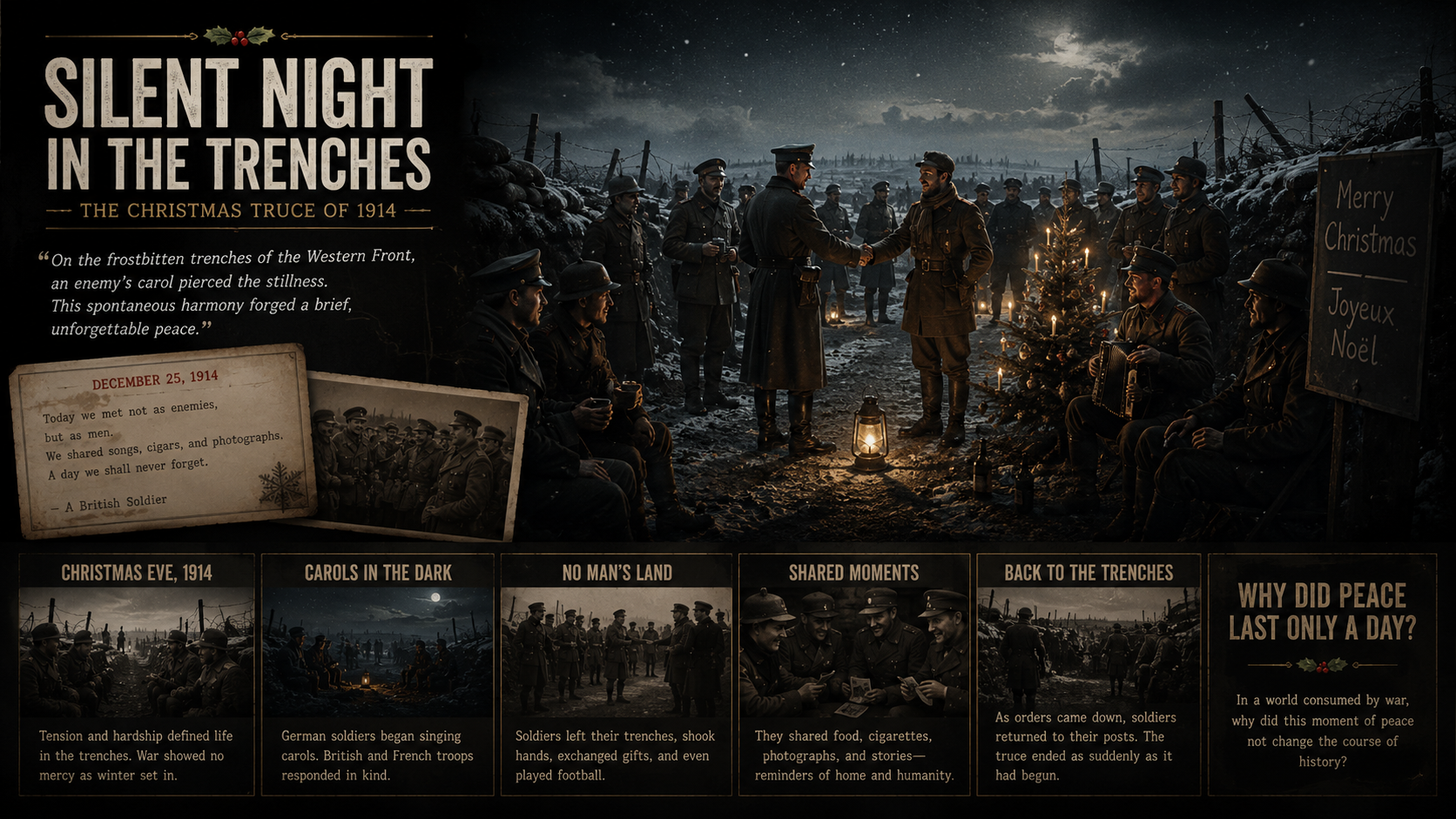
Silent Night in the Trenches
"On the frostbitten trenches of the Western Front, an enemy’s carol pierced the stillness. This spontaneous harmony forged a brief, unforgettable peace."
What Happened?
As Christmas Eve blanketed the Western Front in 1914 with a chilling fog, an unexpected harmony pierced through the air. Soldiers on both sides, entrenched in one of history’s bloodiest conflicts, heard the faint strains of 'Silent Night' rising from the German trenches. In a moment of shared humanity, British soldiers responded with their own carols, echoing peace through the bitter night. By dawn, men emerged from their muddy trenches, not with weapons, but with gifts, songs, and a spontaneous ceasefire. For a brief, surreal span, enemies became allies, enveloped by the shared sacredness of the holiday. This impromptu truce was neither universal nor dictated by higher commands but sprouted organically from the trenches, revealing an intrinsic yearning for peace amid relentless chaos. Yet, as celebrations faded with the holiday lights, questions lingered: Why didn't this spark change the war's course, and what does it say about humanity's capacity for empathy even in the darkest times?
Takeaway
The lesson this story keeps teaching
“Even amidst the most brutal conflicts, a shared moment of humanity can momentarily bridge deep divides.”
Why People Are Talking About This
The 1914 Christmas Truce is a resonance of humanity's latent potential to break free of conflict cycles. It powerfully illustrates that, within locked ideologies and seemingly impenetrable barriers, individuals can unearth shared empathy. This shift momentarily breached structured wartime indoctrination, suggesting hope born from human experience outweighs directives imposed by war's machinery. Today, as modern tensions shadow global landscapes, the truce emerges as an enduring emblem of possibility, fostering conversions from hostility to understanding. It stands as a beacon, referencing that peace, however fleeting, holds potential to plant seeds of lasting unity.
Thread Map
9 entities · 8 connections · Hover to explore, click to inspect
This is the connection map for this thread. Every node is a person, company, event, or idea. The red lines show how they connect. Hover a node to highlight its connections. Click a node to see why it matters to this story.
How We Got Here
World War I Begins, Indoctrination and Mobilization
Tensions boil over into global conflict after years of simmering alliances and rivalries. War unfolds across Europe, drawing in multiple nations.
Tragedy at Ypres Initiates Entrenchment
The First Battle of Ypres transpires, a stalemate ensues leading to entrenched positions across the Western Front. This deadlock invites grim endurance.
War Descends into Stalemate After 'Race to the Sea'
Strategies solidify into entrenched battle lines, affecting thousands as living conditions in trenches deteriorate ahead of winter.
Miracle on the Western Front: The Christmas Truce Unfolds
Out of the frost and mud emerges an unexpected ceasefire as opposing troops sing carols and share festive moments rather than gunfire.
Letters Home Document the Unbelievable Peace
Soldiers recount surreal tales of camaraderie and goodwill, forever preserving these experiences in personal letters that historians like Weintraub later brought to light.
Military Directors Condemn and Terminate Truce
Commands across the frontlines issue orders to resume hostilities, fearing solidarity across enemy lines could undermine martial hierarchies.
Top Commanders Enforce Martial Discipline
Military leaders enforce stringent rules against fraternization to prevent further unauthorized ceasefires. The trenches reverberate once more with combat's roar.
Stricter Military Controls Cement Frontline Hostilities
A push to control masses during war zones becomes stronger after the truce incident. Orders against fraternization propel forward-lined policies.
Wait... Who Is This?
Before World War I erupted into full flame, Europe simmered with long-standing tensions. Various alliances—some secret, others publicly bold—wove a delicate fabric of power balance, holding nations skirting a volatile edge. Nationalism ran high. It was a hotbed for incitement, requiring only a spark to ignite colossal conflict. That spark came on June 28, 1914, with the assassination of Archduke Franz Ferdinand of Austria-Hungary. What should have been a regional disturbance spiraled into unprecedented global war. Mobilization was rapid; alliances triggered reactions across continents, drawing the whole world into a vortex of armed nationalism. The global attack plans designed by competing military strategies resulted in bloody battles that blended into a daunting stalemate—any charm of war eroding in the face of muddy trenches and endless night raids.
Amid this prolonged quagmire, a profound longing for normality whispered, sometimes audibly, through letters sent home. As December approached, frozen soil and solemn vows for peace made their way into the trenches, stunned by the timeworn tradition of Christmas. Amidst pessimism, rumblings echoed—what if for just a moment, there could be peace?
Receipts
Christmas truce - Wikipedia
The Christmas Truce of World War I | Mises Institute
Christmas Truce | Facts & History - Britannica
The Real Story of the Christmas Truce - Imperial War Museums
Christmas Truce of 1914 - WW1 - Vision of Humanity
The remarkable story of the Christmas Truce of 1914 | Sky HISTORY TV Channel
Continue the Rabbit Hole
Each story explores the same idea from a different angle. Follow the connections and discover where the thread leads.







Fictional placeholder content