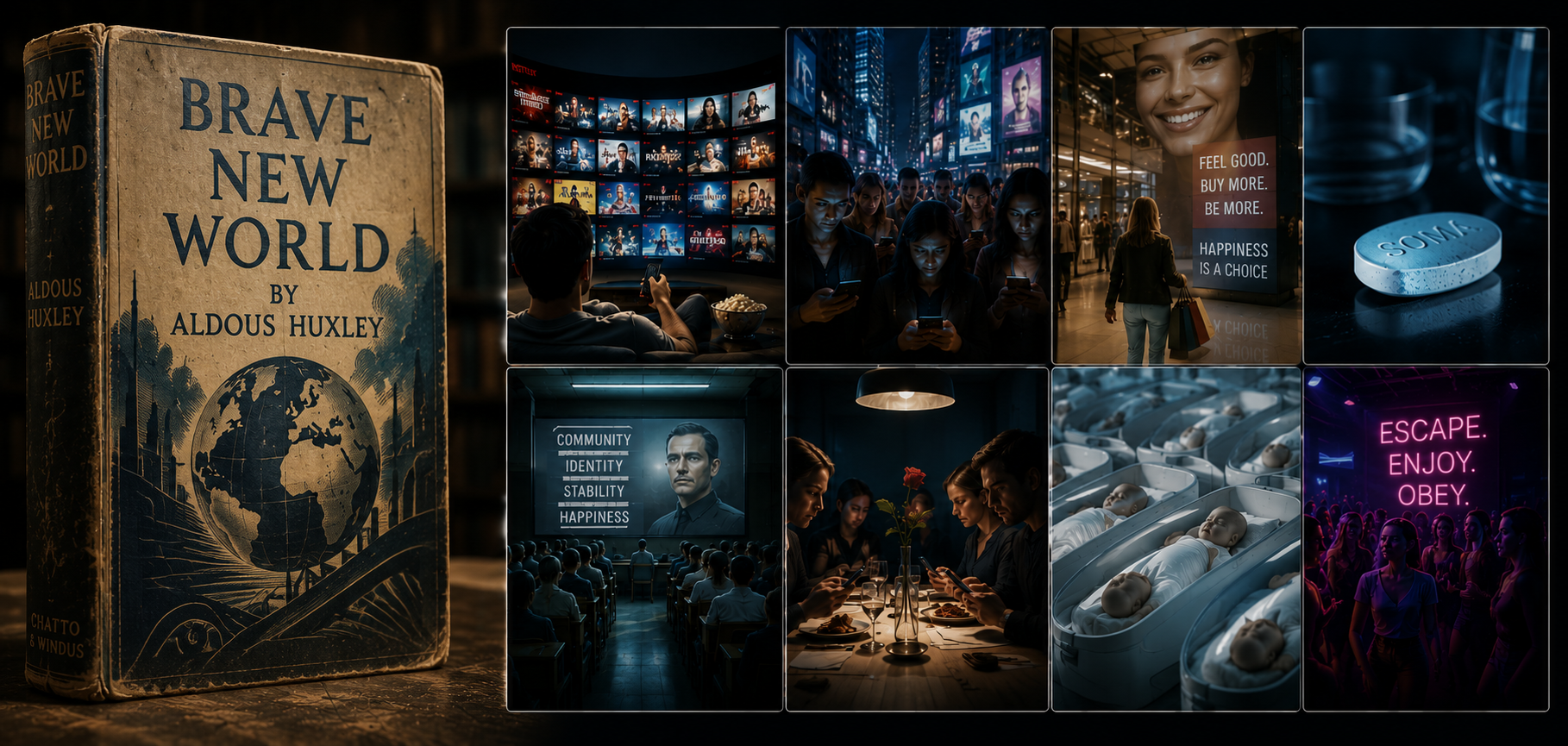
Brave New World's Dystopian Promise
"In Aldous Huxley's vision, entertainment isn't just a distraction—it's society's opiate. What happens when pleasure becomes control?"
What Happened?
The lights dimmed, and the audience settled into their seats, ready for another round of 'feelies.' In Aldous Huxley's 'Brave New World,' this wasn't just entertainment; it was a carefully engineered escape. Designed to tickle every sense, it kept citizens too enthralled to recognize the bars of their societal cage.
Published in 1932, Huxley's masterpiece envisioned a future where pleasure drowned out dissent. This wasn’t some futuristic flight of fancy—Huxley watched the world grapple with the Great Depression, witnessed technologies grow like weeds, and noted how entertainment began to anesthetize rather than invigorate the human spirit. The numbers were telling; by the year of its release, the novel sold 28,000 copies in English alone, forewarning of where the world's passions were headed.
The 'feelies' and soma, a wonder drug that washed away unhappiness, represented more than imaginative concepts—they mirrored concerns of Huxley's present where societal stability overshadowed individual freedom. Bernard Marx, a central character, found himself disillusioned by it all, the hollow unity of Solidarity Services where ecstasy masked empty halls of companionship. In this world, silence meant compliance, and complexity was sacrificed for calm.
The narrative feels eerily familiar today. A time where digital streams and endless scrolls ensure silence on issues that matter, not much has changed. Huxley's caution isn't distant fiction; it echoes in our living rooms as screens flicker and entertainment ensnares. The illusion of comfort is pervasive—just like Huxley foretold, choice slowly evaporates as distraction becomes the norm, all for the price of a ticket and a drug.
Takeaway
The lesson this story keeps teaching
“When society prioritizes pleasure over reality, it trades autonomy for perceived stability.”
Why People Are Talking About This
Huxley's forewarning about entertainment as a tool of control feels eerily prescient today—our screens hum with constant noise, lulling minds into complacency.
In our world, the finest opiates are often digital, mutable, and vast. The story of 'Brave New World' doesn't just showcase a dystopia—it reminds us of the fragile line between pleasure and subjugation.
Thread Map
7 entities · 6 connections · Hover to explore, click to inspect
This is the connection map for this thread. Every node is a person, company, event, or idea. The red lines show how they connect. Hover a node to highlight its connections. Click a node to see why it matters to this story.
How We Got Here
Amidst Global Unrest, Huxley Writes
As the world grapples with the Great Depression, Aldous Huxley begins crafting 'Brave New World,' setting the tone for an unsettling future.
Brave New World is Released
Huxley publishes 'Brave New World,' unveiling a society controlled by entertainment, sparking conversations about technology's role.
The Stock Market Crashes
A monumental economic crash strikes, setting the stage for dystopian anxieties explored in 'Brave New World.'
Rise of Mass Culture
The rise of mass entertainment forms the backdrop for Huxley's cautionary tale of a world seduced by comfort.
Initial Reactions Roll In
'Brave New World' provokes mixed reactions, with some lauding its insight and others dismissing its warnings as far-fetched.
A Global Impact
Huxley's work is translated into 19 languages, expanding its reach and influence across diverse cultures.
Digital Entertainment Evolves
Modern technology presents parallels to 'Brave New World's' themes of pleasure-driven control.
Huxley's World State Unveiled
Set in AF 632, the novel portrays a future where contentment masks societal control, capturing Huxley's vision.
Wait... Who Is This?
In the 1930s, the world found itself teetering on the precipice of modernity. Technological marvels dazzled the masses, offering a tapestry of distraction in uncertain times. Huxley, entrenched in this milieu, saw the comfortable allure of mass entertainment as double-edged—capable of both uniting and isolating society.
Amid post-war recovery and economic volatility, individual pursuits led to sweeping transformations. Methods of production saw progress, and yet, along the way, individuals yearned for a break from life's weight. Vast empires of leisure began taking shape, and among them, Huxley foresaw a terrifying possibility—what if society, in its quest for continuous euphoria, exchanged its liberty for chains concealed in hedonism?
Receipts
Brave New World
Do We Live in a Brave New World? – Aldous Huxley's ...
Entertainment In Brave New World Essay | ipl.org
Brave New World | Encyclopedia.com
Brave New World by Aldous Huxley, first published in 1932, is a ...
ALDOUS HUXLEY: BRAVE NEW WORLD (1932)[1] – Comments on Culture
Continue the Rabbit Hole
Each story explores the same idea from a different angle. Follow the connections and discover where the thread leads.


Fictional placeholder content