Disney's Architectural Illusion
"What if the majestic Cinderella Castle isn't as towering as it appears? Discover how Disney bends reality with architectural sleight of hand."
What Happened?
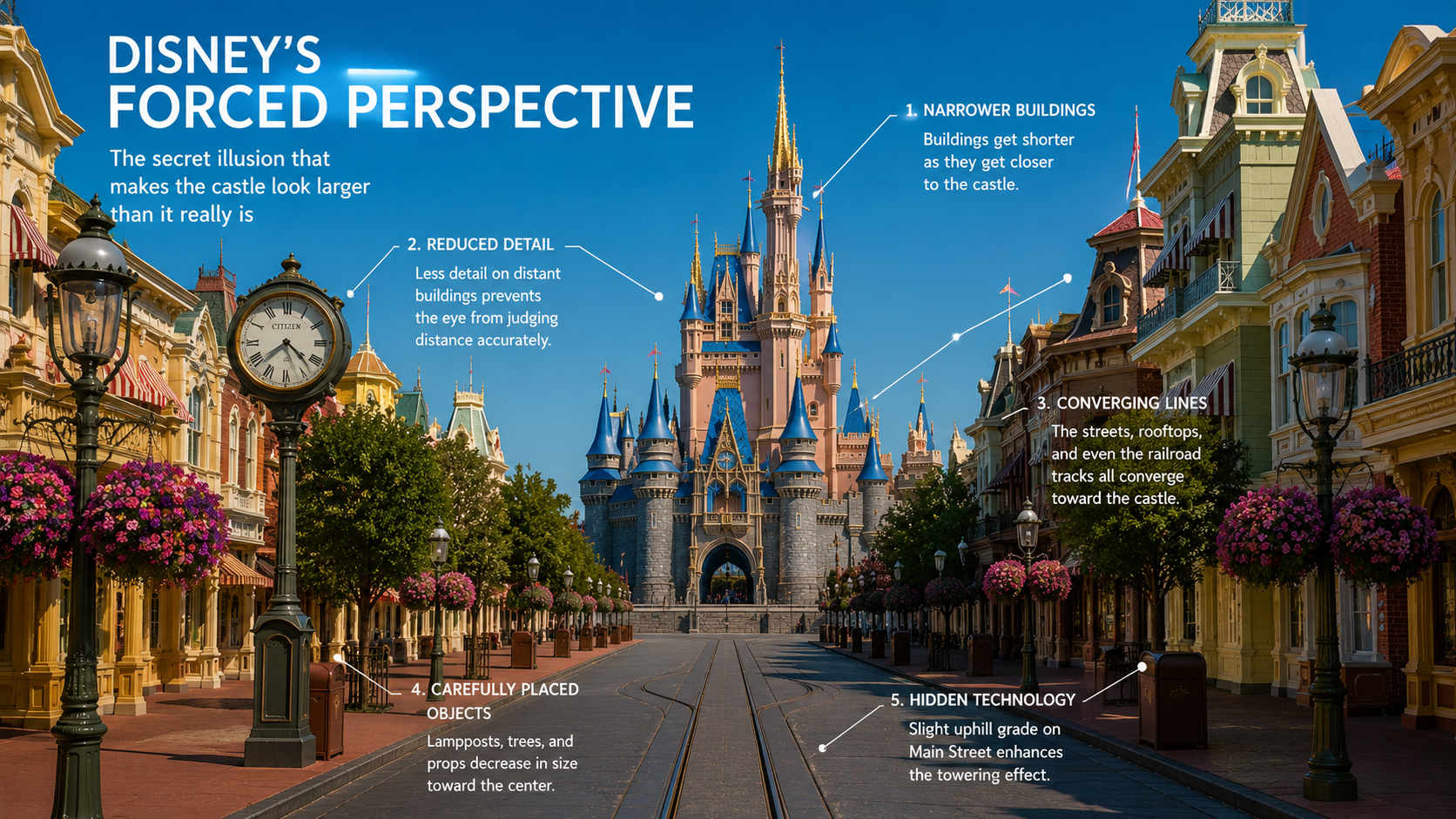
In the heart of Magic Kingdom, something magical, yet deceptive, resides. Guests gaze up at Cinderella's Castle, convinced they're witnessing a structure that shoots into the sky, not knowing the secrets hidden in its stones. The wonder is not in its true height of 189 feet, but in a technique as old as art itself: forced perspective. Deployed by Disney's master Imagineers, this trick of the eye played its most cunning role in bringing fairy tales to life.
Delve into Main Street, USA, where the buildings seem to stretch taller and grander than their modest two-story reality. Harper Goff, inspired by the quaint streets of Fort Collins, brushed an illusion onto Disneyland's canvas—a street that breathes nostalgia, where even the windows and doors are part of the trick, each shrinking as they rise, guiding eyes and belief upward with meticulous precision.
It wasn't always castles and fantasy streets. In the 1950s, Hollywood played with similar optic innovations, such as those seen in "Darby O’Gill and the Little People," under the watchful eye of VFX pioneer Peter Ellenshaw. But in the hands of Disney, the method became a park-wide craft, manipulating entire landscapes, from the American Adventure pavilion at EPCOT, to make them more immersive without expanding physical dimensions.
By 1971, when the majestic Cinderella Castle opened its gates, Disney's fusion of filmmaking and architectural wizardry had reached its peak. John Hench, a creative force behind this vision, saw forced perspective not merely as a visual gag, but as an experience enhancer, drawing guests deeper into the storybook worlds they came to love.
Through stone, spire, and story, forced perspective shapes memories. Visitors leave, enchanted by what they think they’ve seen. It's not just about building heights—it's about crafting dreams with precision, leaving each visitor questioning the boundary between reality and fantasy.
Takeaway
The lesson this story keeps teaching
“The shape of reality can be as malleable as our perceptions allow.”
Why People Are Talking About This
Disney's illusions navigate the intersection of art and psychology, reminding us how easily reality can be warped. As technology pushes boundaries, these lessons in perception are more crucial than ever, illustrating that perceptions shape experiences, often beyond scientific truths. Disney isn't just entertainment; it's a case study in how believing can affect seeing.
Thread Map
9 entities · 8 connections · Hover to explore, click to inspect
This is the connection map for this thread. Every node is a person, company, event, or idea. The red lines show how they connect. Hover a node to highlight its connections. Click a node to see why it matters to this story.
How We Got Here
Disneyland Opens with Main Street Illusions
Harper Goff applied forced perspective to create exaggerated architecture on Main Street, paving the way for Disney's immersive park experiences.
Mary Poppins Released
Peter Ellenshaw crystallized visual deception in Disney's Mary Poppins, foretelling future architectural illusions at Disney's theme parks.
Magic Kingdom Opens with Architectural Marvels
John Hench masterminded Cinderella Castle's design, utilizing forced perspective to captivate millions through perceived grandeur rather than actual size.
EPCOT Opening
EPCOT's American Adventure Pavillion continued Disney's motif of grandeur through deceptive scaling, ensuring architectural magnificence.
Ellenshaw Sheds Light on Cinematic Illusions
During a Movie Magic episode, Peter Ellenshaw shared insights into the challenges of creating illusions, enhancing our understanding of Disney's methodology.
Marceline's Influence Uncovered
Historian Werner Weiss explored Walt's boyhood home, unearthing inspirations that would shape Disneyland’s nostalgic aura.
Main Street's Perspective Unraveled
Articles and forums began popularizing the architectural illusions employed at Disney, sparking renewed interest in the artistry.
Renewed Examination of Past Techniques
YouTube documentaries reignited fascination with Disney's architectural tricks during quarantine, leading to viral discussions and increased online engagement.
Wait... Who Is This?
Walt Disney was known for his ability to weave magic into the mundane. His parks, starting with Disneyland in 1955, set the stage for innovative illusions that would captivate millions. Among these was the clever usage of forced perspective, borrowed from cinematic techniques used in films like "Darby O'Gill and the Little People," to trick the eye and awe the audience. This choice, driven by practicality and a desire to enchant, used scale alterations to transform sights into larger-than-life experiences. As Disney's ambition grew, so did the size of the illusions. Cinderella Castle became the apex of this architectural deceit. Far from being a simple trick of the eye, forced perspective became a cultural icon, a reminder that not everything is as it seems. How can something so simple affect perception so deeply? This magic was not merely in seeing what was there, but in believing in what could be there.
Receipts
Continue the Rabbit Hole
Each story explores the same idea from a different angle. Follow the connections and discover where the thread leads.


Fictional placeholder content