The Global Village Revolution
"Marshall McLuhan glimpsed a future where technology would shrink the world to a 'global village.' He foresaw the chaos it could unleash."
What Happened?
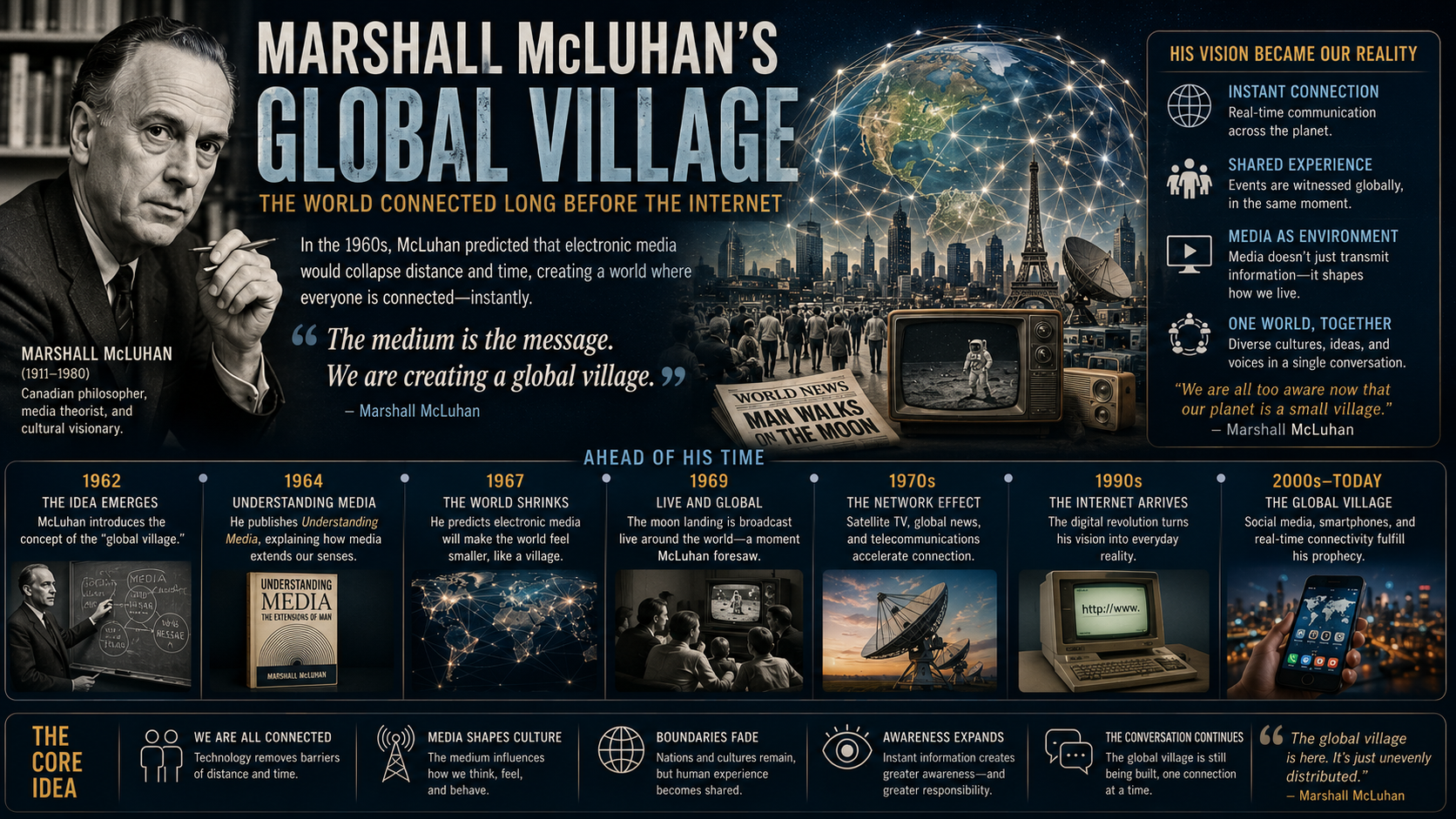
Marshall McLuhan had an uncanny knack for seeing the future. In the 1960s, long before smartphones and social media, he foresaw a world shrunk by electronic interconnectivity and coined the term "global village." He imagined a time when information would pulsate through a worldwide nervous system, connecting disparate corners of the earth as if they were neighboring homes.
McLuhan’s seminal works, "The Gutenberg Galaxy" and "Understanding Media," published in 1962 and 1964 respectively, were revolutionary. He observed that the rise of electronic media—radio, television, and ultimately the internet—would dissolve geographical barriers and redefine human intimacy and interaction. This same media, McLuhan argued, would create a paradox: a broadening of global awareness paired with a narrowing of viewpoint, as local narratives struggled against louder, universal ones.
Despite skepticism when McLuhan first posited his theories, time has proven many of his predictions eerily accurate. Take today's social media landscape. The interconnectedness he spoke of is evident, yet the promised cohesion often collapses into fragmentation, where societies fracture into echo chambers rather than unite.
One of McLuhan’s more unsettling prophecies speaks to the present: his prediction that technological advances could, ironically, lead to heightened tribalism. As the War on Terror has shown, global interactions can amplify cultural conflicts just as swiftly as they foster understanding. In 2001, this became sharply apparent when political unrest halfway around the globe quickly rippled outwards.
As we navigate through today's hyper-connected world, the global village concept continues to challenge us. It nudges us to reassess how technology shapes culture, influences politics, and transforms our lives. In an era where information flows instantaneously yet divisiveness seems more pronounced, McLuhan’s vision endures—a testament to the uncanny foresight of a man decades ahead of his time.
Takeaway
The lesson this story keeps teaching
“Technologies change more than how information is shared—they transform society and culture at their core.”
Why People Are Talking About This
Marshall McLuhan's theory of the global village anticipated how technology would reshape societies, leading to the current era's global interconnectedness. His ideas hadn't just predated the Internet; they pre-empted it. This concept is vital as it underpins modern discussions on globalization, information overload, and media's influence.
As we navigate an increasingly connected world, understanding McLuhan’s predictions provides insight into potential futures. It reveals a world where rapid communication forces societies closer together, yet it can also sow division. His work implores us to consider the implications of how we communicate, as technology continuously wraps the world in a tighter, more complex web.
Thread Map
9 entities · 8 connections · Hover to explore, click to inspect
This is the connection map for this thread. Every node is a person, company, event, or idea. The red lines show how they connect. Hover a node to highlight its connections. Click a node to see why it matters to this story.
How We Got Here
McLuhan Launches 'The Gutenberg Galaxy'
Marshall McLuhan publishes his pivotal work 'The Gutenberg Galaxy,' presenting early insights into media's role in shaping societies. This work sets a new framework for understanding communication's impact beyond content.
The Medium Becomes the Message
In 'Understanding Media,' McLuhan introduces the idea that the medium itself, not the message it carries, influences society most profoundly. This statement begins reshaping the scholarly view of media systems.
Furthering the Global Village Concept
The idea of the global village is expanded in 'The Global Village: Transformations in World Life and Media in the 21st Century,' reinforcing McLuhan's theory as relevant and prescient.
The War on Terror Enhances Media’s Role
With the War on Terror’s global implications, McLuhan’s predictions about a media-dominant environment become ever apparent, as instantaneous news alters public perception and policy responses.
Social Media Begins to Mirror McLuhan’s Predictions
The rise of social networks marks a new era where digital interaction echoes the 'global village,' blurring personal and public realms and validating McLuhan’s prescient insights.
Smartphone Boom Further Condenses the Village
Smartphones become ubiquitous, enabling pervasive connectivity and embodying McLuhan’s ideal of an immediate global village, shaping social interaction and information spread.
Research Submitted: From Global Village to Identity Tribes
A new study reflects on how the once cohesive global village concept is transforming into fragmented digital tribes as context collapse becomes a social reality.
Reassessing McLuhan in the Age of AI
With AI's explosion, media consumption undergoes another shift, spotlighting McLuhan’s theories on media as systemic shapers rather than mere conduits.
Wait... Who Is This?
During the 1960s, an academic revolution began, albeit silently in the corners of university libraries and televised lectures. Marshall McLuhan, an enigmatic figure with an uncanny ability to foresee future trends, introduced a revolutionary concept—the 'global village.' This was a period when television gained a foothold as a significant medium. People gathered around single screens in living rooms, unknowingly participating in the birth of a connected global consciousness. McLuhan saw beyond his era's limits, predicting a world interconnected not just by technology but by shared experiences transcending borders.
His pioneering ideas stemmed from practical observations of how media influenced perception and behavior. As radio broadcasts delivered news instantaneously and televisions engaged viewers with their visual narratives, McLuhan realized the medium itself was becoming the message. This realization posed a paradigm shift, questioning whether humanity was ready for an age where everyone could speak but not necessarily be heard. The Internet was yet decades away, but McLuhan's framework eerily mapped its trajectory, hinting at both the possibilities and dangers of a fully connected world.
Receipts
Global village - Wikipedia
Global village | McLuhan Theory, Globalization, Definition, Examples | Britannica
Understanding The Medium with Marshall McLuhan
Mass Media and the Global Village - Yale University Press
Marshall McLuhan, The Global Village | LivingInternet
THE GLOBAL VILLAGE Globalization, rethinking McLuhan ...
Continue the Rabbit Hole
Each story explores the same idea from a different angle. Follow the connections and discover where the thread leads.

Fictional placeholder content