The Prophecy of Destruction
"H.G. Wells dreamed of a world forever altered by atomic bombs decades before they existed. What bizarre twist of fate turned his fiction into reality?"
What Happened?
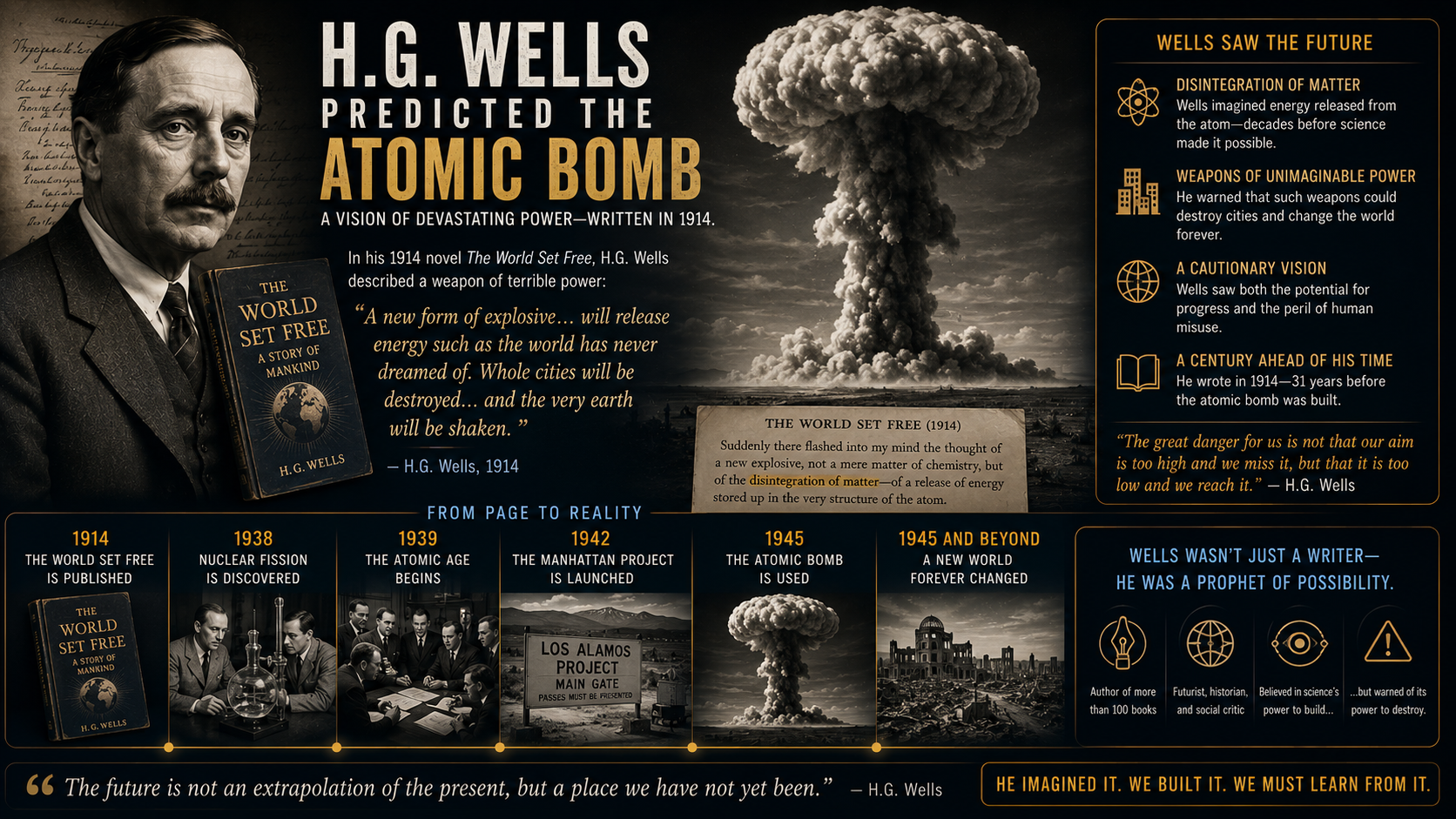
In the haze of post-war destruction, a new kind of terror unleashed its potential over Hiroshima—an atomic bomb, detonating with unprecedented power. Yet, the roots of this devastation stretch back over three decades to the pen of H.G. Wells. In 1914, his novel "The World Set Free" depicted a world where atomic energy was harnessed to create explosive devices of unimaginable destructiveness. This notion of a perpetual bomb seemed fantastical, yet visionary.
Wells was not a scientist, but a writer with a finger on the pulse of emerging scientific theories. His ideas were sparked by the discoveries of physicists like Ernest Rutherford, whose work on atomic structure fascinated and inspired Wells. "The World Set Free" thus set a stage where fiction intertwined with reality—a stage that astounded Leo Szilard, one of the minds behind the eventual creation of the atomic bomb.
Szilard read Wells' words in the early 1930s, finding in them a chilling plausibility. He became convinced of their potential to reshape the future of warfare. By 1932, Szilard, armed with the concept of a chain reaction, would influence projects like the Manhattan Project, which transformed Wells' fiction into a historical pivot point.
Even as Wells watched the world inch toward the war he so vividly imagined, he likely did not foresee how precisely his words would forecast humanity's capacity for self-destruction. When the atomic bombs were dropped in 1945, marking the cataclysmic end of World War II, the profound implications of Wells' speculative foresight became harrowingly real. Wells had seen the potential: not just for technological triumphs, but for their dark shadows—an aspect that remains hauntingly relevant today.
Takeaway
The lesson this story keeps teaching
“Fiction can become a roadmap for reality, pushing boundaries into unforeseen territories.”
Why People Are Talking About This
H.G. Wells' fiction foreshadowed real threats humanity grappled with only decades later, making his tales not just prophetic but profoundly relevant in understanding the ethics of scientific pursuit.
His story serves as a cautionary example of science fiction’s role in shaping not just imaginations but global paradigms, illustrating how narratives can ignite revolutions in thought and technology.
Thread Map
9 entities · 8 connections · Hover to explore, click to inspect
This is the connection map for this thread. Every node is a person, company, event, or idea. The red lines show how they connect. Hover a node to highlight its connections. Click a node to see why it matters to this story.
How We Got Here
H.G. Wells Pens Atomic Fiction
H.G. Wells writes 'The World Set Free,' imagining a world transformed by atomic energy and exploring the potential for bombs of unparalleled destruction.
Inspiration Strikes Leo Szilard
Physicist Leo Szilard reads Wells' 'The World Set Free' and becomes captivated by the concept of nuclear chain reactions, sowing the seeds for future atomic research.
Manhattan Project Begins
The U.S. initiates a project to develop atomic weapons as advancements in nuclear fission signal groundbreaking possibilities and unprecedented risks.
Hiroshima Devastated
The first atomic bomb, 'Little Boy', is dropped on Hiroshima, bringing Wells' once-fictional vision horrifically to life.
Second Bomb on Nagasaki
A second atomic bomb devastates Nagasaki, marking the end of World War II and demonstrating the destructive reach Wells had once envisioned.
Passing of a Visionary
H.G. Wells dies, having seen the foreboding power of his fiction take a chilling place in reality, leaving an indelible mark on scientific ethics.
Legacy of the Atomic Age
Post-war, the impact of atomic weapons spurs both deterrents against future conflicts and discourse on the moral responsibilities of science.
Nuclear Proliferation Concerns
Global tensions arise over nuclear capabilities, echoing Wells' warnings of humanity's struggle to contain its own technologies.
Wait... Who Is This?
Long before the first atomic flash lit up the skies, the seeds of humanity's nuclear future were being sown, not in a laboratory, but in the pages of a book. H.G. Wells was no ordinary author. His words were like spells, conjuring visions of a world where scientific potential was both limitless and perilous. As he penned 'The World Set Free' in his study, he was laying out a future that felt as fantastical as it did cautionary.
By the time Leo Szilard came across Wells' visionary work in 1932, the world had already been enchanted by tales of space invaders and time machines. But Wells' latest narrative, predicting apocalyptic warfare through atomic energy, struck a different kind of chord. It threaded the emergent scientific understanding of the atom's latent power with a societal anxiety that loomed larger as the world inched toward global conflict.
Wells' foresight, drawn from the confluence of science fiction and scientific fact, was not merely an artifact of entertainment but a presentiment of profound implications. The world on the brink of World War I was unknowingly on a collision course with the very stories it consumed, prompting questions about humanity's capacity to rein in its creations.
This tale touches the enigmatic boundary where imagination brushes against the tangible, hinting at the uniquely human fear: that our dreams may one day outstrip our control, casting shadows we are ill-prepared to navigate.
Receipts
H.G. Wells' novel 'The World Set Free' predicts atomic warfare - Bulletin of the Atomic Scientists
How an H.G. Wells sci-fi novel predicted Oppenheimer and atomic bombs
We should remember HG Wells for his social predictions, not just his ...
Nuclear fallout - Wikipedia
History of nuclear weapons - Wikipedia
H.G. Wells: Dream boldly, but build responsibly
Continue the Rabbit Hole
Each story explores the same idea from a different angle. Follow the connections and discover where the thread leads.


Fictional placeholder content