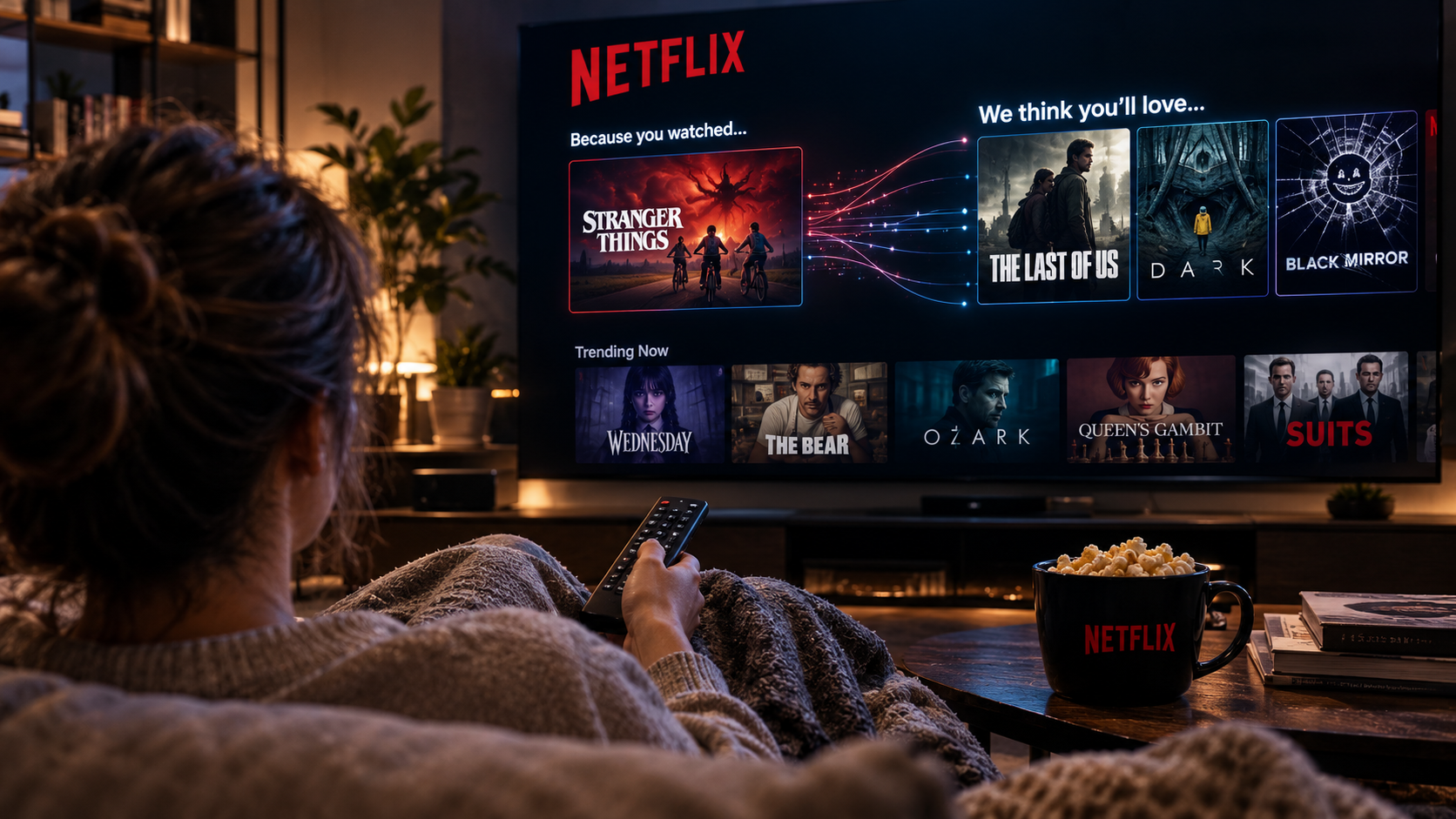
How Netflix Predicts Your Next Binge
"As you settle onto the couch, Netflix knows what you want to watch — before you do. The secret? An invisible army of algorithms."
What Happened?
At any given moment around the globe, over 230 million Netflix subscribers unknowingly participate in an intricate dance with artificial intelligence. Picture this: you're lounging on your couch, your finger hovering over the remote as the last episode of "Stranger Things" ends. Netflix's algorithm is already one step ahead, predicting the next series you'll binge based on patterns you didn't even know you had.
This complex web of predictions is no accident. It comes from an ever-evolving AI system that meticulously analyzes every click, pause, and skip you make. By turning watching habits into data points, Netflix's layered algorithms – including tools like Personalised Video Ranking and collaborative filtering – shape what appears on your screen. This isn't just about what you watched last; it's about how you felt watching it, whether you've gravitated towards 80s nostalgia or intense sci-fi. Netflix’s AI even adapts to your device, curating your options differently on a laptop compared to a mobile phone.
Back in 2000, the introduction of Cinematch, a collaborative filtering system, was just the beginning. Now, with advanced machine learning models, Netflix predicts content preferences with striking accuracy. These models create dynamic user profiles, which are updated in real-time, to present customized rows of recommendations. In fact, a staggering 80% of all watching decisions come from these AI-generated suggestions.
What’s fascinating isn't just the technology, but the implications. Netflix's success with "Stranger Things" was no fluke. Its ability to connect sci-fi aficionados with lovers of coming-of-age tales is a testament to the predictive power of AI. As Netflix continues to refine and focus its technology, the very definition of entertainment shifts, molding seamlessly to our unspoken desires and viewing habits. This is more than just algorithmic wizardry; it's a glimpse into the future of personalized connectivity on a massive scale.
Takeaway
The lesson this story keeps teaching
“Data turns preference into prediction, revolutionizing how we choose to consume entertainment.”
Why People Are Talking About This
Netflix's ability to predict what you'll watch next heralded a new era in entertainment. From being a simple DVD rental service to a streaming powerhouse, they paved the way for content recommendation science. This shift in consumer experience isn't isolated.
It suggests a larger commentary on privacy and personalization, where the thin line between facilitation and intrusion is drawn by algorithmic precision. As data mounts, the question remains: who leads who on this journey, the viewer or the algorithm?
Thread Map
9 entities · 8 connections · Hover to explore, click to inspect
This is the connection map for this thread. Every node is a person, company, event, or idea. The red lines show how they connect. Hover a node to highlight its connections. Click a node to see why it matters to this story.
How We Got Here
Cinematch Introduces Algorithmic Recommendations
Netflix unveiled Cinematch, a groundbreaking recommendation system that analyzed user reviews, enhancing personal viewing suggestions.
Five-Star Rating System Rolls Out
Netflix implemented a five-star rating system to capture nuanced user preferences, refining the recommendation engine's accuracy.
House of Cards Puts Data to the Test
Netflix released House of Cards, an original series greenlit based on data insights suggesting demand for political dramas.
Stranger Things Hits the Scene
Leveraging unparalleled recommendations, Stranger Things became a worldwide phenomenon as Netflix's algorithms directed the right eyes.
Machine Learning Overhaul
Netflix's recommendations system integrated advanced machine learning, elevating personalized predictions with context awareness.
Over 230 Million Global Subscribers
Netflix's subscription base reaches 230 million, underscoring its dominant role in shaping global viewing habits.
AI Predicts Viewing Habits
Netflix announced the use of AI to anticipate viewer engagement, drastically enhancing content discovery processes.
Privacy Concerns Emerge
As algorithms improve, discussions on privacy surface, questioning how much personal data is necessary for content personalization.
New Data-Driven Content Production
Netflix transitions to producing shows fundamentally shaped by audience data, reflecting a shift in how entertainment is conceived.
Wait... Who Is This?
Before the dawn of Netflix as a streaming giant, the world of home entertainment was defined by late fees and slow shipping speeds. Blockbuster reigned supreme, ruling an empire of physical stores. People would roam aisles as if in a candy shop, guessing at which cover might satisfy their weekend viewing palettes.
This changed forever when a small company named Netflix proposed a different model in 1998, using the internet to ship DVDs right to customers' doors. But this was only the beginning. Two years later, as the new millennium turned, the real game-changer arrived: Cinematch. By analyzing user behavior and preferences, Netflix crafted a recommendation engine that sparked an evolution from shelves to streams.
As data became the currency of a new age, Netflix carved its niche by nurturing algorithms that could think. This heralded an era of customized entertainment, paving the way for the consumption revolution we stream into today.
Receipts
Data Science at Netflix: Analytics Strategy
How Netflix Uses Machine Learning to Decide What You’ll Watch Next” | by Abhay Aditya | ILLUMINATION’S MIRROR | Medium
Netflix Artificial Intelligence: The Truth Behind Personalized Content
How Netflix Uses Big Data: Personalization, Recommendations and Content Strategy (2026)
Netflix Knows What You'll Watch Next — And How To Profit From It
How Netflix Knows What You'll Watch Next (It's AI)
A Brief History of Netflix Personalization | by Gibson Biddle | Medium
Continue the Rabbit Hole
Each story explores the same idea from a different angle. Follow the connections and discover where the thread leads.


Fictional placeholder content