The Perfect Cosmic Coincidence
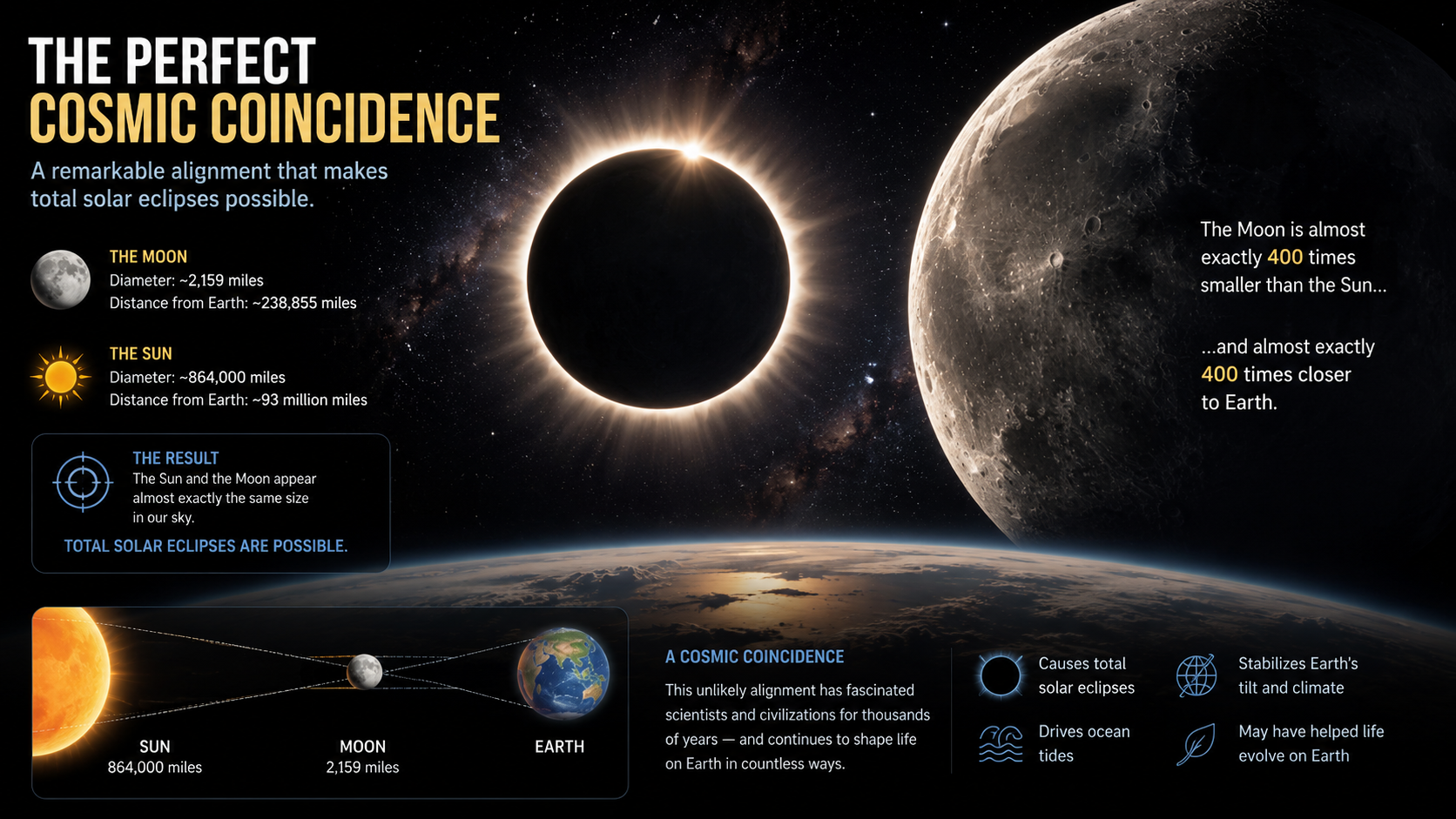
"The Moon and the Sun, though vastly different in size, appear nearly identical from Earth. This unlikely celestial magic permits total solar eclipses, but it's a fleeting miracle."
What Happened?
At a precise moment in time and space, the Moon singularly obscures the Sun, a quirk of cosmic proportions resulting from its size and distance mirroring the Sun’s from Earth. This surreal effect, emitting awe and mystery throughout the ages, is gradually fading: the Moon drifts slowly farther from us. Its departure signals the eventual end of the total solar eclipse phenomenon—unless we grasp its beauty now, the chance will soon become a cosmic artifact, leaving future generations without this spark to astronomy and mythology.
Takeaway
The lesson this story keeps teaching
“Nature's delicate balances mask astonishing coincidences, prompting us to cherish the fleeting phenomena that shape our universe.”
Why People Are Talking About This
As the Moon continues its subtle departure from Earth, the eventual loss of total solar eclipses reminds us of the fragile confluence of celestial circumstances. Right now, we live in a time uniquely privileged to witness such astronomical phenomena. The cosmic ratio aligns; nature choreographs a dazzling ballet visible to the naked eye—a rehearsal faced by no future spectator.
Thus, it channels awe into scientific wisdom—a compelling push towards grasping our universe's intricacies. This backs stargazers probing shadows with eager hopes to discover the universe’s coded depths. Such fleeting celestial concord motivates both wonder and understanding, challenging us to appreciate and explore the cosmic concerns before they fade from sight forever.
Thread Map
4 entities · 3 connections · Hover to explore, click to inspect
This is the connection map for this thread. Every node is a person, company, event, or idea. The red lines show how they connect. Hover a node to highlight its connections. Click a node to see why it matters to this story.
How We Got Here
A Cataclysmic Collision Gives Birth to the Moon
Earth forms following a massive collision with a planet-sized object, and the debris coalesces to form the Moon. This event sets the stage for the eventual complex gravitational dance between Earth and Moon.
Moon's Tidal Embrace
In ancient times, the Moon was much closer to Earth due to tidal interactions. As it began to drift away, the seeds of today's rare total solar eclipses were planted.
Einstein's Theory of Relativity Proved by Solar Eclipse
During a total solar eclipse, scientists observed the bending of starlight around the sun, confirming Einstein's general relativity and revolutionizing our understanding of gravity.
The Moon Matches the Sun
Today, the Moon is perfectly situated to cover the Sun's disk during a total solar eclipse, a consequence of it being approximately 400 times smaller and 400 times closer to Earth.
The Great American Eclipse
A total solar eclipse sweeps across the contiguous United States, captivating millions and underscoring the delicate geometry of our solar system.
The Moon's Ongoing Drift
The Moon is drifting away from Earth at about 3.8 centimeters per year. This slow dance will one day end the possibility of total solar eclipses due to the increasing distance.
The End of Total Solar Eclipses
As the Moon continues its slow recession, there will come a time when it can no longer cover the Sun completely, eliminating total solar eclipses.
The Last Total Eclipse
Far into the future, the Moon's ever-widening orbit will mean Earth's inhabitants can no longer witness a total solar eclipse, as the alignment responsible will be lost.
Wait... Who Is This?
In the distant past, an event both miraculous and violent forged a skyward kinship between Earth and its Moon. Project your mind back to 4.5 billion years ago, as Earth took its first breaths in cosmic infancy. An unfathomable collision, primal and cataclysmic, linked our planet to a companion celestial body, formed as fragments fused and fell into orbit.
For hundreds of millions of years, the Moon orbited closely, exerting its gravitational grip. This increased Earth’s rotational speed and influenced its tidal patterns profoundly. Eclipses then were not as awe-inspiring because the Moon covered the Sun more frequently, with less sky between them. Over eons, receding slowly from this newborn Earth, it painted a cosmic path that guides it now.
The Moon's retreat wasn’t mere distortion of distance; it rewrote Earth-Moon interactions, altering our celestial experience. These gravitationally bound partners provided an astral symmetry humanity grew to appreciate, leaving early societies to ponder shadows astride daylight.
Receipts
TIL the Moon is about 400 times smaller than the Sun, but it also just ...
A total solar eclipse is only possible because of a cosmic coincidence: the Moon is about 400 times smaller than the Sun but also ...
Why is the Moon exactly the same apparent size from Earth as the Sun? Surely this cannot be just coincidence; the odds against such a perfect match are enormous.
How is the Sun completely blocked in an eclipse?
Continue the Rabbit Hole
Each story explores the same idea from a different angle. Follow the connections and discover where the thread leads.






Fictional placeholder content