The Secret Saga of the Moon Trees
"In 1971, seeds were smuggled aboard a NASA mission to the Moon—not by a rogue agent, but by the official mission plan. And what happened when these seeds returned to Earth is still unfolding today."
What Happened?
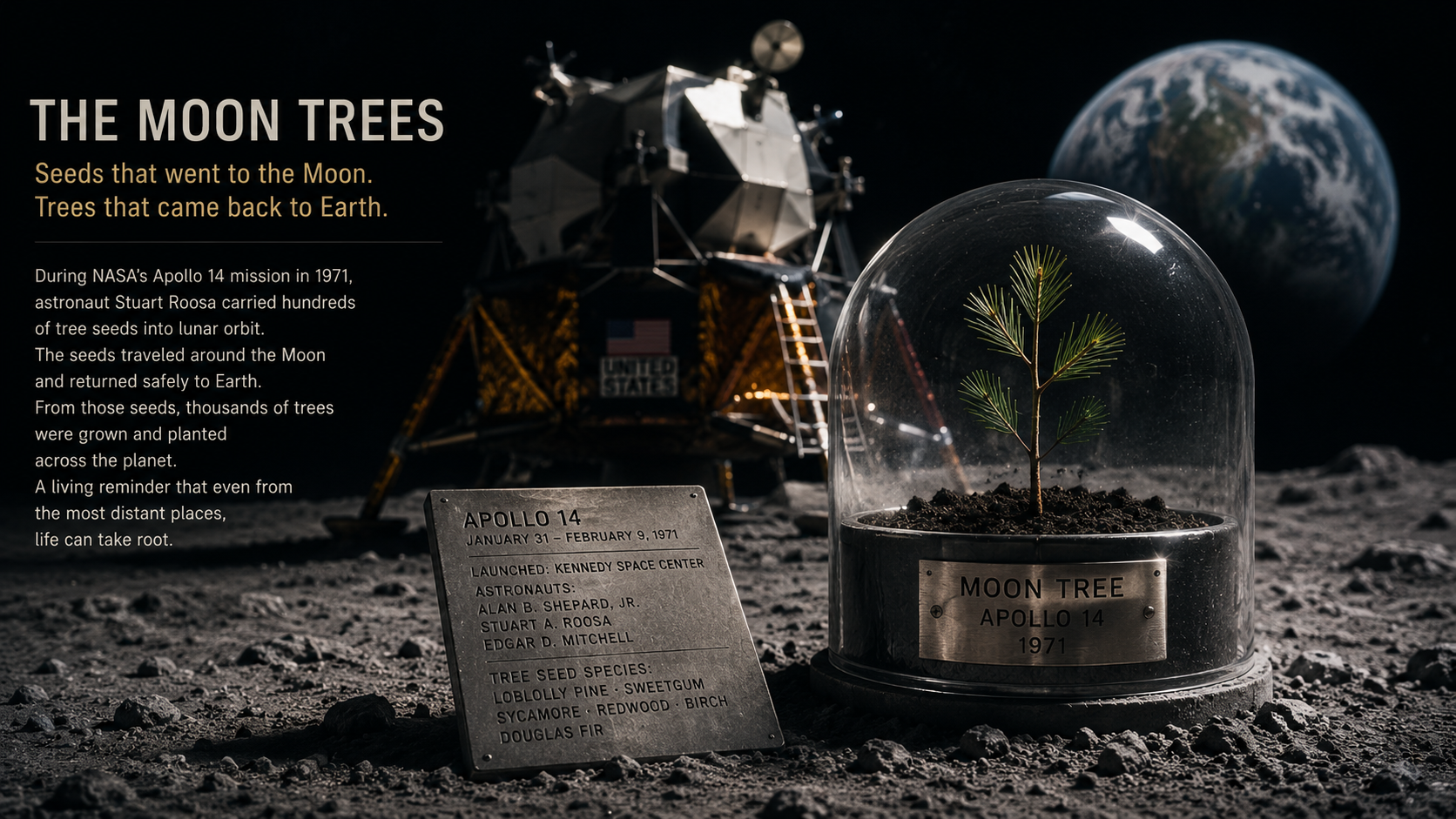
In the Apollo 14 mission of 1971, astronaut Stuart Roosa brought an unexpected cargo into space: nearly 500 tree seeds. The idea originated from a collaboration with the U.S. Forest Service to explore how nature might fare in the emptiness of space. Despite a chaotic return resulting in ruptured seed canisters, many survived and were later planted as Moon Trees during America's Bicentennial celebrations in 1976. Roosa's seeds created a legacy of curiosity and ecological symbolism, blending terrestrial and celestial realms. Today, these trees stand as testaments to the unforeseen connections between Earth and outer space.
Takeaway
The lesson this story keeps teaching
“Human connections to space often grow through just a single extraordinary decision.”
Why People Are Talking About This
The Moon Trees are primordial legacies of human ability to envisage uncharted realms, standing amid few tangible linkages between Earth and space. They remind us of ventures beyond intentions, where small choices create wider ripples. Conceived amid ambition yet largely forgotten, these trees reinforce curiosity that fuels technological advances and species preservation—lessons that transcend generational boundaries as renewed space endeavors echo history's resolve.
Thread Map
10 entities · 9 connections · Hover to explore, click to inspect
This is the connection map for this thread. Every node is a person, company, event, or idea. The red lines show how they connect. Hover a node to highlight its connections. Click a node to see why it matters to this story.
How We Got Here
Apollo 14 Launches with Secret Seeds
Apollo 14 launches carrying astronauts and hundreds of tree seeds. Stuart Roosa's mission includes an experimental payload of seeds, chosen for their American forestry lineage. This unassuming cargo would capture imaginations beyond its lunar voyage.
Safe Return of Apollo 14
Apollo 14 returns, splashdown achieved. Among astronauts returning to Earth, viable seeds are carried back following their celestial journey, ready for germination experiments. Little did anyone know, the mission’s roots held deeper stories.
Moon Trees Planted Across the USA
The United States Forest Service distributes seedlings for America’s Bicentennial. Symbolizing growth from afar, they are planted nationwide, from the White House to public gardens, entwined in ceremonies of national significance.
Stolen Moon Tree in Philadelphia Discovered
A Moon Tree, celebrating the Bicentennial, is taken from its Philadelphia site but later returned. The event raises awareness of the Moon Trees' symbolic importance.
Moon Trees Begin to Disappear
As years pass, many Moon Trees go undocumented, forgotten, and some are destroyed. Efforts to pinpoint their locations meet mixed results, with speculations about their fate a common theme.
NASA's Moon Tree Quest Begins
NASA starts a meticulous effort to locate and catalog surviving Moon Trees. This involves cross-checking historical records, leading to the finding of some trees.
Digital Moon Tree Archives Launched
Online databases are established to chronicle Moon Tree histories. This birth of a digital era enlightens the public on their presence and lingering mystery.
Artemis I Mission Launches
Continuing the legacy, Artemis I launches with new seeds destined to become Moon Trees. The mission carries botanical hope anew, bridging past aspirations with contemporary exploration goals.
Wait... Who Is This?
The Moon Trees' origins are rooted in an era of bold exploration and pioneering spirit. The Apollo 14 mission, despite following the underdog’s mantle of its predecessors, embraced an energy poised for discovery beyond immediate reach. Stuart Roosa, whose past as a Forest Service agent mirrored his affinity for the terrestrial world, carried seeds as a concealed tribute to natural wonder.
Discussions with Edward P. Cliff added layers to this endeavor; it was not just about historic space feats but children witnessing a pinnacle of imagination—little Earthly treasures launched amid the silent skies. These seeds, selected for their darting hopes from places like Southern Pine communities, foretold more than ecological promises—they marked the union across Earth's ecosystems and the cosmic stage.
As the lunar mission reached its narrative of humanity’s stepping stones, Roosa ensured a future just as rooted in Earth’s continuity manifested through space—averse isolation. From catapulting pines into infinite darkness arose a realization: profound simplicity could extend across realms.
Receipts
Continue the Rabbit Hole
Each story explores the same idea from a different angle. Follow the connections and discover where the thread leads.





Fictional placeholder content