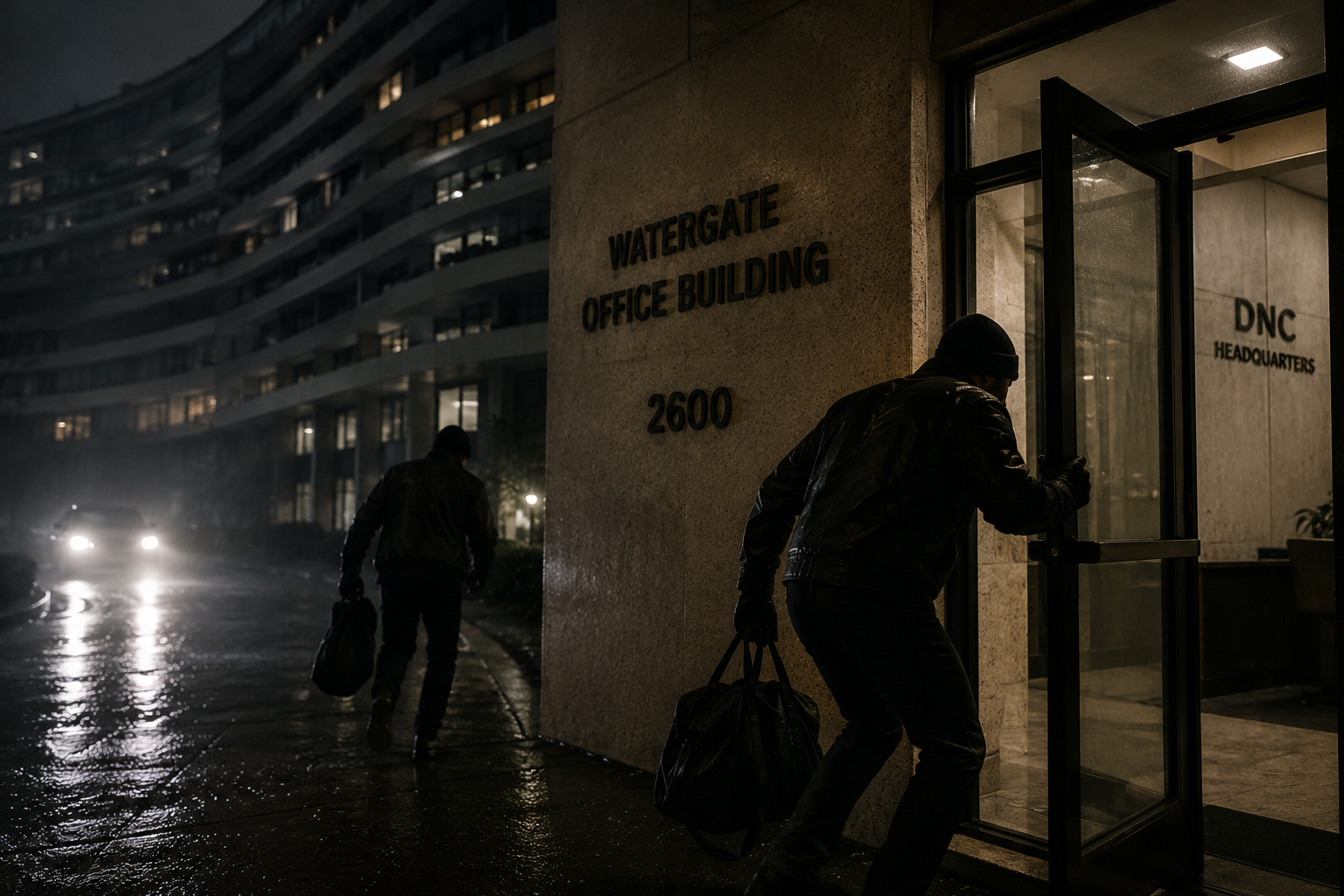
The Watergate Whodunit Unraveled
"The tapes that toppled a presidency had an 18 ½ minute mystery. The gap was no accident, and the erasure became as infamous as the scandal itself."
What Happened?
The Watergate scandal began in the early hours of June 17, 1972, when five men were caught breaking into the Democratic National Committee at the Watergate complex. While initially dismissed as a botched burglary, this event snowballed into one of the most significant political controversies in American history. The scandal exposed a tangled web of political espionage and resulted in the discovery of an unexplained 18 ½-minute gap in White House tapes, sealing President Nixon's fate. Investigations revealed secretive operations by the Committee to Re-Elect the President, indirectly implicating Nixon himself, which ultimately led to his resignation in 1974. Watergate forever changed the landscape of American politics, highlighting the crucial need for ethical standards and transparency in government, as illustrated by the ensuing reforms and the enduring public skepticism towards political figures.
Takeaway
The lesson this story keeps teaching
“Unchecked power often erodes from within, exposing hidden vulnerabilities when pushed to extremes.”
Why People Are Talking About This
Watergate stands as a historic watershed moment in U.S. history, having sculpted a new era of political accountability. It cemented the crucial role of investigative journalism in maintaining democratic checks and balances, while introducing an enduring skepticism towards political figures and authority.
The scandal's ramifications prompted significant legislative reforms to bolster transparency, notably with the Ethics in Government Act and amendments to the Freedom of Information Act. Watergate etched a legacy of cautionary tales that transcend its era, serving as a touchstone for vigilance and truth-seeking in governance.
Thread Map
9 entities · 8 connections · Hover to explore, click to inspect
This is the connection map for this thread. Every node is a person, company, event, or idea. The red lines show how they connect. Hover a node to highlight its connections. Click a node to see why it matters to this story.
How We Got Here
Breaking into Watergate
Five men were arrested inside the Democratic National Committee headquarters at the Watergate complex, connected to Nixon's re-election committee. The incident initially appeared as just another criminal act until ties to the White House began to surface.
John Dean Follows the Money
Amid growing pressure, White House Counsel John Dean began cooperating with prosecutors, revealing deep links between the burglary and high-level officials—turning point that would catalyze subsequent investigations.
Nixon Cleans His House
Facing mounting evidence, President Nixon announced the resignations of key aides H.R. Haldeman and John Ehrlichman, and fired White House Counsel John Dean. This marked a desperate attempt to preserve his presidency as the nation looked on in disbelief.
The Disappearing Tape
White House Watergate counsel J. Fred Buzhardt revealed an 18 ½ minute gap in the tape of a Nixon-Haldeman conversation. This gap became the centerpiece of speculation and accusations of cover-up.
Supreme Court Demands Evidence
The battle over Nixon's tapes reached its legal apex when the Supreme Court ordered a subpoena for all White House recordings, marking a resolute push to uncover the truth behind the scandal.
Nixon Steps Down
As the Watergate scandal's intensity peaked, Richard Nixon became the first U.S. President to resign under looming impeachment, leaving Washington D.C. shrouded in humiliating defeat and wary resignation.
Settlements for Silence
In a final act of closure, four figures involved in the Watergate burglary received $200,000 as a settlement from Nixon’s campaign fund. A hush payment for the ghosts of a political past.
Wait... Who Is This?
In the early 1970s, America stood at a crossroads marked by disillusionment and upheaval. The contentious Vietnam War had deeply divided the nation, leaving skepticism towards the government at an all-time high. Scenes of anti-war protests were commonplace, reflecting the pervasive unrest simmering under the surface.
President Richard Nixon, elected in 1968, entered the scene amid this turbulence. Known for his fierce anti-communist rhetoric and promise to restore law and order, Nixon became a contentious figure as he navigated the complexities of both domestic and foreign challenges. His administration pursued detente with the Soviet Union and opened diplomatic relations with China, yet his avid pursuit of a landslide re-election in 1972 drove him into murky political waters.
As the re-election campaign gained momentum, Nixon sanctioned clandestine operations targeting the Democratic Party, orchestrated by the Committee to Re-Elect the President (CRP). While measures taken were meant to secure political advantage, they sowed the seeds of scandal, culminating in the infamous burglary of the Democratic National Committee's headquarters at the Watergate office complex on June 17, 1972.
The ensuing scandal—unveiled through a combination of investigative journalism, whistleblower revelations, and judicial scrutiny—soured the national mood. The facade Nixon so carefully crafted shattered under the weight of irrefutable evidence, leading to a critical reassessment of government transparency and ethics.
Receipts
The Watergate Scandal: A Timeline | HISTORY
Who Was Involved in the Watergate Scandal? | Key Players
The Watergate Scandal - Timeline, Deep Throat & Nixon's Resignation | HISTORY
Introduction - Richard Nixon’s Political Scandal: Researching Watergate in the Manuscript Collections at the Library of Congress - Research Guides at Library of Congress
The Watergate Files | Gerald R. Ford
Watergate: Who Did What and Where Are They Now? | HISTORY
Continue the Rabbit Hole
Each story explores the same idea from a different angle. Follow the connections and discover where the thread leads.





Fictional placeholder content