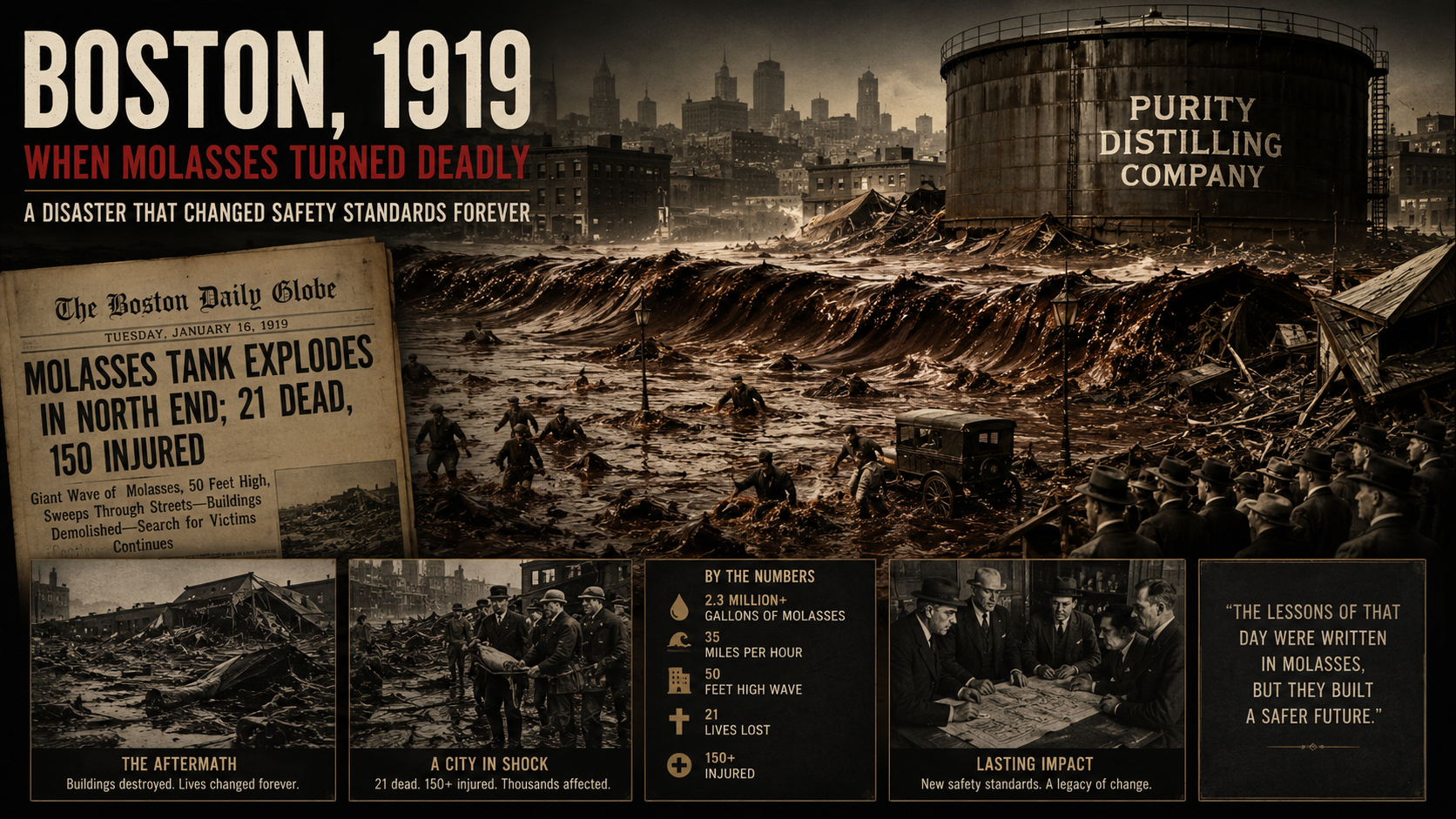
When Molasses Turned Deadly
"A 25-foot wave of molasses tore through Boston, sweeping buildings off their foundations. How did an industrial accident become a wake-up call for safety standards?"
What Happened?
In Boston's North End, January 15, 1919, seemed like just another winter day until the metal groans of a towering molasses tank shuttered across the city. With no warning, the mammoth vessel ruptured, sending 2.3 million gallons of molasses crashing through the streets at a stunning 35 miles per hour. Buildings were swept away, and panicked cries filled the air as 21 people perished and 150 more were injured. The event, known as the Great Molasses Flood, served as a grim reminder of the consequences when corporate greed eclipses human safety, prompting vital changes in infrastructure regulations.
Takeaway
The lesson this story keeps teaching
“When profit overshadows safety, the resulting negligence can lead to unimaginable tragedies.”
Why People Are Talking About This
The Great Molasses Flood serves as a potent allegory for the perils of prioritizing economic gains over human security. It reveals how the short-term vision in engineering and construction can lead to unforeseen and tragic outcomes, emphasizing the everlasting necessity of rigorous inspection and regulatory compliance.
As cities across the globe expand today with similar zest, the lessons from Boston stand salient, asserting that safety regulations are far more than bureaucratic niceties; they are crucial guardians against disaster. History’s bitter milestone reminds us that the future demands architecture built on principles — not as mollusks bracing tidal greed.
Thread Map
4 entities · 3 connections · Hover to explore, click to inspect
This is the connection map for this thread. Every node is a person, company, event, or idea. The red lines show how they connect. Hover a node to highlight its connections. Click a node to see why it matters to this story.
How We Got Here
Molasses Tank Construction Begins
In response to World War I's demand for industrial alcohol, United States Industrial Alcohol constructs a massive storage tank in Boston's North End.
Molasses Tank Filled to Capacity
A large shipment of molasses arrives from the Caribbean, and the tank is filled nearly to its maximum capacity of 2.3 million gallons.
The Great Molasses Flood Strikes Boston
In a matter of moments, a 25-foot wave of molasses crashes through the streets at 35 mph, leaving devastation in its wake. Twenty-one people die, and over 150 are injured.
Rapid and Desperate Rescue Efforts
Rescuers work tirelessly, battling the thick molasses to reach trapped victims, while the chaos disables communication lines, complicating coordination efforts.
Beginning of Legal Proceedings
The aftermath sees the start of a lengthy court case, aiming to assign blame for the disaster. United States Industrial Alcohol comes under heavy scrutiny.
US Industrial Alcohol Held Liable
After years of legal battles, US Industrial Alcohol is found liable for the improper construction and maintenance of the defective tank.
Settlement Reached in Lawsuit
A settlement amounting to $628,000 is reached, representing compensation for the families of victims and signaling a change in corporate responsibility practices.
Implementation of Strict Safety Regulations
The disaster spurs new industrial safety regulations and procedures ensuring oversight and structural integrity, fundamentally changing how such facilities are regulated.
Wait... Who Is This?
In 1919, Boston stood as a cornerstone of American industry, with its North End being a barometer of bustling activity. This neighborhood was more than just a residential enclave; it was the stage of critical intersections between commerce and community. Dominating this landscape was a steel giant housing molasses, that untapped, would flow to factories elsewhere for both explosives and spirits production.
Supporting World War I efforts, the United States Industrial Alcohol accelerated construction based on financial gratification, focusing less on oversight. The build was rushed for expedience: engineers waved architectures smooth without thorough stress testing, citizens raising concerns over foreboding noises.
Yet, peace returned to a world reshaped by conflict, occasioning pause; meanwhile, these industrial towers loomed unmoved. Haunted by unseen ramifications of greed, the neighborhood awaited results of wartime legacy—an incendiary sequel unrolling slow between cobble-lined roads.
Receipts
Continue the Rabbit Hole
Each story explores the same idea from a different angle. Follow the connections and discover where the thread leads.



Fictional placeholder content