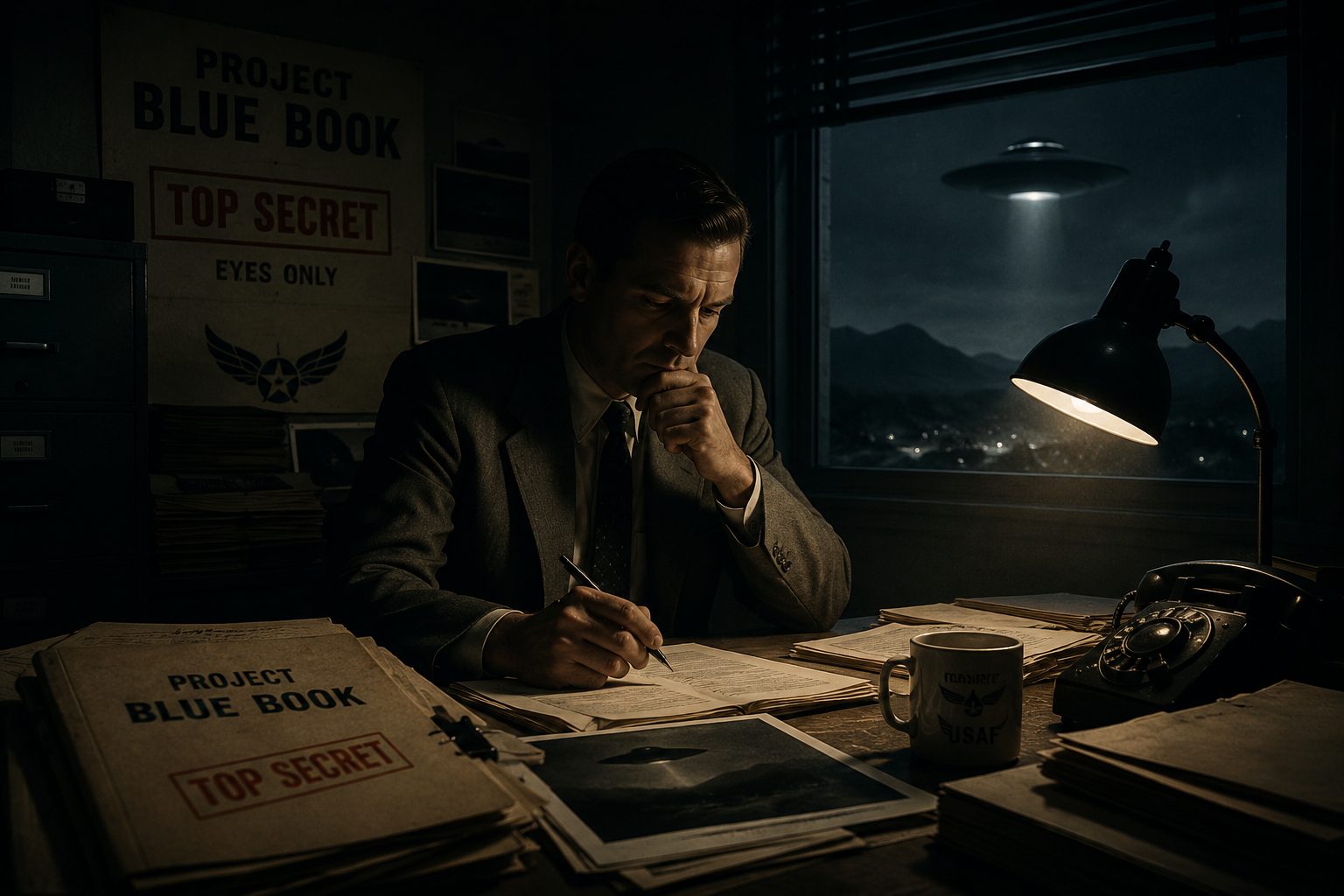
The Secret Files of Project Blue Book
"On a cold March morning in 1952, Captain Edward J. Ruppelt sat staring at a mountain of files that could reshape humanity's understanding of the universe. But what if the truth was hidden not by mystery, but by a desire to control the narrative?"
What Happened?
It was an ordinary evening in 1952 when an Air Force pilot flew over the Midwest, his eyes catching what seemed like a metallic disc gliding through the sky, reflecting the sun. The pilot, seasoned and skeptical, couldn't believe his eyes. This incident would become one of the 12,618 UFO sightings logged by the United States Air Force under Project Blue Book, among the most extensive studies of its kind. Yet, after nearly two decades, the project would reach a baffling conclusion: not a single UFO posed a national security threat, and most could be explained away by conventional means.
Project Blue Book, initiated in March 1952 at Wright-Patterson Air Force Base, was born out of a need to quell public intrigue and panic. It took over from earlier studies like Project Sign and Project Grudge. Captain Edward J. Ruppelt, an organized and meticulous officer, was tasked with leading the effort. His mission: to sift through myriad accounts from civilians, military personnel, and even scientists — each convinced they had observed something extraterrestrial.
However, not everyone was content with the Air Force's dismissals. In 1966, the University of Colorado conducted a study led by physicist Edward Condon, ultimately echoing the Air Force's stance. The Condon Report, as it became known, recommended ending Blue Book's operations as it found no evidence of extraterrestrial origins in the unexplained phenomena. By December 1969, the project was officially terminated.
The legacy of Blue Book is complex. While conclusive on the surface, it fueled countless conspiracy theories and a perennial fascination with the skies above. Its records are meticulously preserved, feeding speculation and curiosity about what the government might still be hiding. Even today, as new technologies and government disclosures rekindle public interest, Project Blue Book reminds us how suspense and doubt can persist long after official investigations have concluded.
Takeaway
The lesson this story keeps teaching
“Public perception shapes reality more than truth — the narrative often trumps the evidence.”
Why People Are Talking About This
Project Blue Book mattered because it represents decades of government attempts to quantify the unquantifiable: public belief. It disclosed more about humanity's changes and challenges than previously imagined, formalizing what suspicion might look like under scrutiny. The narrative dance between fact and fancy continues, plumbing Earth’s skies — and politics’ hidden-box underpinnings. In doing so, it confirmed our insatiable and sometimes perilous lust for stories that mystify over the ones that simply conclude.
Thread Map
9 entities · 8 connections · Hover to explore, click to inspect
This is the connection map for this thread. Every node is a person, company, event, or idea. The red lines show how they connect. Hover a node to highlight its connections. Click a node to see why it matters to this story.
How We Got Here
Project Blue Book Officially Begins
Captain Edward J. Ruppelt leads Project Blue Book, aiming to systematically investigate UFO sightings. It was a concerted effort to understand a surge of reports that challenged the boundary of known science.
A Surge in UFO Sightings Test Air Force Limits
The mid-year brought nearly 1,500 sighting reports within months, thrusting Project Blue Book into frantic analysis. Ruppelt’s team confronted a swell of public interest.
University of Colorado Begins Condon Report
Under the aegis of physicist Edward Condon, this study by the University of Colorado evaluated all available Blue Book data, questioning the legitimacy of extraterrestrial claims. It signaled a tide shift in official accountability.
Project Blue Book is Terminated
After years of investigation and the significant Condon Report influence, Project Blue Book is concluded, with findings announcing no evidence linking UFOs to extraterrestrial activity or threat to national security.
Public Records from Blue Book Released
Following the project's closure, certain records were declassified, feeding the public's persistent hunger for answers and inadvertently perpetuating mythologies around them.
UFO Theorists Seize Blue Book as Evidence
Blue Book's files, decades on, continue as reference points among UFO theorists, channeling speculation into modern folklore.
Renewed Interest in UFO Phenomena
The digital age rekindles interest in UFO phenomena, highlighting Blue Book's unresolved files as cultural touchstones in internet circles.
Project Blue Book Inspires New Media
Films and series draw from the Blue Book saga, capitalizing on its enduring mysterious allure that both captures viewers and revives debates.
Wait... Who Is This?
In the aftermath of World War II, the American public found itself peering into the skies more often than before. Flying objects — whose origins spanned from technological advancements to imaginative fantasies — danced into its collective periphery. Fear brewed from the shadow of an entire Cold War era steeped in aversion and the unknown. When Kenneth Arnold spotted a formation of airfield dissent in June 1947, America's suspicion was officially ignited. Official military endeavors, first through Project Sign followed swiftly by Project Grudge, sought to uncurl these reports into confirmable truths. But uncertainty and trepidation, rather than answers, wove themselves into the fabric of these state-sanctioned pursuits.
Blue Book enters this atmospheric crossroads, soon capable of seeding truths through its protagonist, Captain Ruppelt, masterminding the task of unmasking myth from manufacturing. Built upon serialized spots of local paranoia, its investigations simultaneously wrestled with avaricious narratives. And yet, as the public roamed article by article of newsprint and films ducked behind shadows of reality's fringes, it became less about those witnessing inexplicable phenomena and more about how they wished to approach them.
Receipts
Project Blue Book - Wikipedia
What we know from decades of UFO government investigations | National Geographic
Project Blue Book | Definition, History, Aliens, UFOs, & Facts | Britannica
50 Years Ago: Government Stops Investigating UFOs - National Archives Foundation
History of UFOs - Sightings, Timeline & Abductions
'Project Blue Book' Is Based on a True U.F.O. Story. Here It Is. - The New York Times
Same Pattern
Different story. Same lesson.

The Lab That Invented Tomorrow
In December 1979, Steve Jobs saw echoes of the future inside Xerox PARC's halls. There, in a secluded lab, lay the blueprint for the modern tech landscape.
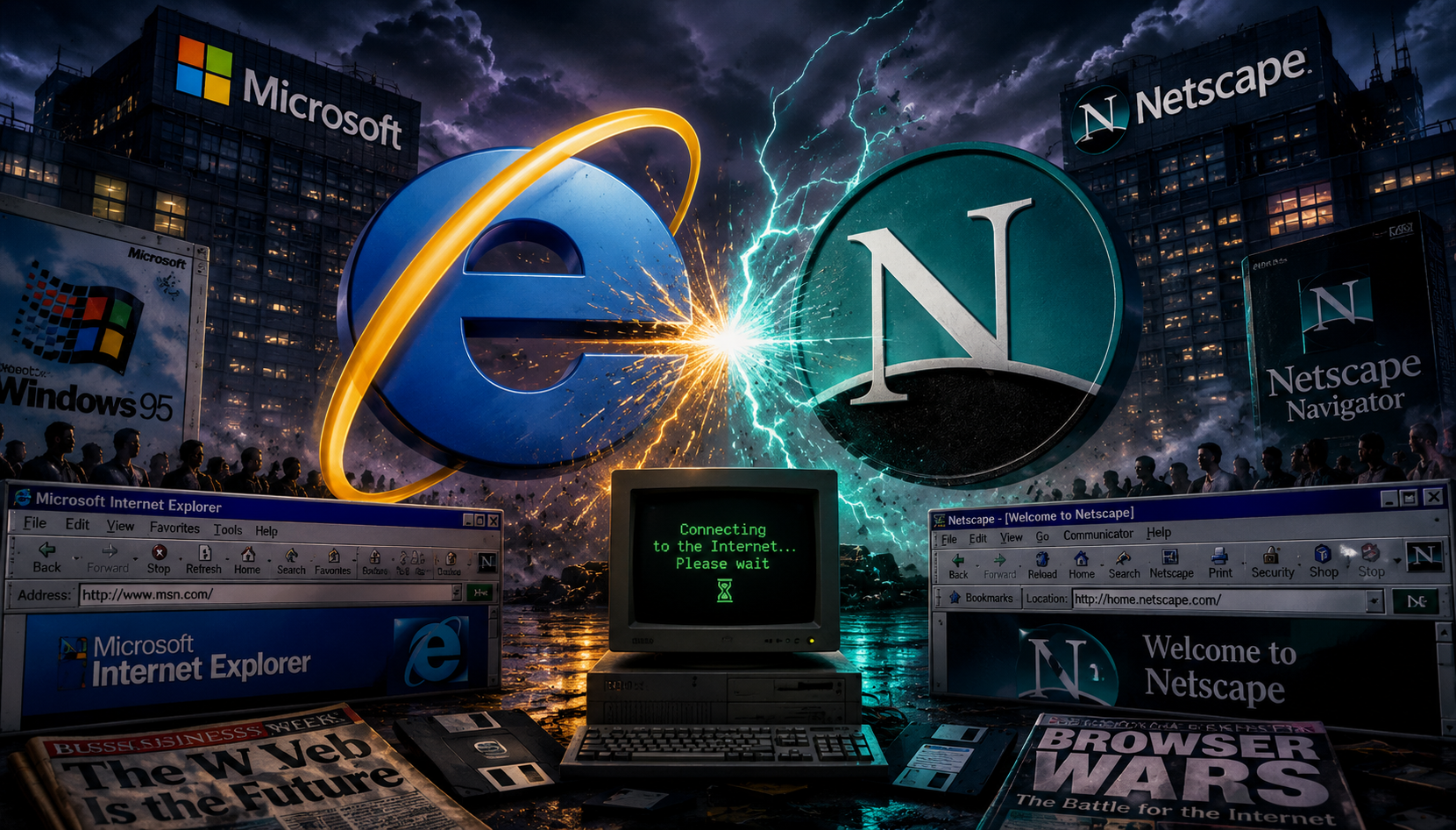
The Browser War That Built the Internet
In the mid-1990s, a software battle erupted that would shape how billions accessed information. Few could predict that the victor would soon face its own downfall.

The Wii Gamble That Saved Nintendo
In a world obsessed with graphics and power, Nintendo bet on simplicity. The Wii was laughed at — until it wasn't.

Pixar's Radical Feedback Loop
In a stark, unadorned room, some of the most powerful voices in animation face off with ruthless honesty. Their weapons? Brutal feedback that molds raw ideas into cinematic gold.

The Chicken That Changed Retail
Costco's $4.99 rotisserie chicken isn't just a meal — it's a strategic masterpiece. The unexpected ripple effects changed retail forever.

Minority Report's Prescient Touchscreen Reality
In 2002, Hollywood imagined a future of seamless touchscreen interfaces. Today, Steven Spielberg's vision feels eerily prescient as technology catches up.
Continue the Rabbit Hole
Each story explores the same idea from a different angle. Follow the connections and discover where the thread leads.

Fictional placeholder content