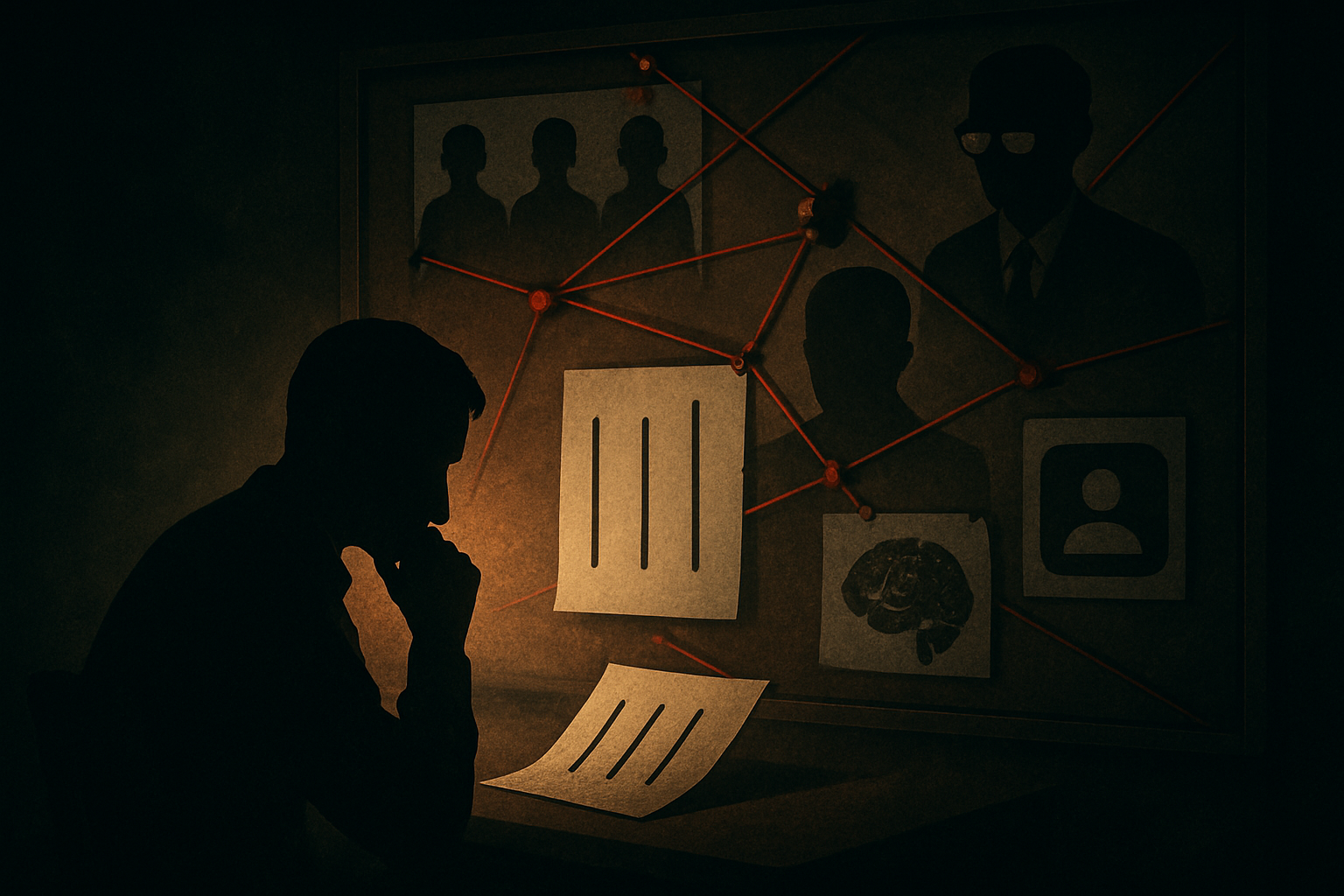
When One Voice Becomes Many
"In a quiet room, a man stares hard at the lines before him, knowing the answer but doubting his own eyes as everyone around him insists on a lie. Forty out of one hundred such eyes fell in line during Asch's pioneering experiment."
What Happened?
The question was simple, yet it became infamous for the revelations it unearthed: which of the three lines matched the length of a reference line? In Solomon Asch’s 1951 experiment, the lines were drawn and the stage set for a psychological drama. Only, the real plot twist came from the unseen actors in the room—confederates planted to give blatantly incorrect answers. Asch’s unwitting participants found themselves in a peculiar predicament; would they trust their own eyes or fall in line with a wrong majority opinion?
This scene of conformity unknowingly captured the zeitgeist of 1950s America—a time heavily influenced by Cold War tensions and social conformity. Asch's experiment revealed the extent to which individuals would bend their reality to align with a group's consensus. Astonishingly, among 123 subjects, approximately 75% conformed at least once, while a majority accepted erroneous group opinions in 36.8% of the trials. The implication: social pressure could warp even the simplest truths.
By 1955, Asch’s findings were published, transforming this experiment into a cornerstone of social psychology. It was not just about the peer pressure faced in a lab setting; it was a reflection of broader societal dynamics. The participants weren’t merely matching lines; they were giving shape to a narrative that questioned the very foundation of individual certainty.
As we reflect on today's culture of pervasive groupthink in social media and corporate environments, Asch’s questions about autonomy and social influence remain hauntingly relevant. His lines may have been drawn in chalk, but they sketched a far more enduring picture of human nature.
Takeaway
The lesson this story keeps teaching
“Social pressure can lead individuals to question their own senses and conform to the majority, illustrating a profound human vulnerability.”
Why People Are Talking About This
In a world dominated by social media, Asch’s findings are more relevant than ever. They offer potent insights into the mechanisms behind groupthink and the perpetuation of misinformation. The pattern of prioritizing group opinion over personal conviction remains a cautionary tale as digital enclosures increasingly dictate everyday realities.
Thread Map
9 entities · 8 connections · Hover to explore, click to inspect
This is the connection map for this thread. Every node is a person, company, event, or idea. The red lines show how they connect. Hover a node to highlight its connections. Click a node to see why it matters to this story.
How We Got Here
Asch's Experiment Stirs the Psychological World
In a bid to explore social influence, Solomon Asch crafted an experiment where participants declared line lengths. The twist was the presence of confederates answering incorrectly to observe conformity.
Publishing the Startling Results
Asch published his findings revealing that a significant portion of participants conformed to incorrect majority opinion, altering the landscape of psychological research.
Movement Towards Individualism Observed
Subsequent research during this period showed a decline in conformity, suggesting a societal move towards individualism, diverging from Asch’s initial findings.
Digital Age Increases Group Influence
With the rise of the internet and social media, Asch's theories return to relevance as online environments amplify instances of groupthink.
Replicating Asch's Experiment in Modern Times
Psychologists revisit Asch's paradigms, endeavoring to evaluate conformity with contemporary cultural dynamics and technological factors.
Social Media Amplifies Asch's Findings
Social networks serve to demonstrate Asch’s insights in real-time, as algorithm-driven content reshapes perceptions and collective agreement.
New Studies on Groupthink Emerge
Further studies on group dynamics and decision-making are released, establishing direct links to Asch’s work to explain contemporary societal behaviors.
Virtual Conformity Under the Microscope
Studies continue to explore how digital spaces replicate and exacerbate the effects of groupthink, echoing Asch's findings in a new medium.
Wait... Who Is This?
In the tense sociopolitical climate of post-World War II America, the Asch Conformity Experiment emerged as a beacon illuminating the interplay between individual awareness and collective pressure. With America steeped in Cold War anxieties, the concept of conformity gained intricate layers of societal relevance. Asch’s study, a straightforward examination on the surface, brought to light deeper questions of autonomy and the psychological weight of consensus. It was during this time when the tide of majority influence wielded an unseen power, shaping individual behaviors and perceptions. In this atmosphere, Solomon Asch, motivated by a desire to understand social influence’s reach, constructed an experiment poised to challenge our understanding of human independence.
Receipts
Asch conformity experiments - Wikipedia
Asch Conformity Line Experiment
Social Conformity: Insights from The Asch Conformity Experiment - Achology
Asch conformity studies (Asch line studies) (video) | Khan Academy
Key Study: Conformity - Asch (1955) | The IB Psychology Blog
Same Pattern
Different story. Same lesson.

The Lab That Invented Tomorrow
In December 1979, Steve Jobs saw echoes of the future inside Xerox PARC's halls. There, in a secluded lab, lay the blueprint for the modern tech landscape.

Pixar's Radical Feedback Loop
In a stark, unadorned room, some of the most powerful voices in animation face off with ruthless honesty. Their weapons? Brutal feedback that molds raw ideas into cinematic gold.

The Browser War That Built the Internet
In the mid-1990s, a software battle erupted that would shape how billions accessed information. Few could predict that the victor would soon face its own downfall.

The Wii Gamble That Saved Nintendo
In a world obsessed with graphics and power, Nintendo bet on simplicity. The Wii was laughed at — until it wasn't.

The Chicken That Changed Retail
Costco's $4.99 rotisserie chicken isn't just a meal — it's a strategic masterpiece. The unexpected ripple effects changed retail forever.

Minority Report's Prescient Touchscreen Reality
In 2002, Hollywood imagined a future of seamless touchscreen interfaces. Today, Steven Spielberg's vision feels eerily prescient as technology catches up.
Continue the Rabbit Hole
Each story explores the same idea from a different angle. Follow the connections and discover where the thread leads.

Fictional placeholder content