The Illusion of Babylon's Gardens
"The Hanging Gardens of Babylon, one of the Seven Wonders, might never have existed at all. Their legend persists, but where is the evidence?"
What Happened?
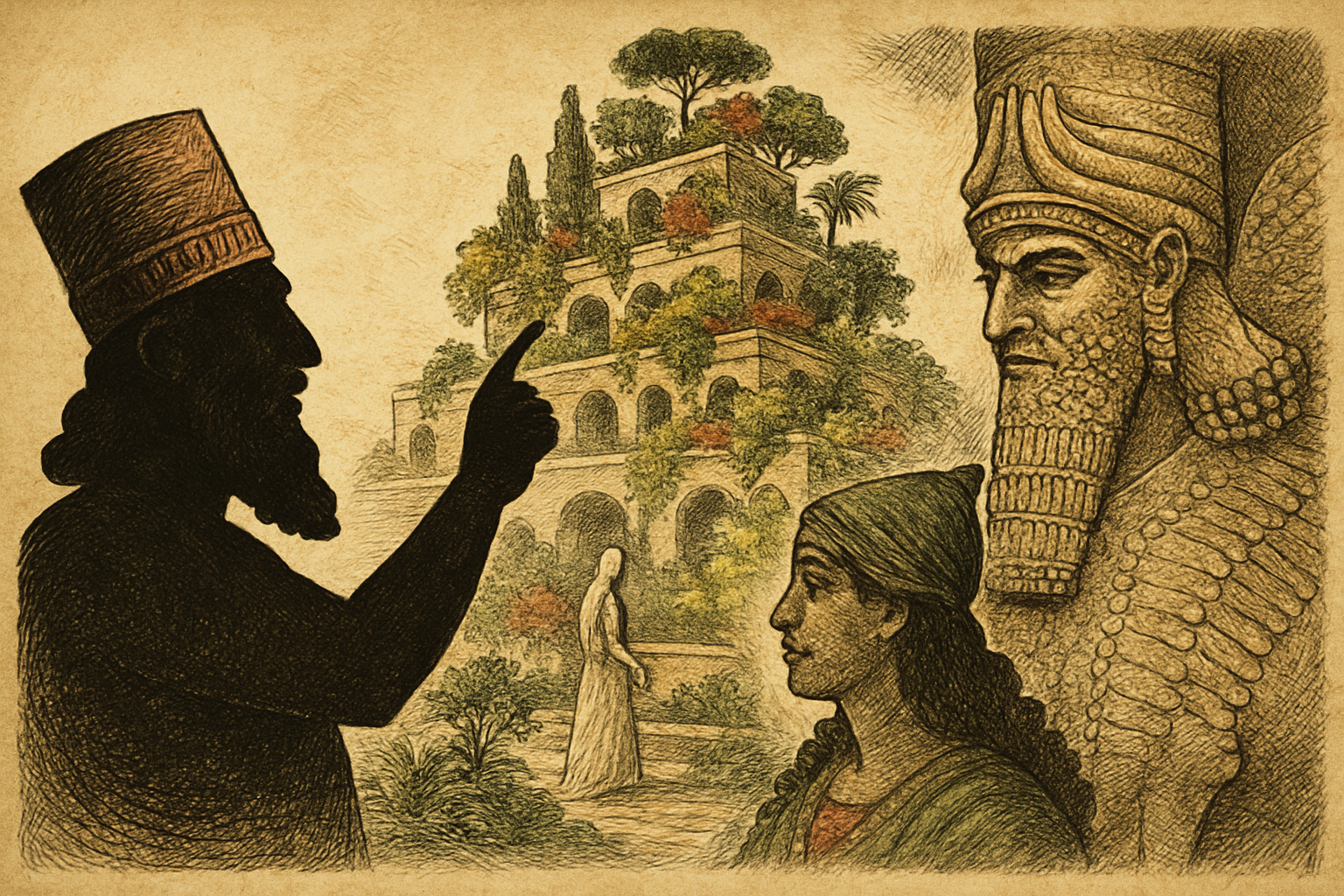
It's a story bathed in myth and mystery. The Hanging Gardens of Babylon, one of the Seven Wonders of the Ancient World, is shrouded in doubt. Was it ever real, or just an ancient legend? Traditionally credited to Nebuchadnezzar II in the 6th century BCE, these verdant terraces were said to have been built to cure his wife Amytis's homesickness for the lush landscapes of Media. Some say it was an engineering marvel, a mountain of greenery crafted in the arid sands of Babylon, with water raised high through a system as ingenious as it was mysterious.
But there's a twist. Recent debates suggest the famed gardens might not have been in Babylon at all. Assyriologist Stephanie Dalley proposes they were located in Nineveh, built by the Assyrian King Sennacherib, whose reign predated Nebuchadnezzar by decades. In Nineveh, we find traces of irrigation systems that mirrored the grandeur described in ancient texts, challenging the very core of Babylon's claim to fame.
Throughout centuries, historians like Diodorus Siculus painted vivid pictures of cascading foliage and towering terraces. Yet no conclusive evidence has surfaced in Babylon. Excavations unearth stories, but not roots or ruins. Did these gardens flourish as described, or do their mysteries bloom best in the fertile bed of human imagination?
This uncertainty endures, feeding into the idea that sometimes, the myths we build are as towering as the feats we hope they are based on. The Gardens of Babylon, if they truly existed, remind us of civilization's early strides toward architectural wonder—or perhaps, they simply reflect our timeless appetite for beauty and intrigue amid the sands of uncertainty.
Takeaway
The lesson this story keeps teaching
“Perception often outweighs evidence, transforming myths into accepted realities long after the truth is lost.”
Why People Are Talking About This
The tale of the Hanging Gardens highlights the precarious nature of historical narrative. These stories shape perceptions more than facts themselves, affecting how cultures record and understand their identities. As with many historical mysteries, the gardens’ saga urges caution and curiosity when considering what we accept as truth. It reminds us how historical narratives influence cultural memory, and in turn, our perception of reality.
Thread Map
8 entities · 7 connections · Hover to explore, click to inspect
This is the connection map for this thread. Every node is a person, company, event, or idea. The red lines show how they connect. Hover a node to highlight its connections. Click a node to see why it matters to this story.
How We Got Here
Nebuchadnezzar's Ambitions
Ruling the Neo-Babylonian Empire, Nebuchadnezzar II is traditionally credited with creating the Hanging Gardens, supposedly to appease his wife Amytis's homesickness.
Legend of Semiramis
Greek historians sometimes attributed the Hanging Gardens to the legendary queen Semiramis, adding layers of myth to their origin.
Gardens of Nineveh
King Sennacherib of Assyria is proposed by some scholars to have built grand gardens in Nineveh, possibly conflated with the Hanging Gardens of Babylon.
Rise of Sennacherib
Sennacherib’s reign and his documented innovations in gardening techniques raise questions about the true location of the legendary gardens.
Herodotus's Silence
Despite his detailed descriptions of Babylon, Herodotus did not mention the Hanging Gardens, leading to debates about their historicity.
Berossus’s Accounts
Berossus, a Babylonian priest, mentioned the gardens, solidifying the myth but complicating the search for tangible evidence.
Descriptions by Diodorus
Greek historian Diodorus Siculus provided vivid accounts of the gardens, further entrenched in myth without archaeological support.
Modern Debates
Contemporary archaeologists continue to dispute the gardens' existence and actual location, with Nineveh as a strong contender.
Wait... Who Is This?
In the heart of the ancient Mesopotamian empire, a city rose to prominence under the stewardship of Nebuchadnezzar II. Known for his architectural feats and vast empire, the Hanging Gardens of Babylon were said to crown his legacy—a testament to his wealth and power that could turn barren desert cliffs into lush greenery. But as time went on and empires crumbled, the fate of these gardens blurred between fact and myth. Later generations, who inherited tales of the wonders of Babylon, lacked concrete evidence. The city's grandeur was well-documented, yet the majestic gardens eluded discovery. This absence fueled speculation and wonder among historians and archaeologists alike, making the search for the gardens an enduring enigma. Today, while Babylon's ruins whisper tales of its past splendor, the existence of its famed gardens remains a mystery. In a world that struggles to separate legend from truth, the Hanging Gardens challenge us to consider which parts of our history we value enough to preserve—not in stone, but in story.
Receipts
Hanging Gardens of Babylon - Wikipedia
Hanging Gardens of Babylon - World History Encyclopedia
Hanging Gardens of Babylon | Location, Images, History, & Facts | Britannica
The History of The Hanging Gardens of Babylon – Banknote World
Were the Hanging Gardens of Babylon actually in Babylon? | National Geographic
Same Pattern
Different story. Same lesson.

Minority Report's Prescient Touchscreen Reality
In 2002, Hollywood imagined a future of seamless touchscreen interfaces. Today, Steven Spielberg's vision feels eerily prescient as technology catches up.

The Lab That Invented Tomorrow
In December 1979, Steve Jobs saw echoes of the future inside Xerox PARC's halls. There, in a secluded lab, lay the blueprint for the modern tech landscape.

The Browser War That Built the Internet
In the mid-1990s, a software battle erupted that would shape how billions accessed information. Few could predict that the victor would soon face its own downfall.

The Wii Gamble That Saved Nintendo
In a world obsessed with graphics and power, Nintendo bet on simplicity. The Wii was laughed at — until it wasn't.

Pixar's Radical Feedback Loop
In a stark, unadorned room, some of the most powerful voices in animation face off with ruthless honesty. Their weapons? Brutal feedback that molds raw ideas into cinematic gold.

The Chicken That Changed Retail
Costco's $4.99 rotisserie chicken isn't just a meal — it's a strategic masterpiece. The unexpected ripple effects changed retail forever.
Continue the Rabbit Hole
Each story explores the same idea from a different angle. Follow the connections and discover where the thread leads.


Fictional placeholder content