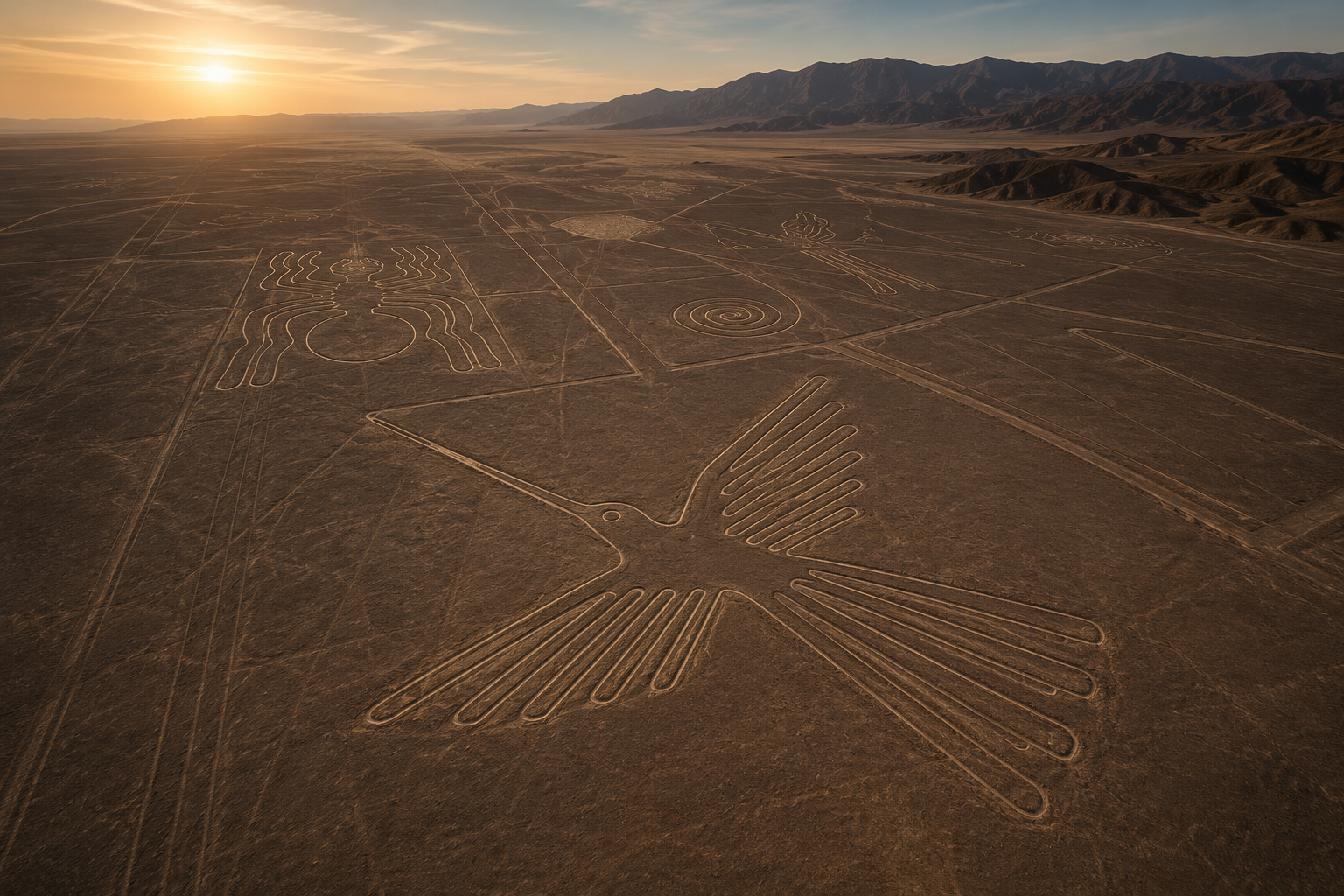
Nazca Lines: Ancient Wonder or Alien Message?
"In the vast, arid landscape of southern Peru lie 2,000-year-old gigantic geometric shapes and figures. Their true purpose? Still debated amid theories of alien visitations and ancient rituals."
What Happened?
Stretching over 190 square miles in the Nazca Desert of Peru, the massive geoglyphs known as the Nazca Lines challenge our understanding of ancient peoples. Discovered in the early 20th century from aerial views, these lines form over 800 shapes and figures, including hummingbirds and a spider, revealing an ancient touch of artistic genius visible only from the sky. Created by the Nazca culture between 500 BC and 500 AD, they continue to baffle scholars. Theories range from religious rituals to astronomical alignments, but their true purpose remains elusive. This mystery drives a narrative of human ingenuity and the enduring quest for understanding.
Takeaway
The lesson this story keeps teaching
“The perseverance of mystery illuminates the human urge to seek answers, fueled by our insatiable curiosity.”
Why People Are Talking About This
The Nazca Lines embody humanity's enduring quest to understand the past, challenging perceptions of ancient societies as less complex. Their enigmatic nature fuels dialogues about creativity, technical ability, and civilization’s relationship with nature. In exploring these designs, we confront the delicate balance between preserving history and making new discoveries, echoing larger truths about heritage and cultural identity. As we continue to discover more through technology, these lines remind us of human curiosity’s perpetual drive to decode the secrets of yesteryears.
Thread Map
6 entities · 5 connections · Hover to explore, click to inspect
This is the connection map for this thread. Every node is a person, company, event, or idea. The red lines show how they connect. Hover a node to highlight its connections. Click a node to see why it matters to this story.
How We Got Here
Nazca Lines Creation Begins
The nascent stages of the Nazca Lines' creation unfold in the arid plains of Peru. These constructions emerge during the Paracas phase, etching the beginning of a mystery that spans millennia.
Nazca Culture Flourishes in Peru
The Nazca culture thrives along Peru's southern coast. Known for their distinct pottery and innovative textiles, they simultaneously craft the beginnings of what would become known as the enigmatic Nazca Lines.
Completion of the Nazca Lines
As the Nazca civilization reaches its zenith and begins to wane, the grand puzzle pieces of the lines are completed, etched into the land for epochs to come.
Formal Studies Begin by Toribio Mejia Xesspe
Toribio Mejia Xesspe begins the first formal study of the Nazca Lines. His observations reveal their astounding scale to the broader world, sparking international fascination.
Maria Reiche Takes Charge of Line Studies
German mathematician Maria Reiche encounters the Nazca Lines in 1946, dedicating her life to exploring their meaning. Her theories energize public interest, although the true purpose remains elusive.
UNESCO World Heritage Site Designation
The Nazca Lines are declared a World Heritage Site by UNESCO, underscoring their importance as a cultural and historical marvel worthy of international protection.
Greenpeace's Controversial Campaign
During a demonstration, Greenpeace inadvertently damages part of the Nazca Lines. The incident highlights the delicate balance between activism and heritage conservation, causing global outrage.
Drones Discover New Geoglyphs
The deployment of drone technology reveals several hundred new geoglyphs across the Nazca region, hinting at more hidden mysteries within the expansive desert.
Peru Reinstates Protection for Nazca
Amidst controversies and criticism, the Peruvian government retracts a plan that would have reduced the protected area of the Nazca Lines, reaffirming their commitment to heritage preservation.
Wait... Who Is This?
Flying above Peru’s coastal desert, one might easily miss the spectacle that engraved itself into the earth below millennia ago. Yet, seen from above, these geoglyphs become inarguably clear—a feat so enduring it spans nearly 2,000 years. Created by the Nazca people, known for their advanced agricultural systems and striking pottery, these lines marked both cultural achievement and a mysterious departure. As the Nazca civilization faded into obscurity around 600 CE, their marks stood resilient against time and elements, leaving modern audiences with more questions than answers.
In 1927, Peruvian archaeologist Toribio Mejia Xesspe was among the first to formalize the acknowledgment of these lines. While flying over the desert, he observed the vast network of geometric and animal figures that had lain hidden for centuries. His findings prompted intense scholarly interest, but the true significance remained elusive.
Through decades of study, scholars like Maria Reiche expanded understanding of the Nazca Lines. Reiche dedicated her life to documenting the arrangements, publishing theories that these were astronomical maps or ceremonial sites. Despite comprehensive research, these enigmas remain just that—unsolved puzzles of geometric brilliance, mystery, and human ambition.
Receipts
Nazca lines - Wikipedia
Nazca Lines Theories: The Mystery of The Geoglyphs - Nazca Lines Tours
Nazca Lines | History, Location, Lima, Spider, & Facts | Britannica
Nazca Civilization - World History Encyclopedia
Lines and Geoglyphs of Nasca and Palpa - UNESCO World Heritage Centre
Same Pattern
Different story. Same lesson.

The Lab That Invented Tomorrow
In December 1979, Steve Jobs saw echoes of the future inside Xerox PARC's halls. There, in a secluded lab, lay the blueprint for the modern tech landscape.

The Browser War That Built the Internet
In the mid-1990s, a software battle erupted that would shape how billions accessed information. Few could predict that the victor would soon face its own downfall.

The Wii Gamble That Saved Nintendo
In a world obsessed with graphics and power, Nintendo bet on simplicity. The Wii was laughed at — until it wasn't.

Pixar's Radical Feedback Loop
In a stark, unadorned room, some of the most powerful voices in animation face off with ruthless honesty. Their weapons? Brutal feedback that molds raw ideas into cinematic gold.

The Chicken That Changed Retail
Costco's $4.99 rotisserie chicken isn't just a meal — it's a strategic masterpiece. The unexpected ripple effects changed retail forever.

Minority Report's Prescient Touchscreen Reality
In 2002, Hollywood imagined a future of seamless touchscreen interfaces. Today, Steven Spielberg's vision feels eerily prescient as technology catches up.
Continue the Rabbit Hole
Each story explores the same idea from a different angle. Follow the connections and discover where the thread leads.


Fictional placeholder content