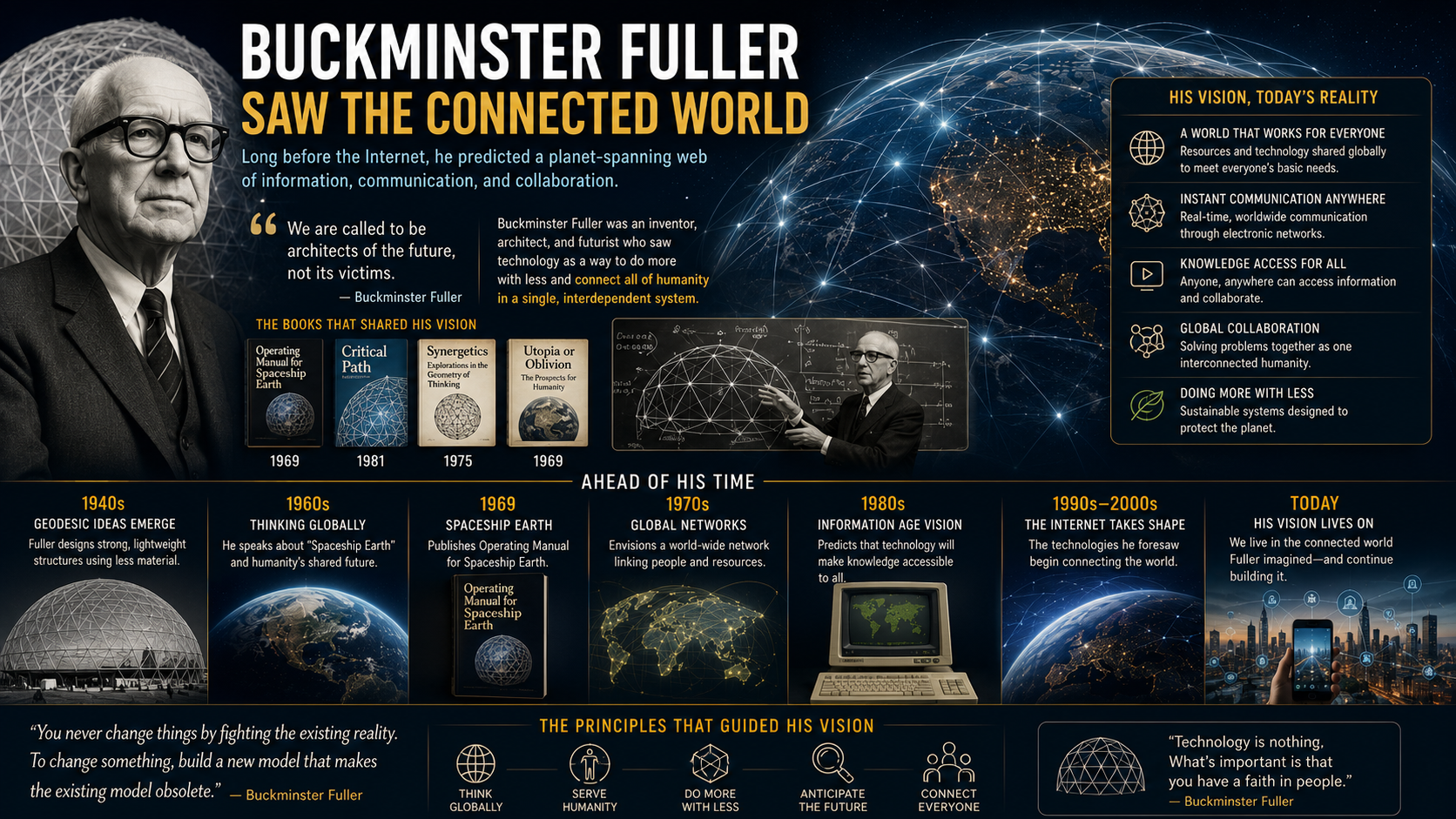
Buckminster Fuller's Visionary Mind
"Buckminster Fuller stood before a captivated crowd, sketching the world connected in ways they couldn’t imagine. His map was the becoming reality."
What Happened?
Imagine seeing the world as one cohesive unit, where boundaries dissolved and resources flowed like lifeblood across continents. This was the vision R. Buckminster Fuller had long before global interconnectedness became the norm. In 1969, Fuller published "Operating Manual for Spaceship Earth," a call to redefine humanity's relationship with our planet's resources. His blueprint was radical; it envisioned Earth as a spaceship careening through the cosmos, where humans must act as responsible crew members, not isolated passengers.
Fuller's world was not just theoretical. Twenty years earlier, he developed the Dymaxion Map, a projection that changed our perspective of Earth's geography, minimizing distortions of landmasses and presenting them in surprising proximity. This unconventional map was Fuller's tool to advocate unity over division, challenging the perception of separation that fueled geopolitical rivalries.
Yet, his innovations were not confined to maps. Fuller was an architect of ideas, literally and figuratively. His geodesic domes, with their strength-to-weight ratio that defied logic, symbolized his approach to design: efficient, sustainable, and synergistic. Over 500,000 domes exist today as testaments to his enduring influence. But it was his "World Game," launched in 1961 at Southern Illinois University, that truly encapsulated his ethos. Here, students engaged in complex simulations, navigating scenarios that underscored the necessity of global cooperation in resource management. Fuller dared to ask: what if we prioritized collaboration over competition?
His ideas gained traction during the radical 60s and 70s, resonating with a generation hungry for change. They flocked to his lectures, captivated by the scale of his thinking: not just to improve individual lives, but to ensure the viability of human civilization. Fuller's legacy is not just the structures he built, but the way he taught us to see beyond what is, to what could be.
Takeaway
The lesson this story keeps teaching
“Visionary ideas that challenge prevailing beliefs often become blueprints for future realities.”
Why People Are Talking About This
Buckminster Fuller's ideas transcended mere architectural innovation to challenge the fundamentals of human interdependence. In a world increasingly confronted by challenges of climate change and sustainability, his work laid the groundwork for how we think about systemic solutions today. Fuller taught us that effective design requires holistic thinking, weaving together previously disparate concepts into actionable, coherent visions for a sustainable future.
Thread Map
5 entities · 4 connections · Hover to explore, click to inspect
This is the connection map for this thread. Every node is a person, company, event, or idea. The red lines show how they connect. Hover a node to highlight its connections. Click a node to see why it matters to this story.
How We Got Here
The Birth of a Visionary
R. Buckminster Fuller was born in Milton, Massachusetts. This was the starting point for the life of an individual who would eventually redefine architectural and design possibilities.
Formulating the World Game
Buckminster Fuller conceived the World Game, an idea meant to educate about global resource responsibility. This vision laid groundwork for future systemic and educational innovations.
Published in Fortune Magazine
Fuller published studies on industrialization and energy trends in Fortune magazine, making his theories more widely known and accessible to a broader audience.
Patent of the Dymaxion Map
R. Buckminster Fuller received a patent for the Dymaxion Map, designed to show Earth’s continents with minimal distortion. This innovation laid the foundation for future work in representation of global information.
Operating Manual for Spaceship Earth Published
Fuller published Operating Manual for Spaceship Earth, a treatise arguing for sustainable management of Earth’s resources. It was a pivotal moment in his advocacy for global perspective.
Publication of Earth, Inc.
Fuller released Earth, Inc., a book analyzing the global economy and resource management, adding another layer to his visionary outlook on planetary stewardship.
Introduction of Synergetics
Fuller published Synergetics, a comprehensive exploration of geometric design and systems theory. It marked a keystone in his lifelong mission of understanding the interconnected complexities of human and physical realms.
The Passing of an Innovator
R. Buckminster Fuller passed away, leaving behind an indelible legacy shaping modern architecture, sustainable design, and global thinking. His insights remain pivotal to ongoing advancements in these fields.
Wait... Who Is This?
Born into a family that valued inquiry and intellectual pursuit, Buckminster Fuller was destined for greatness from a young age. The tumult and innovation of early 20th-century America shaped his formative years, giving him a playground of ideas to explore. Yet, it was his failures, not his successes, that transformed his trajectory. After dropping out of Harvard twice, he launched into the industrial world only to face bankruptcy and personal loss. These painful experiences did not defeat him; they fueled him. By the late 1920s, Fuller was reborn through introspection. This period of ‘silent restlessness’ resulted in the powerful concept of the World Game—a simulation aimed to promote awareness of global resource management.
Fuller’s innovations thrived in the post-war era—a time where technological advancements drove society toward modernity, yet societal structures lagged, bound by old boundaries. Against this backdrop, Fuller championed interdisciplinary thinking with new urgency, laying the groundwork for globalized cooperation in a manner still echoing today. It was Fuller's unique geometry of ideas that paired imaginative speculation with realistic design, making him less a man of a particular era and more an architect of an enduring future.
Receipts
The legacy of Buckminster Fuller and the Conference on World Affairs
Buckminster Fuller and the Impact We Don't See
Fuller Legacy – Fuller Dome Home
Visionaries of Regenerative Design III: R. Buckminster Fuller (1895–1983)
Timeline – Buckminster Fuller Institute
Buckminster Fuller - Wikipedia
Same Pattern
Different story. Same lesson.

The Wii Gamble That Saved Nintendo
In a world obsessed with graphics and power, Nintendo bet on simplicity. The Wii was laughed at — until it wasn't.
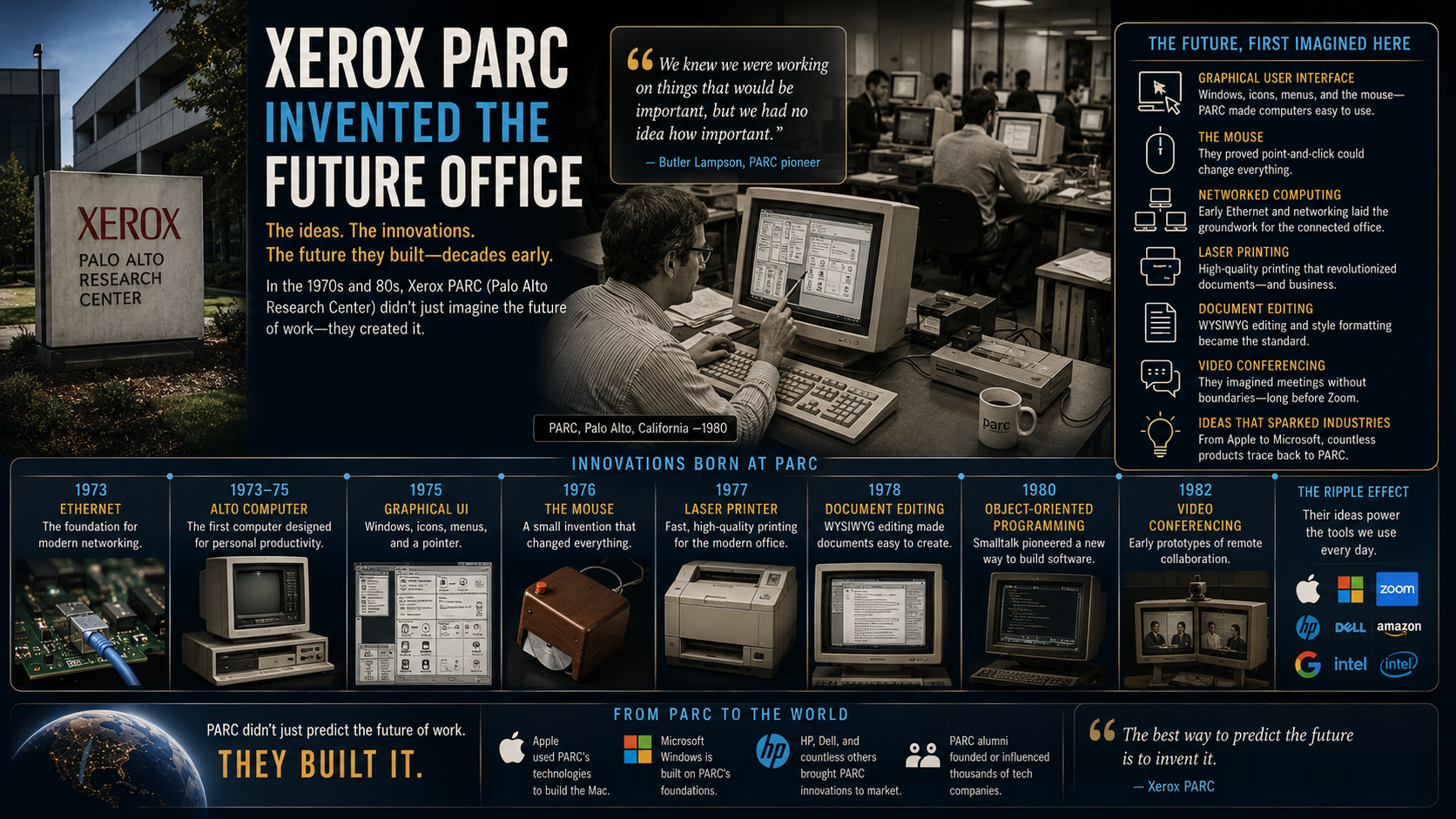
The Lab That Invented Tomorrow
In December 1979, Steve Jobs saw echoes of the future inside Xerox PARC's halls. There, in a secluded lab, lay the blueprint for the modern tech landscape.
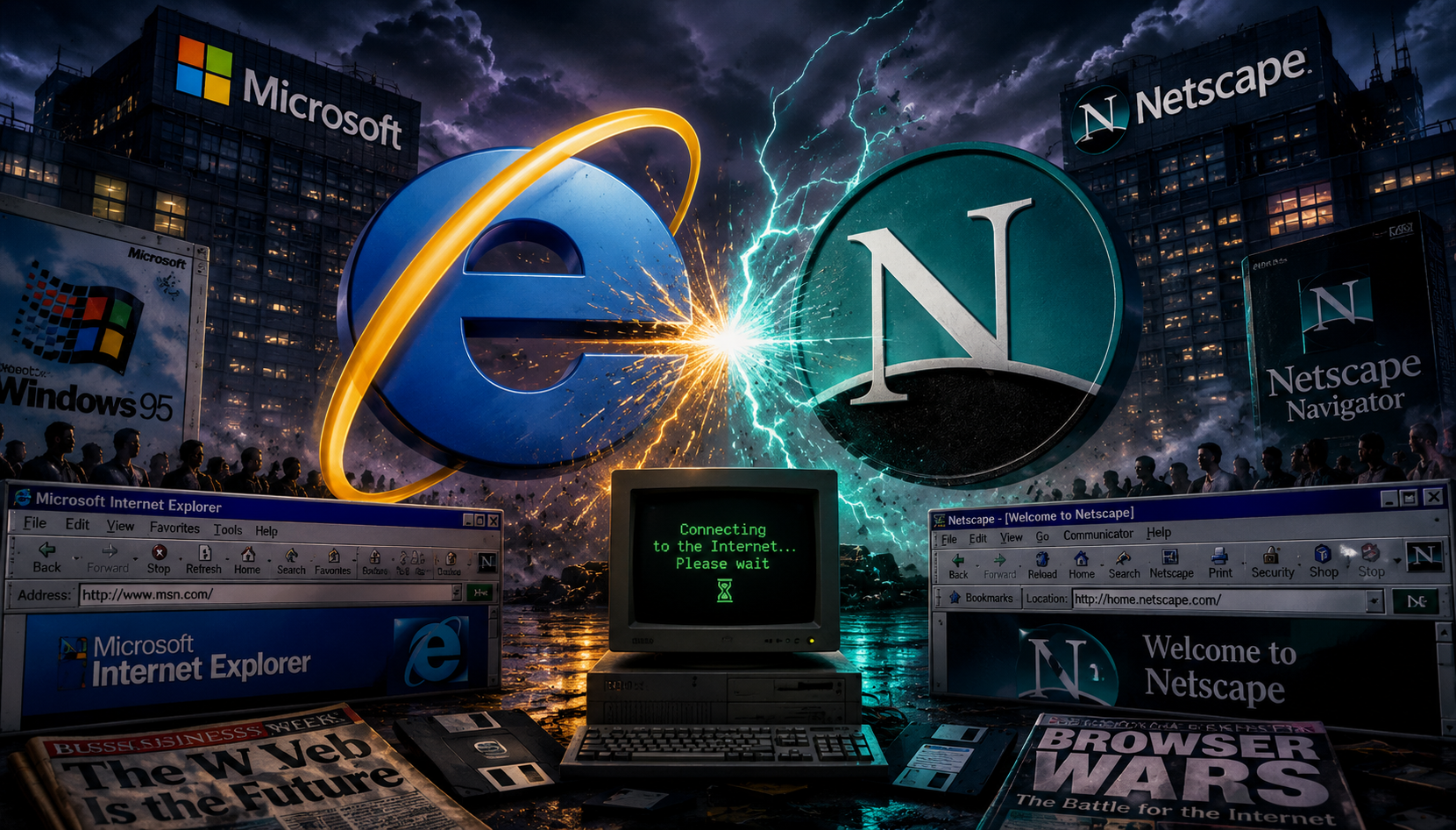
The Browser War That Built the Internet
In the mid-1990s, a software battle erupted that would shape how billions accessed information. Few could predict that the victor would soon face its own downfall.

The Chicken That Changed Retail
Costco's $4.99 rotisserie chicken isn't just a meal — it's a strategic masterpiece. The unexpected ripple effects changed retail forever.
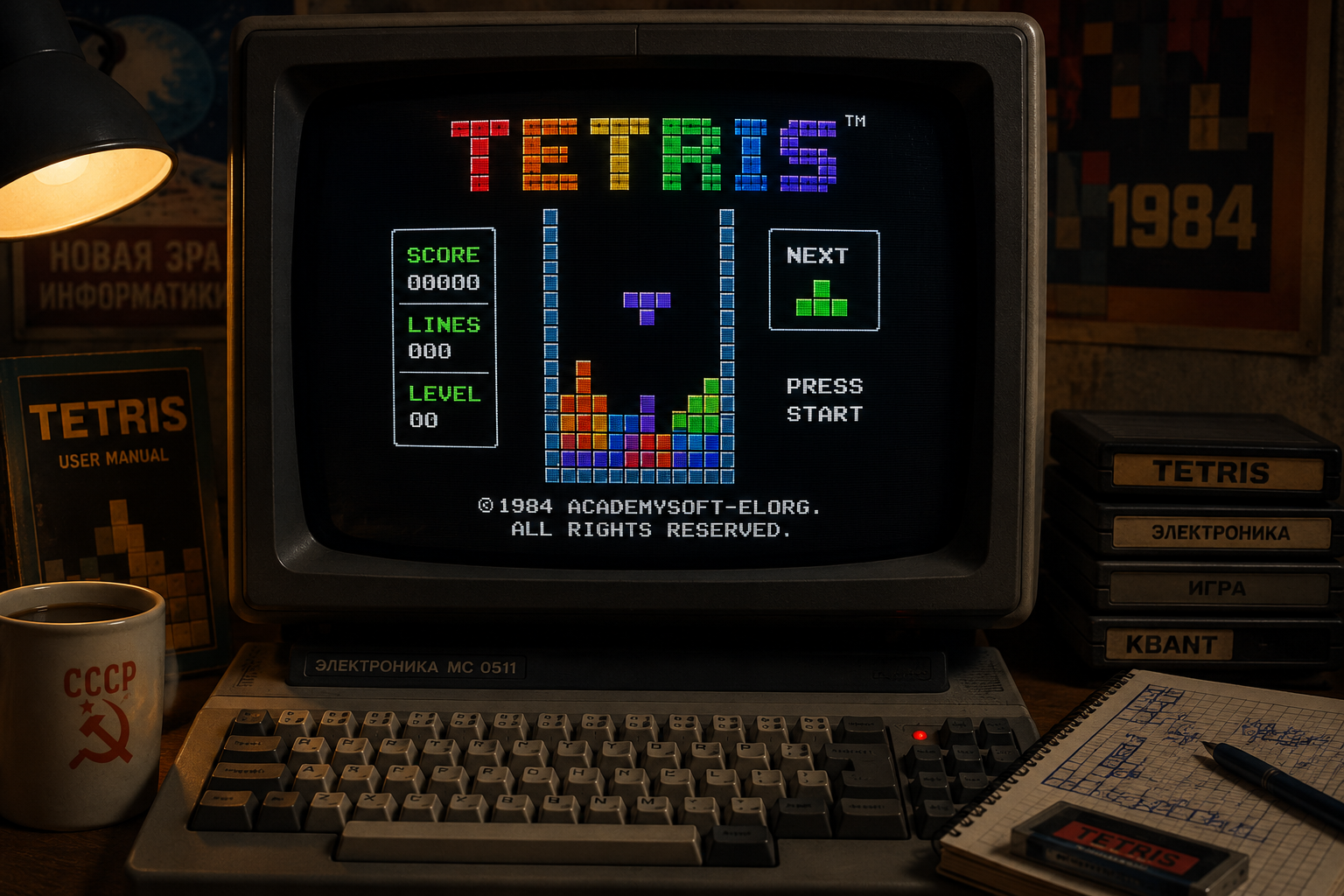
The Puzzle that Conquered the World
A Soviet engineer at his desk, unknowingly poised to create a legend. His creation? Tetris — a game that would break barriers and forever alter the gaming landscape.

Cracking the Cicada Code
In 2012, an enigmatic online puzzle appeared that promised enlightenment. But who was behind Cicada 3301?
Continue the Rabbit Hole
Each story explores the same idea from a different angle. Follow the connections and discover where the thread leads.


Fictional placeholder content