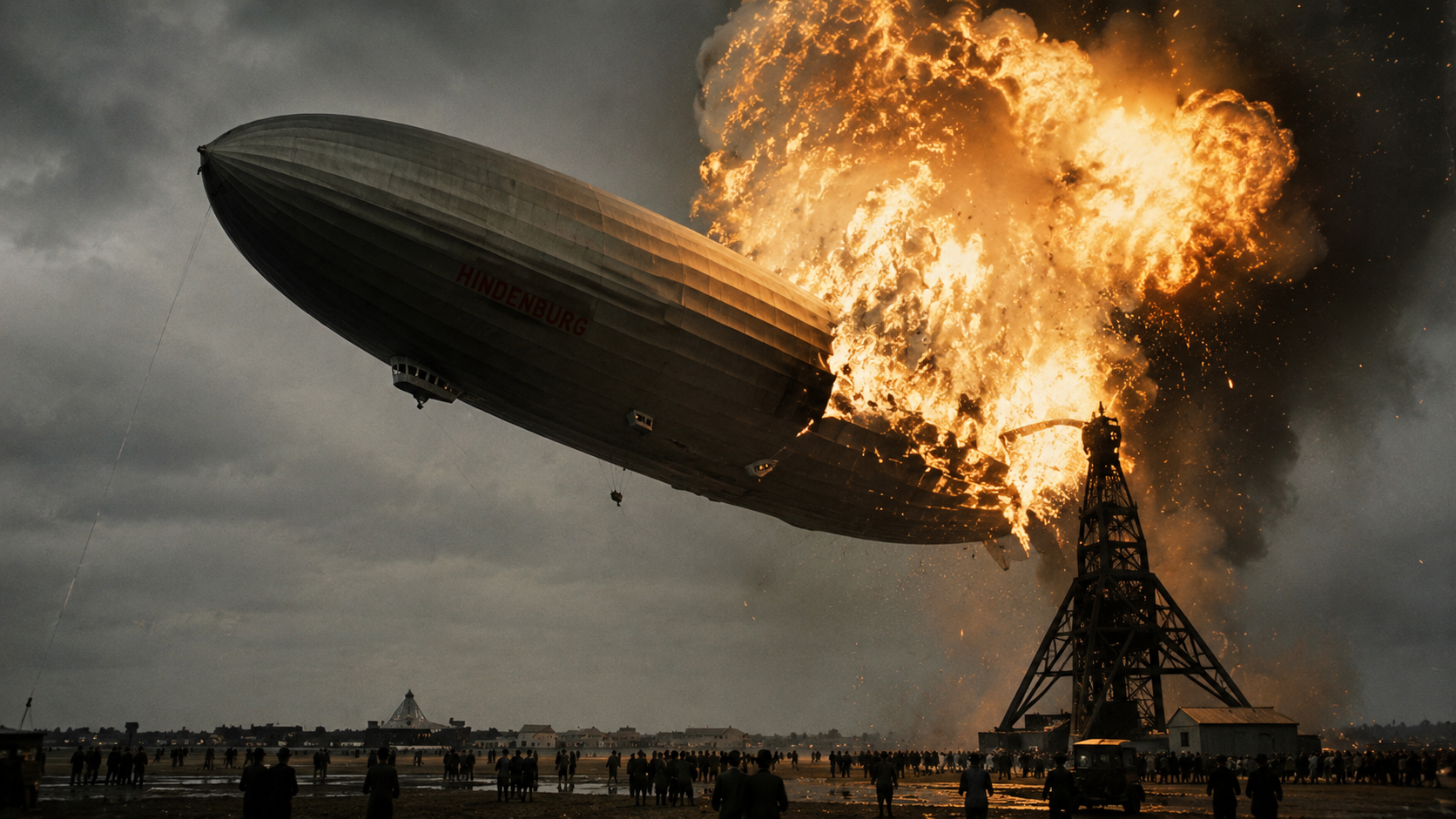
The Hindenburg Disaster: Airship Dreams In Flames
"On a serene May evening, the largest airship ever built descended into fiery chaos. What went wrong?"
What Happened?
In less than a minute, the dreams of the Hindenburg vanished in a fiery spectacle. It was the evening of May 6, 1937, as the massive German airship attempted to dock at the Lakehurst Naval Air Station in New Jersey. Passengers and crew were preparing to disembark, unaware that their fates were about to be rewritten. Suddenly, flames engulfed the elegant craft, fueled by the hydrogen gas that kept it afloat. "Oh, the humanity!" cried radio journalist Herbert Morrison, whose broadcast immortalized the disaster. Out of 97 people aboard, 36 lost their lives, including one ground crew member, a testament to both the calamity and the astonishing number of survivors.
The origins of this tragedy were shrouded in theories. Hugo Eckener, once the head of the Zeppelin Company, floated the idea of sabotage, citing threatening letters received in the days leading up to the disaster. However, scientific investigations leaned toward a different culprit: the infamous hydrogen spark theory. It suggested that atmospheric conditions—particularly a discharge of static electricity—ignited the combustible elements of the airship, causing the inferno.
Yet, the human stories interwoven with this disaster are what linger. The Hindenburg was more than just a mode of transport; it was a floating symbol of Nazi Germany's technological prowess. Its destruction marked not only the end of an era but also a death knell for passenger airship travel. In 34 heartbeats, the age of the rigid airship perished, transforming public perception and embedding itself as a pivotal moment in aviation history. The Hindenburg's demise swept away illusions of safety, replacing them with charred reminders of vulnerability, a saga echoed on the faces of those who survived and those who, for the briefest second, defied impossible odds to live.
Takeaway
The lesson this story keeps teaching
“Even the most advanced technologies are susceptible to forgotten, small vulnerabilities that can lead to disastrous outcomes.”
Why People Are Talking About This
The Hindenburg became the infernal end to the era of airships, burning not just in physicality but in the imagination, transforming trust in new technologies forever. As aviation began relying on higher stakes advancements, the disaster reminded us that even the most grandiose technologies are not beyond vulnerability.
It also redefined media coverage, as Morrison's broadcast captured public consciousness, demonstrating the power of real-time news in shaping collective memory. The Hindenburg's legacy lives on as a cautionary tale about ambition overtaking safety concerns, making it a durable symbol of the cost when these balances are overlooked.
Thread Map
9 entities · 8 connections · Hover to explore, click to inspect
This is the connection map for this thread. Every node is a person, company, event, or idea. The red lines show how they connect. Hover a node to highlight its connections. Click a node to see why it matters to this story.
How We Got Here
The Hindenburg Catastrophe Strikes
The Hindenburg begins its landing in New Jersey and bursts into flames, destroying the airship and resulting in 36 fatalities. This incident marks the abrupt end of passenger airship travel.
The Rise of Airship Travel
During the 1930s, airships become a popular means of passenger travel, offering luxury and speed unmatched by other transportation methods at the time.
Herbert Morrison Gives a Haunting Broadcast
The famed radio journalist delivers an emotional, eyewitness broadcast from the scene of the Hindenburg disaster. His words capture the world’s attention and mark one of the earliest instances of breaking news journalism.
Sabotage or Accident? Theories Emerge
Immediately after the disaster, theories about its cause abound, including the possibility of sabotage or accidental ignition of hydrogen gas.
End of the Airship Era
The Hindenburg disaster signals the decline of passenger airships, as public confidence collapses alongside the charred remains of the Zeppelin.
Technological Showpieces of Nazi Germany
The Hindenburg and its sister airships are seen as the technological pride of Nazi Germany, used both as luxurious travel and tools of propaganda.
Introduction of Hydrogen Spark Theory
A theory suggesting a spark ignited the hydrogen gas gains traction as a possible cause of the disaster, while other theories persist.
Eckener Proposes Sabotage Theory
Hugo Eckener, a leading figure in airship travel, suggests sabotage as the cause of the Hindenburg disaster, though this theory never gains ultimate traction.
Public Trust in Airships Plummets
Confidence in airship travel erodes, leading to the cancellation of many future airship plans and marking a pivotal shift in aviation history.
Wait... Who Is This?
In the midst of the 1930s, a world electrified by the promise of technological advancements and still reeling from the effects of the Great Depression was ripe for the spectacle and luxury offered by airship travel. Strange as it may sound today, these flying behemoths symbolized a future unbound by the limitations of the past. Anchored by the dirigibles, this era of awe and ambition was best embodied by the Hindenburg — a symbol of transatlantic elegance.
Despite its sleekness, the Hindenburg ran on hydrogen — a cheaper, more volatile choice influenced by geopolitical currents. The U.S. controlled the safer helium, making hydrogen the fateful pick for Germany. Yet, airships were the apple of the Nazi regime’s eye, a technological marvel and prestige symbol, representing national pride. With remarkable luxurious interiors and the promise of grand flights, this leviathan danced in the skies, seemingly invulnerable, until that pivotal day at Lakehurst, when reality would shatter this airborne dream.
Receipts
The Hindenburg Disaster | Airships.net
The Hindenburg disaster | May 6, 1937 | HISTORY
The Hindenburg Disaster and the End of the Airship Era | History Today
Hindenburg | Zeppelin, Nazi Germany, Disaster | Britannica
Dealing with the Aftermath of the Hindenburg Disaster | National Air and Space Museum
Same Pattern
Different story. Same lesson.

The Fall of BlackBerry
In a boardroom once buzzing with innovation, silence filled the air as BlackBerry executives watched Apple's iPhone dismantle their empire one launch at a time.

The Lab That Invented Tomorrow
In December 1979, Steve Jobs saw echoes of the future inside Xerox PARC's halls. There, in a secluded lab, lay the blueprint for the modern tech landscape.

The Wii Gamble That Saved Nintendo
In a world obsessed with graphics and power, Nintendo bet on simplicity. The Wii was laughed at — until it wasn't.

Pixar's Radical Feedback Loop
In a stark, unadorned room, some of the most powerful voices in animation face off with ruthless honesty. Their weapons? Brutal feedback that molds raw ideas into cinematic gold.

The Chicken That Changed Retail
Costco's $4.99 rotisserie chicken isn't just a meal — it's a strategic masterpiece. The unexpected ripple effects changed retail forever.

The Puzzle that Conquered the World
A Soviet engineer at his desk, unknowingly poised to create a legend. His creation? Tetris — a game that would break barriers and forever alter the gaming landscape.
Continue the Rabbit Hole
Each story explores the same idea from a different angle. Follow the connections and discover where the thread leads.





Fictional placeholder content