Moore's Law: Against the Odds
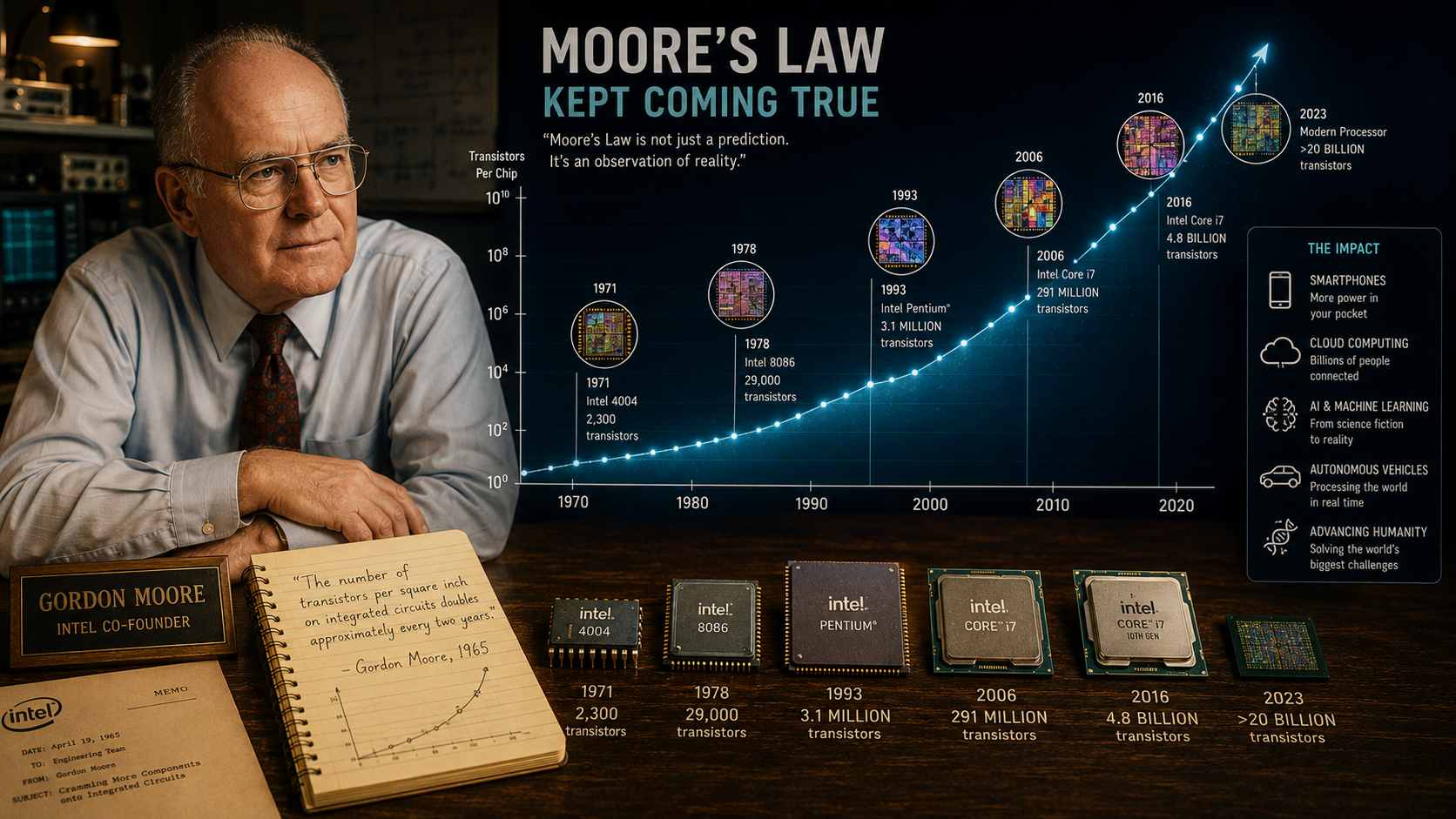
"In 1965, Gordon Moore laid out a prophecy that would defy doubt and define an industry, stating transistors would double every year. Over half a century later, this audacious claim still shapes silicon aspirations and realities."
What Happened?
Gordon Moore didn’t intend to redefine technology forever when he published his prediction in 1965. Yet, what began as an observation soon spiraled into a prophecy that propelled Silicon Valley into a frenzy. He noted that the number of transistors on a microchip would double approximately every year, later revising it to every two years. But what Moore’s Law encapsulated was more than a mere technicality; it was an audacious bet on innovation’s relentless march forward.
Every major milestone, from the Intel 4004’s 2,300 transistors in 1971 to the 80286 processor's 134,000 transistors a decade later, bore testament to this doubling. It wasn't just a forecast; it was the heartbeat of progress that fueled an entire industry. Suddenly, every corner of technology seemed to pulse with the intensity of Moore’s vision.
Years later, despite looming challenges—manufacturing complexities, rising costs, and the very physics of miniaturization—engineers continued to defy expectations. Take 2016, when Intel's struggle with shrinking transistor sizes seemed insurmountable. However, they leaned into innovation, refining extreme ultraviolet lithography and optimizing materials, just enough to keep the prophecy alive.
This perpetual cycle of expectation and adaptation has become the industry’s own myth, much like Moore himself said, "There always seems to be an impenetrable barrier down the road." Yet, somehow, the road stretches on. Today, as we face the limits of atomic dimensions, Moore's Law persists as an emblem of the indomitable human drive to push boundaries. A prediction that started as a simple graph in an electronics magazine continually shapes and reshapes the technology landscape decades later.
Takeaway
The lesson this story keeps teaching
“The narrative of progress can often drive reality, as collective belief and effort can turn daring predictions into self-fulfilling prophecies.”
Why People Are Talking About This
Moore's Law isn't just about chip density; it's a beacon for innovation. It represents the relentless pursuit of improvement, as industries continue racing against theoretical limits. This ongoing race highlights the interplay of vision, risk-taking, and the power of collective focus.
Technology's rapid evolution has revolutionized entire sectors—from computing to artificial intelligence—pushing boundaries while encouraging the unexpected. As the end of Moore's Law looms, the story raises questions about our future and the role audacious predictions will play in shaping it.
Thread Map
9 entities · 8 connections · Hover to explore, click to inspect
This is the connection map for this thread. Every node is a person, company, event, or idea. The red lines show how they connect. Hover a node to highlight its connections. Click a node to see why it matters to this story.
How We Got Here
Gordon Moore Publishes His Bold Prediction
In Electronics Magazine, Moore predicted that the number of transistors on a microchip would double every year. This bold claim established what would become known as Moore's Law, setting a benchmark for the semiconductor industry.
Intel Releases the Revolutionary 4004 Microprocessor
Intel launched the 4004 microprocessor, with 2,300 transistors, marking a significant step aligned with Moore's visionary prediction. It paved the way for more complex computing solutions.
Moore Revises His Prophecy: Slower But Still Relentless
Gordon Moore updated his prediction to suggest that transistor counts would double every two years. This shift allowed the industry breathing room while still maintaining the momentum of rapid advancement.
Technological Progress Aligns with Moore’s Expectations
Throughout the late 20th century, rapid technological advancements in microchip design improved computational power, allowing industries to expand capabilities in line with Moore’s aptly revised law.
Intel Faces Manufacturing Setbacks Amid Transition
As the semiconductor giant labors to transition from 14nm to 10nm technology, questions loom over the feasibility of Moore's Law in modern times. The limits of physics and materials spark industry-wide debate.
Moore’s Law Remains Relevant Despite New Hurdles
In 2025, even with swelling challenges and physical constraints, Moore's Law continues guiding the pace of technology as transistor sizes shrink to near-atomic levels.
Material Challenges Test Industry's Limits
The semiconductor industry grapples with physical limits and explores alternative materials to sustain growth trends predicted by Moore, indicating a possible end to a predictable future.
Chemical Printing Breakthrough Reshapes Transistors
At Fairchild Semiconductor, significant advancements in chemical printing paved the way for transistors to be created more affordably and efficiently. This milestone laid the groundwork for Moore's seminal observation on transistor doubling.
Wait... Who Is This?
In the mid-20th century, an ambitious young engineer by the name of Gordon Moore began contributing to the fields that would eventually form today's Silicon Valley. Moore's talents found fertile ground at Shockley Semiconductor Laboratory and later Fairchild Semiconductor, where his observations would soon form the foundational bedrock of technological progress.
Back then, California was not yet the digital epicenter it is today. Instead, local aerospace firms and new ventures in physical sciences provided the spark to light what would become the definitive culture of rapid innovation. It was the ideal setting for Moore's bold theoretical proposition.
Imagine workers at Fairchild developing chemical printing breakthroughs that made transistors cheaper and more efficient, with Moore quietly taking notes. This was the breeding ground for the iconic Moore's Law—a prediction so stark and definitive that it became synonymous with modern technological advancement soon after it was publicly articulated in 1965.
Moore’s focus was not on profit but on potential. Fairchild innovated through sleepless nights, tapping into the accelerating heartbeat of a burgeoning Silicon Valley. It was a time when dreams had no bounds, and audacity was currency.
Receipts
Same Pattern
Different story. Same lesson.
The Lab That Invented Tomorrow
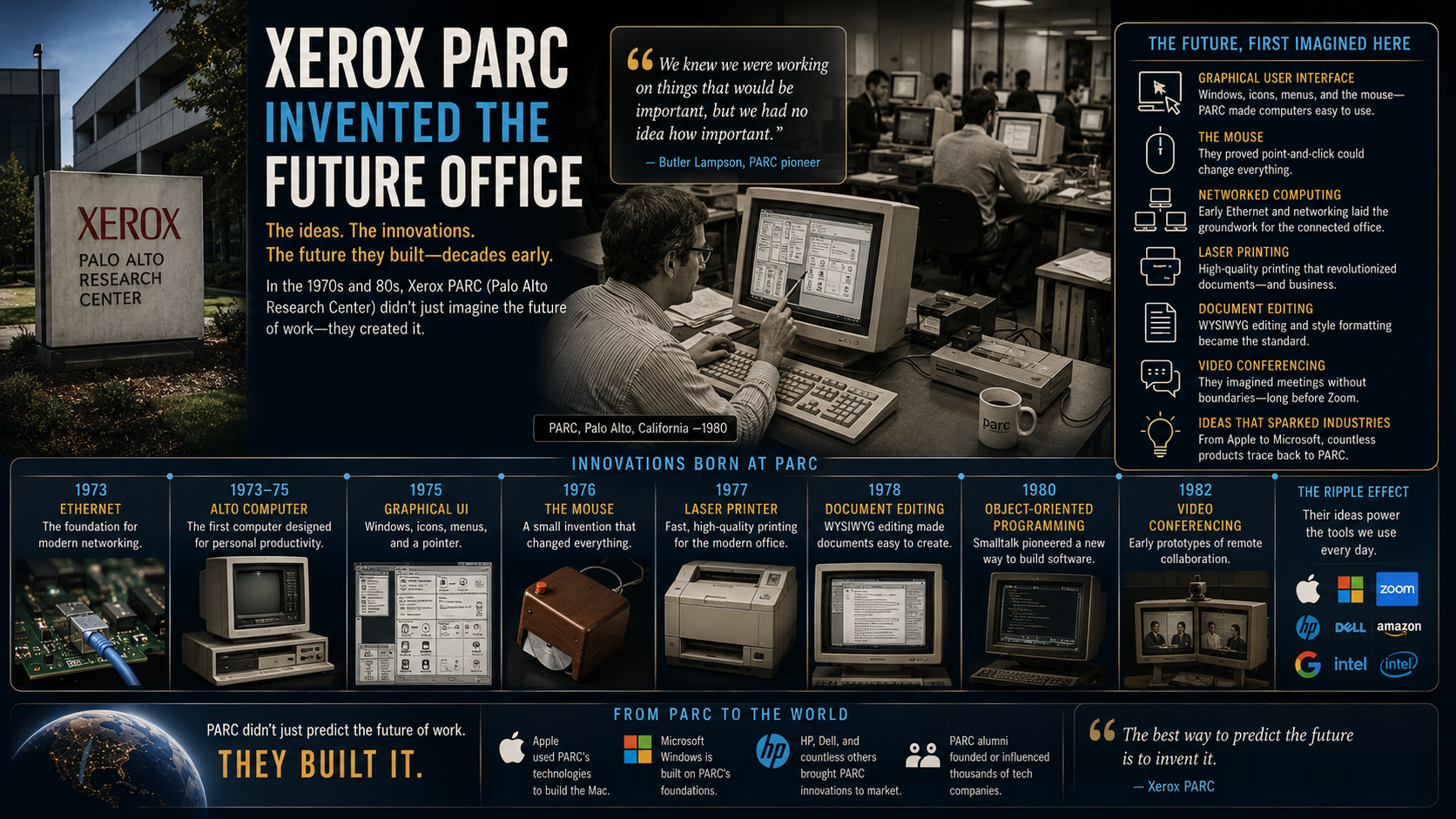
In December 1979, Steve Jobs saw echoes of the future inside Xerox PARC's halls. There, in a secluded lab, lay the blueprint for the modern tech landscape.
The Browser War That Built the Internet
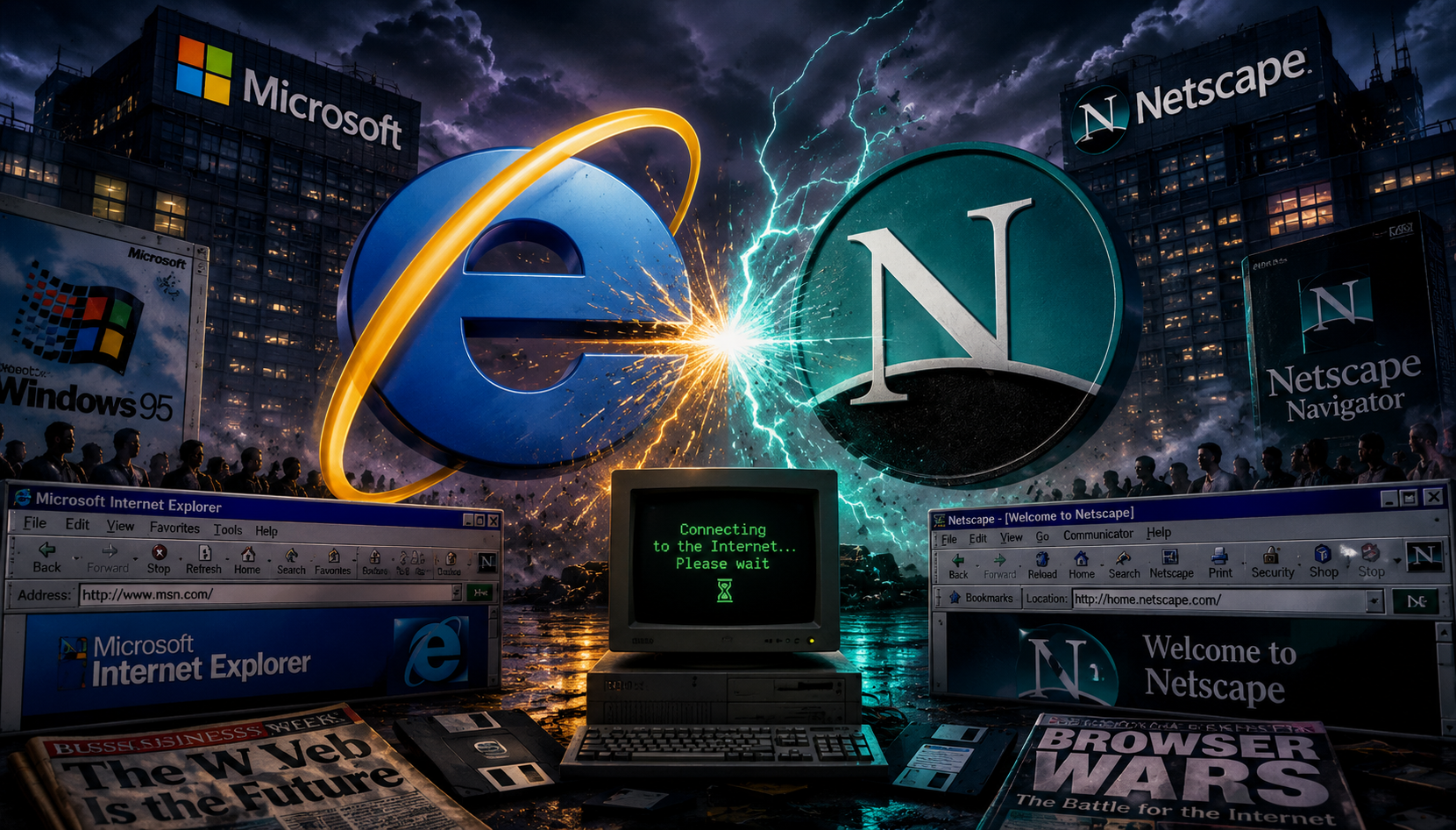
In the mid-1990s, a software battle erupted that would shape how billions accessed information. Few could predict that the victor would soon face its own downfall.

The Wii Gamble That Saved Nintendo
In a world obsessed with graphics and power, Nintendo bet on simplicity. The Wii was laughed at — until it wasn't.

Pixar's Radical Feedback Loop
In a stark, unadorned room, some of the most powerful voices in animation face off with ruthless honesty. Their weapons? Brutal feedback that molds raw ideas into cinematic gold.

The Chicken That Changed Retail
Costco's $4.99 rotisserie chicken isn't just a meal — it's a strategic masterpiece. The unexpected ripple effects changed retail forever.

Minority Report's Prescient Touchscreen Reality
In 2002, Hollywood imagined a future of seamless touchscreen interfaces. Today, Steven Spielberg's vision feels eerily prescient as technology catches up.
Continue the Rabbit Hole
Each story explores the same idea from a different angle. Follow the connections and discover where the thread leads.





Fictional placeholder content